

Economic Freedom through Technology: A Review of Cameroon’s Policy
December 8, 2025
A Review of Cameroon’s Implementation of the African Continental Free Trade Area (AfCFTA)
December 10, 2025Is the Global Economy Deglobalizing?
Introduction
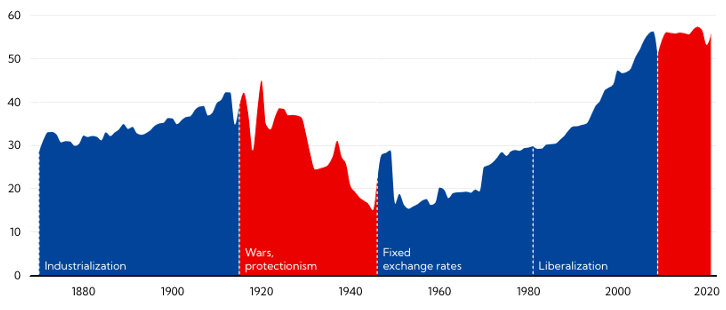
After the Second World War, the creation of the Bretton Woods Institutions ensured global macroeconomic policy convergence. The International Monetary Fund, the World Bank, the United Nations, and the World Trade Organization (WTO) created the framework for countries to converge. Countries began to trade with each other, trade blocs began to form, and the world became globalized and integrated. To understand whether the world is becoming more or less globalized, we should first understand the different phases of globalization. The Cameroon Economic Policy Institute (CEPI) has looked back at over a century and a half of data, and the main phases of globalization can be identified by using the trade openness metric—the sum of exports and imports of all economies relative to global gross domestic product. Globalization mostly plateaued since the 2007-2008 Great Financial Crisis, and the latest era can be referred to as slowbalisation.”
Figure 1: The Many Eras of Globalization (sum of exports and imports as a percent of GDP)
Sources: PIIE, Jorda-Schularick-Taylor Macrohistory Database, Penn World Data (10.0), World Bank, and IMF staff calculations.
After decades of integration, prosperity, and economic gains, globalization could be retreating as trade wars, pandemics, and politics cause countries to re-shore, re-localize, or regionalize their supply chains. We illustrate the many phases of globalization characterized by different configurations of economic and financial power, different international rules for trade and commerce, and the impact of trade fragmentation and technological decoupling.
- The Industrialization era was dominated by Argentina, Australia, Canada, Europe, and the United States, and was facilitated by the gold standard and driven by transportation advances that lowered trade costs and boosted trade volumes.
- The Interwar era saw globalization go into reverse due to international conflicts and the rise of protectionism. Despite the multilateral cooperation being pushed by the League of Nations, trade became more and more regionalized, and trade barriers accelerated the emergence of trading blocs, still under the gold standard.
- The Bretton Woods era saw the United States (U.S.) emerge as a superpower with the dollar pegged to gold, underpinning a system where other currencies were pegged to the dollar. The post-war recovery and trade liberalization caused rapid growth in expansion in Europe, Japan, and developing economies, and many countries relaxed capital controls. The United States ended dollar-gold convertibility in the early 1970s after military spending caused its system to become unstable, and many countries switched to floating exchange rates.
- The Liberalization era saw emerging countries like China and other large emerging market economies remove trade barriers, and economic cooperation accelerated as the former soviet union fractured. Trade grew as countries liberalized, and the World Trade Organization (WTO) was established in 1995 and began overseeing trade agreements, negotiations, and dispute settlement. As a result of positive reforms, the global financial system became interconnected and more complex as capital flows surged.
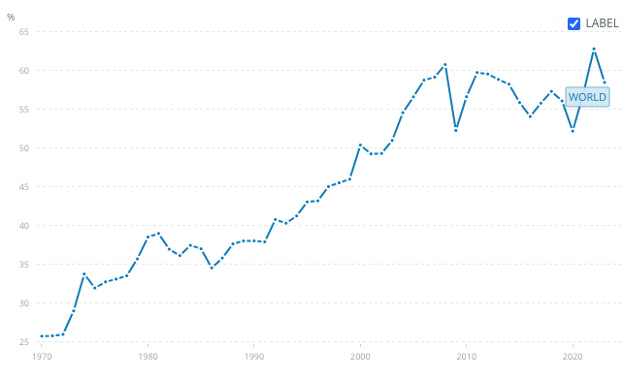
- After the 2008 GFC, “Slowbalization” followed, and this period was characterized by a slowdown in trade reform, weakening political support for open trade, and rising geopolitical tensions. We are in the era of globalization, where global trade as a percentage of GDP is in a slump. Figure 2 illustrates that countries are trading with each other, just less than they were before.
Globalization appears to be at a tipping point. If one looks at trade as a percentage of global GDP, globalization appears to be in a state slightly in recent years. Figure 2 illustrates that trade is receding but remains high. Globalization could be slowing, but it is not in retreat. While countries in similar regions may be trading more among themselves, countries continue to trade with each other. It is more challenging for firms that source inputs from countries across the world. For example, in 2021, several countries in Europe had to wait several months for critical parts like microchips from Asia 2021 and Russia’s war in Ukraine showed how dependent Europe was on Russian energy. Far from deglobalization, the economic impact of the war in Ukraine on food and fertilizer prices across the world illustrates how Ukraine and Russia are vital in sunflower seed supply chains.
The energy crisis created by Russia’s war in Ukraine illustrates Europe’s dependence on Russia and further highlights that global value chains are interconnected. Are supply chains changing or merely being reshuffled, or are we experiencing a paradigm shift towards newer trends of deglobalization?
The World is not globalizing! Here’s why!
- Counties are Still Trading with Each Other: One measure of “globalization” is trade as a percentage of GDP. According to data from the World Bank, Trade between countries has been increasing since the 1970s,s but slowed after the 2008 Great Financial Crisis before peaking in 2022 and falling back in 2023. One can conclude from this that countries are still trading with each other, and so the global economy is far from deglobalizing. In 2023, trade in goods and services expanded by a mere 0.2%, the slowest pace in 50 years outside all main global recessions, according to the World Bank. However, UNCTAD finds that global trade likely hit is poised to $33 trillion in 2024, up $1 trillion from the previous year. The world is trading with each other, and trade tensions have impacted some goods and services, but have not impacted global trade significantly.
Figure 2: Trade as a Percentage of GDP
Source: World Bank
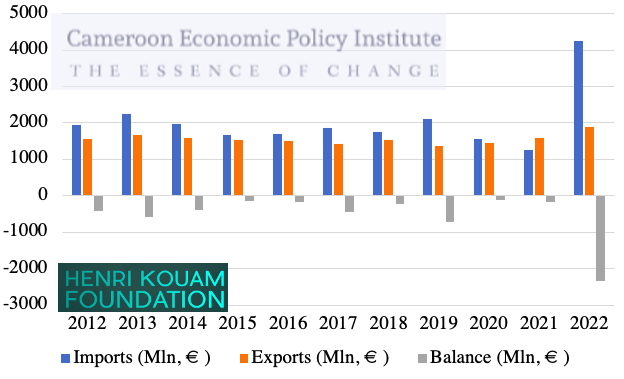
If the world is still trading goods and services, how about Cameroon? Cameroon continues to trade with the EU, and imports have increased over the last six years, as illustrated in Chart 3. Cameroon is certainly not deglobalizing as it relies on imports for vital products like milk, fish, and meat.
Figure 3: Cameroon Trade with the European Union (EU)
Source: Eurostat, CEPI
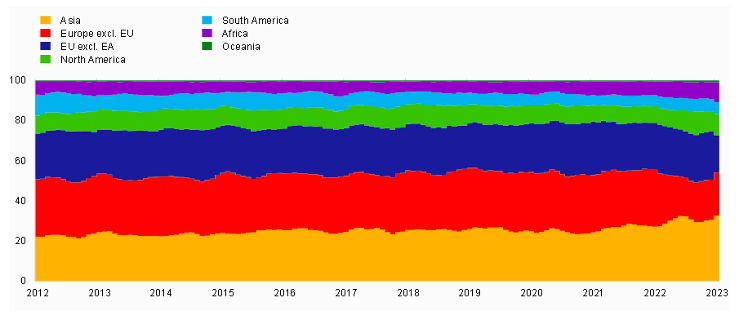
Looking at globalization from a trade perspective alone, trade between the EU and other regions across the world. To cut a long story short, the EU’s share of imports from Africa is falling, but imports from Asia and Europe are on the rise.
Fig 4: Euro area imports of intermediate goods by region
Source: Eurostat
The majority of Cameroon’s trade happens with the European Union (EU), while over 50% of EU trade happens with other European countries.
Some Deglobalization is happening in the EU: Chart 3 shows that in the past decade, the share of intermediate goods imported from within the EU increased.[3] This mirrors the long-term global trend of producing goods closer to their final markets, which has benefited central and eastern European countries.[4] This shift has reversed in the wake of the pandemic as the share of both intermediate and strategic goods imported from the EU decreased. And it is the result of comparatively smooth global supply chain conditions and cheaper input costs outside the EU.[5]
EU Still Trading with other countries across the World:
Overall trade in intermediate goods (a reliable indicator of global production chains) has remained high. The share of trading partners from outside the EU accounted for about 40% of total imports of intermediate goods (including those between euro-area countries) in 2022. The figure for strategic goods was even higher, at 65%, with Asia as the major sourcing region owing to its leading role as an exporter of electronics.[6] Analysis shows that there is no change in the pattern of euro area imports of intermediate goods from within the EU compared to those from outside the EU.[7] In conclusion, the data presented above support survey and anecdotal evidence that there has been no strong response in terms of restoration within the EU. Companies are instead pursuing other strategies, including diversifying suppliers (e.g., via the increase of sourcing countries) and building up strategic inventories.
Conclusion
In order to gauge whether the world is deglobalizing or not, trade is only one indicator. We can also look at capital and financial flows, payment systems, and the share of production from local companies and domestic sources. Looking at trade data alone, Cameroon, the European Union, and much of the world are trading strongly with each other. After the COVID-19 pandemic, countries returned production to their own countries or began importing more from other countries in their region. As a result, we can conclude that the world is experiencing a new phase of globalization, not “de-globalization” together.
About the Author
Henri Kouam is the Founder and the Executive Director of CEPI. He is a contributor to the Economic Intelligence Unit (EIU), previously consulted for NATO Joint Naples Command. He runs, rides, and occasionally codes and models very basic econometrics. Under him, CEPI has caused policymakers to lower VAT for locally made flour, reduced SME taxes from 35% to 30% and led the government to publish export and import procedures in 2.8 years (Fun Fact: There is evidence for all CEPI’s wins)