The Ban of Maize Imports Brings More Problems Than Solutions
May 23, 2026
The African Trade Observatory Will Unleash New Markets for Cameroonian Entrepreneurs
June 3, 2026
Introduction
The government of Cameroon has gone tough on maize imports. On May 7th, the Prime Minister, Chief Dr. Joseph Dion Ngute, chaired a high-level interministerial meeting. On the agenda was the systemic problem faced by local maize farmers. The next day, May 8, the Minister of Trade, Luc Magloire Mbarga Atangana, instructed the suspension of maize import permits. The official correspondence (No. 0424/MINCOMMERCE/CAN) directs, until further notice, a stop to the issuance of new import permits and a suspension of existing ones.
According to officials, this ban aims to protect farmers from ‘mévente’. While Cameroon consistently imports tens of thousands of tons of the cereal, local farmers struggle to sell the maize they have produced. Also, the imported maize exerts downward force on the market price of the commodity, reducing revenues for sellers. There is no guarantee that the mismatch between buyers and sellers is driven by inaccessible roads, weak digital literacy on e-commerce, or better signaling from the industry that relies on corn. Secondly, are we sure that corn prices are falling? In early 2026, food prices rose by 6.6% of the average even as overall inflation fell back to 3.1%. Food prices remain the primary
In early 2026, food inflation in Cameroon averaged 6.6% year-over-year. While overall consumer price inflation has eased to roughly 3.1%, food remains the primary driver of price pressures, significantly reducing purchasing power for urban and displaced households. Statistics confirm the necessity for limiting imports. In 2023, maize imports rose by 229% from the previous year to 39,991 tons, costing 7.8 billion CFA francs. Total imports doubled in 2024 to 81,233 tons (11 billion CFA francs) and edged down to 72,586 tons (10.2 billion CFA francs) in 2025. These are billions of francs that local producers could earn. Now, because of the suspension of imports, consumers will be forced to buy in the country.
There are clear potential benefits for maize producers. However, consumers may have reason to worry. Despite high volumes of maize imports, Cameroon experiences a prolonged structural maize shortage. Local yearly demand for maize is estimated at 2.8 million tons, while the average yearly local production between 2017 and 2021 was only 2.2 million tons. That’s a raw shortage of 600 thousand tons of maize. Added to this raw shortage is the fifty thousand tons of maize illegally exported and the 11% of production lost post-harvest. This inflates the shortage to north of 892,000 tons. It is hard to justify an import ban when we fail to produce enough corn for consumers and industry.
Figure 1: Potential Demand and Production of Corn (Million tons)
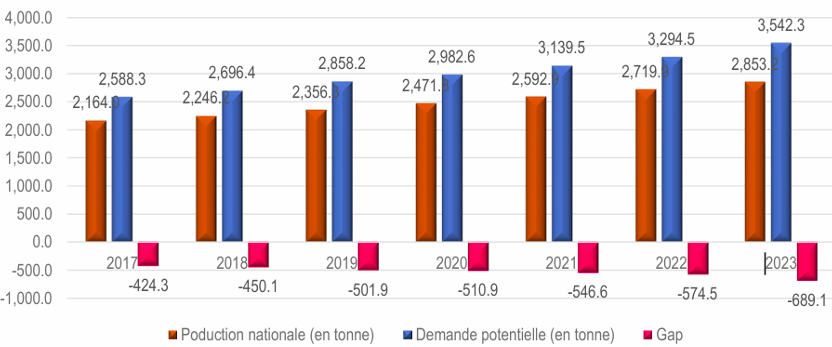
At its peak in 2024, maize imports were 81,233 tons. Although it is a large volume, it was less than 10% of the total maize shortage. Therefore, the import ban cannot be justified based on quantity alone. Because local producers still have an 800,000-ton maize shortage to address. At the center of the ban is the price of maize and tough competition from foreign maize producers. In May 2026, foreign maize was cheaper than locally produced maize. On international markets, one ton costs between 131,000 and 155,000 FCFA, while locally produced maize costs between 140,000 and 255,000 FCFA/ton.
However, given the massive productivity gap and high production costs in Cameroon, competition is unbearable. A local farmer produces only 1.8 tons of maize per hectare, while the global average lies at 5.9 tons/hectare. Moreover, the production cost per hectare in Cameroon is north of 428,000 FCFA. Consequently, it costs local producers about 237,000 FCFA per ton of maize. This is more than the higher end of prices on international markets.
Food Insecurity Could Rise
Households in Douala and Yaoundé will face food security concerns until September as food prices remain above average and continue to erode their purchasing power. This is especially the case for poor urban dwellers and displaced Cameroonians. Relief Web estimates that food prices will be higher than their five-year average due to reduced inflows of food from conflict-hit areas. As the May and June harvest seasons near, we are likely to see another round of high food prices, which means poorer consumers. It is unlikely that corn prices are falling while food prices as a whole are rising due to the centrality of corn in foods like corn chaff, Koki corn, Pap, and Sha.
Recommendations
- We recommend a phased ban, where 100,000 tons of corn are removed progressively to allow the market time to adjust.
- Policymaker should grade 1500kmof roads nationally and 1000km of roads and connecting infrastructure linking corn/maize production basins to urban centers, border towns, and export markets.
- Farmers should join cooperatives, accelerate the transformation of corn into sweet corn and popcorn in a competitive manner, to ensure that they can compete against international brands from Europe and Africa. This is especially true as Cameroon signed the African Continental Free Trade Area (AfCFTA).
- Improve matching in the market by matching production companies and manufacturing firms with cooperatives so that local production can supply the industrial sector.
- The government should ensure locally-produced corn is available at all supermarkets so that buyers of all classes can benefit from similar prices, which should be public, to ensure that consumers pay similar prices across the country.
Therefore, once the ban is enforced, local producers will be shielded from cheaper external competition. This is good news for local producers. However, for Cameroonians grappling with persistent inflation, the silver lining has a big dark cloud. Unless policymakers provide clear instructions to limit maize prices in local markets, consumers should brace for upcoming price spikes. Furthermore, Cameroon’s decentralized and informal markets make it easy for sellers to price arbitrarily, worsening the impacts of a ban on corn imports. Cameroon has likely not closed the 500,00-ton structural deficit, and food prices are rising – it is unwise to implement policies that could leave consumers poorer and financially fragile.
References
Cameroon Tribune (2026). Suspension of maize imports: Cameroon moves to shield local farmers from market inundation. Available at: Cameroon Tribune article (Accessed: 15 May 2026).
AfricTelegraph (2026) Cameroun : Yaoundé envisage la suspension des importations de maïs. Available at: AfricTelegraph article (Accessed: 15 May 2026).
Sika Finance (2026) Le Cameroun veut stopper les importations de maïs pour protéger son marché intérieur. Available at: Sika Finance article (Accessed: 15 May 2026).
Milling Middle East & Africa (2025) Cameroon’s maize sector grapples with rising demand and imports. Available at: MillingMEA article (Accessed: 15 May 2026).
Ministère de l’Économie, de la Planification et de l’Aménagement du Territoire (MINEPAT) (2024) Plan Intégré d’Import-Substitution Agropastoral et Halieutique (PIISAH) 2024–2026. Yaoundé: République du Cameroun. Available at: PIISAH report PDF (Accessed: 15 May 2026)
Authors
Jules Moukam, Research Analyst