Impact of Taxes on Women Entrepreneurs in Cameroon
April 29, 2026
Artificial Intelligence (AI) & Gender Equality in Cameroon
May 5, 2026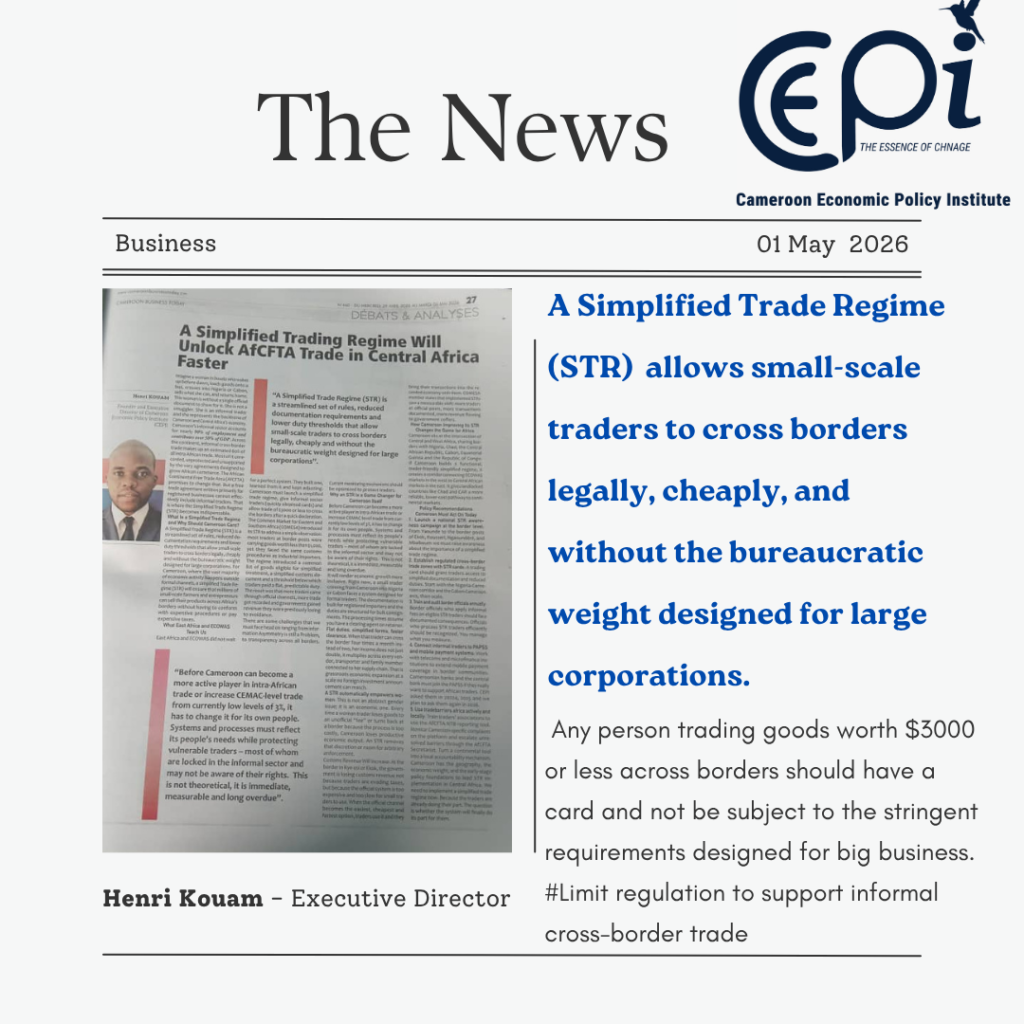
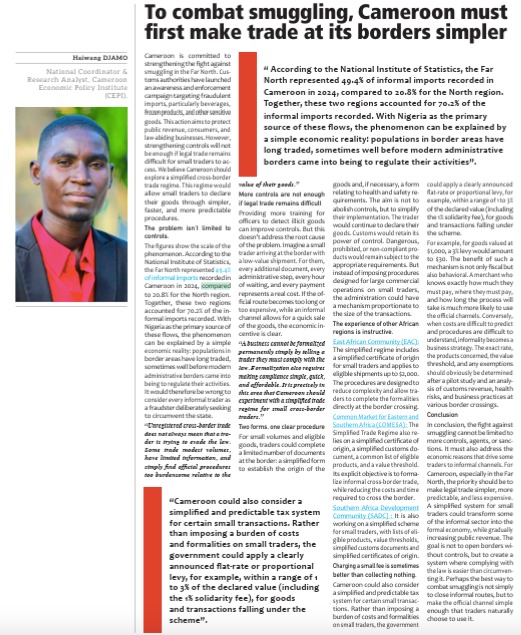
Imagine a woman in Douala who wakes up before dawn, loads goods onto a bus, crosses into Nigeria or Gabon, sells what she can, and returns home. This woman is without a single official document to show for it. She is not a smuggler. She is an informal trader, and she represents the backbone of Cameroon and Central Africa’s economy. Cameroon’s informal sector accounts for nearly 90% of employment and contributes over 50% of GDP. Across the continent, informal cross-border trade makes up an estimated 60% of all intra-African trade. Most of it is unrecorded, unprotected, and unsupported by the very agreements designed to grow African commerce. The African Continental Free Trade Area (AfCFTA) promises to change that. But a free trade agreement written primarily for registered businesses cannot effectively include informal traders. That is where the Simplified Trade Regime (STR) becomes indispensable.
What Is a Simplified Trade Regime and Why Should Cameroon Care?
A Simplified Trade Regime (STR) is a streamlined set of rules, reduced documentation requirements, and lower duty thresholds that allow small-scale traders to cross borders legally, cheaply, and without the bureaucratic weight designed for large corporations. For Cameroon, where the vast majority of economic activity happens outside formal channels, a simplified Trade Regime (STR) will ensure that millions of small-scale farmers and entrepreneurs can sell their products across Africa’s borders without having to conform to expensive procedures or pay taxes.
What East Africa and ECOWAS Teach Us
East Africa and ECOWAS did not wait for a perfect system. They built one, learned from it, and kept adjusting. Cameroon must launch a simplified trade regime, give informal sector traders (quickly obtained cards), and allow trade of $3000 or less to cross the borders after a quick declaration.
The Common Market for Eastern and Southern Africa (COMESA) introduced its STR to address a simple observation: most traders at border posts were carrying goods worth less than $1,000, yet they faced the same customs procedures as industrial importers. The regime introduced a common list of goods eligible for simplified treatment, a simplified customs document, and a threshold below which traders paid a flat, predictable duty. The result was that more traders came through official channels, more trade got recorded, and governments gained revenue they were previously losing to avoidance. There are some challenges that we must face head-on, ranging from information asymmetry still being a Problem to transparency across all borders. Current monitoring mechanisms should be optimized to protect traders.
Why an STR Is a Game Changer for Cameroon Itself
Before Cameroon can become a more active player in intra-African trade or increase CEMAC-level trade from its current low levels of 3%, it has to change its approach for its own people. Systems and processes must reflect their people’s needs while protecting vulnerable traders – most of whom are locked in the informal sector and may not be aware of their rights. This is not theoretical; it is immediate, measurable, and long overdue.
It will render economic growth more inclusive. Right now, a small trader crossing from Cameroon into Nigeria or Gabon faces a system designed for formal traders. The documentation is built for registered importers, and the duties are structured for bulk consignments. The processing times assume you have a clearing agent on retainer.
Flat duties, simplified forms, faster clearance. When that trader can cross the border four times a month instead of two, her income does not just double, it multiplies across every vendor, transporter, and family member connected to her supply chain. That is grassroots economic expansion at a scale no foreign investment announcement can match.
A STR automatically empowers women: This is not an abstract gender issue; it is an economic one. Every time a woman trader loses goods to an unofficial “fee” or turns back at a border because the process is too costly, Cameroon loses productive economic output. An STR removes that discretion or room for arbitrary enforcement.
Customs Revenue will Increase: At the border in Kye-osi or Ekok, the government is losing customs revenue not because traders are evading taxes, but because the official system is too expensive and too slow for small traders to use. When the official channel becomes the easiest, cheapest, and fastest option, traders use it, and they bring their transactions into the recorded economy with them. COMESA member states that implemented STRs saw a measurable shift: more traders at official posts, more transactions documented, and more revenue flowing to government coffers.
How Cameroon Improving Its STR Changes the Game for Africa
Cameroon sits at the intersection of Central and West Africa, sharing borders with Nigeria, Chad, the Central African Republic, Gabon, Equatorial Guinea, and the Republic of Congo. If Cameroon builds a functional, trader-friendly simplified regime, it creates a corridor connecting ECOWAS markets in the west to Central African markets in the east. It gives landlocked countries like Chad and CAR a more reliable, lower-cost pathway to continental markets.
Policy Recommendations Cameroon Must Act On Today
1. Launch a national STR awareness campaign at the border level: From Yaounde to the border posts of Ekok, Kousséri, Ngaoundéré, and Mbaiboum- we must raise awareness about the importance of a simplified trade regime.
2. Establish regulated cross-border trade zones with STR cards: A trading card should grant traders access to simplified documentation and reduced duties. Start with the Nigeria-Cameroon corridor and the Gabon-Cameroon axis, then scale.
3. Train and audit border officials annually: Border officials who apply informal fees on eligible STR traders should face documented consequences. Officials who process STR traders efficiently should be recognized. You manage what you measure.
4. Connect informal traders to PAPSS and mobile payment systems: Work with telecoms and microfinance institutions to extend mobile payment coverage in border communities. Cameroonian banks and the central bank must join the PAPSS if they really want to support African traders. CEPI asked them in 20224, 2025, and we plan to ask them again in 2026.
5. Use tradebarriers.africa actively and locally: Train traders’ associations to use the AfCFTA NTB reporting tool. Monitor Cameroon-specific complaints on the platform and escalate unresolved barriers through the AfCFTA Secretariat. Turn a continental tool into a local accountability mechanism.
Cameroon has the geography, the economic weight, and the early-stage policy foundations to lead STR implementation in Central Africa. We need to implement a simplified trade regime now. Because the traders are already doing their part, and we should not penalise 85% of the population simply because we fail to adjust policies to reflect their needs.
. The question is whether the system will finally do its part for them.
Author
Henri Kouam
Executive Director