3-5% Locally Produced Flour Should Be Included in Baked Products.
June 3, 2026
Jerome Powell Legacy: Inflation, Political Pressure, and Independence
June 6, 2026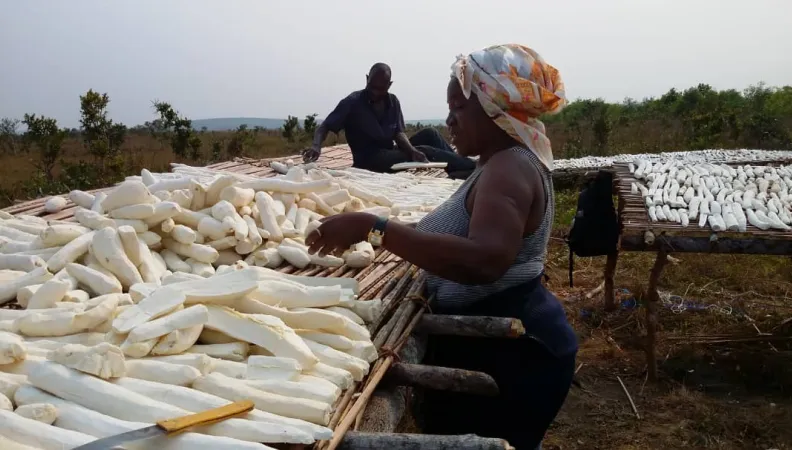
Introduction
Cassava ranks among the top two most consumed foods in Cameroon and remains an important source of carbohydrate for the central African region. While agriculture contributes 18.5% of GDP (2024) or $143,20 billion, the cassava sector contributes about 1-2% of Cameroon’s GDP. Cameroon signed the African Continental Free Trade Area (AfCFTA) in 2018 and was a pioneer of trade under the preferential terms of the agreement. This presents a unique opportunity for the 6 – 6.5 million tons of cassava produced in the country and the country’s 800,000 producers.
Cassava is consumed as flakes (garri), fufu, bobolo, and starch by Cameroonians and its neighbors. Following CEPI’s successful advocacy to lower VAT on locally-made cassava flour in 2023/2024, wheat flour imports dropped dramatically in 2025. Section I analyses driving and mitigating, followed by an evidence-based analysis on how the AfCFTA will drive the cassava Value Chain in Section II. We analyze how the AfCFTA will drive industrialization in the cassava value chain in Section III followed by policy recommendations and conclusions.
Section 1: Drivers of the Cassava Sector in Cameroon
The cassava (Manihot esculenta) sector in Cameroon has transformed from a traditional subsistence crop into a dynamic engine for rural development and food security. Understanding its structural drivers is critical for leveraging the African Continental Free Trade Area (AfCFTA) to transition this value chain from local trade to regional agro-industrialization.
The primary driver of the sector is its exceptional agronomic resilience and versatility. Cassava acts as an indispensable “insurance crop” against food insecurity and climate change due to its high drought tolerance and capacity to produce viable yields on marginal soils where traditional cereals fail (Ndjouenkeu et al., 2020). This adaptive capacity has expanded its cultivation across all five of Cameroon’s agroecological zones, generating an estimated annual output of over 6 million metric tons (Evouna et al., 2024).
Furthermore, the sector is heavily propelled by demographic shifts and rapid urbanization. Rapidly growing urban centers have accelerated the market demand for processed, shelf-stable, and highly storable cassava derivatives like gari, eba, and fufu (Olaosebikan et al., 2023). This shifting demand has restructured traditional supply chains, transitioning cassava from a post-harvest loss-prone fresh root into a highly commercialized cash crop.
Finally, the market is driven by evolving consumer quality preferences and institutional breeding support. Strategic initiatives by national and international research bodies have prioritized developing improved genotypes characterized by high starch density, low water content, and favorable sensory traits like superior texturing and moldability (Ndjouenkeu et al., 2020; Olaosebikan et al., 2023). These targeted varietal advancements directly fulfill processing requirements, creating a predictable and scalable raw material base essential for future cross-border industrial processing under the AfCFTA framework.
Section 2: How will the AfCFTA drive the cassava Value Chain
The African Continental Free Trade Area (AfCFTA) serves as a structural catalyst for transitioning Cameroon’s fragmented, subsistence-based cassava sector into a modernized, export-oriented agro-industrial value chain. By eliminating 90% of intra-African tariffs and reducing non-tariff barriers, the agreement establishes a single continental market of 1.4 billion consumers, directly reshaping the economic viability of domestic processing (African Liberty, 2026; Kouam & Djamo, 2023).
The primary mechanism of this transformation operates through economies of scale and regional market integration. Under the AfCFTA framework, Cameroonian agri-preneurs are incentivized to move beyond low-value traditional foods (fufu and gari) toward industrial-grade derivatives such as high-quality cassava flour (HQCF), bioethanol, and industrial starch (African Liberty, 2026; Akono & Djamo, 2026). This broader cross-border access stimulates specialized agro-industrial clusters and public-private partnerships, allowing local processors to secure stable off-take agreements with high-demand markets like Nigeria (Akono & Djamo, 2026).
Furthermore, the pact accelerates institutional and regulatory harmonization. To participate competitively in regional trade, Cameroon is systematically aligning its agricultural policies with AfCFTA sanitary and phytosanitary (SPS) frameworks and technical standards (African Liberty, 2026). This regulatory pressure drives the formalization of local value chains, prompting the adoption of standardized processing technologies and digital aggregation networks that bridge the information gap between smallholders and large-scale industrial buyers. Ultimately, by attracting targeted foreign direct investment into rural infrastructure and processing zones, the AfCFTA shifts Cameroon from an exporter of raw tubers to a competitive regional hub for value-added starchy commodities.
Section 3: How the AfCFTA will Drive Industrialization in the Cassava Value Chain
The African Continental Free Trade Area (AfCFTA) serves as the primary structural catalyst for the industrial transformation of Cameroon’s cassava sector. Historically confined to low-yield subsistence farming and informal processing, the value chain is being rapidly re-engineered into a high-value manufacturing sector. This shift aligns directly with Cameroon’s National Development Strategy 2030 (SND30) import-substitution policy, which prioritizes endogenous agribusiness growth to capture expanded regional markets (Akono & Djmao, 2026; Nyemb, 2025).
The core engine of this industrialization is the standardizing pressure of regional value chain (RVC) integration. To exploit preferential tariff access under the AfCFTA Guided Trade Initiative, Cameroonian agro-processors are pivoting away from perishable fresh roots toward shelf-stable, industrial-grade derivatives (Kouam et al., 2024). Eliminating regional trade barriers makes it economically viable to establish large-scale processing units within production basins. These factories process raw tubers into High-Quality Cassava Flour (HQCF), bioethanol, and industrial starch, serving as critical inputs for continental pharmaceutical, textile, and food manufacturing sectors (MINPMEESA, 2025).
Furthermore, the AfCFTA facilitates capital accumulation and technology transfers. The creation of a single continental market acts as a strong incentive for foreign and domestic direct investment, flowing directly into rural infrastructure and Special Agro-Industrial Processing Zones (SAPZs) (Camepi, 2026). This capital influx drives mechanization—from automated peeling and grating machines to industrial flash dryers—effectively mitigating past processing failures and structural inefficiencies (Invest in Central Africa, 2026). By standardizing sanitary and phytosanitary frameworks, the AfCFTA transitions Cameroon from an artisanal producer into a modernized, competitive agro-industrial hub capable of supplying resilient starch commodities across Central and West Africa.
Policy Recommendations
- Policy makers should maintain a reduced VAT rate for locally-made flour to support import substitution for at least five years. As seen in the past, actors will formalize their activities, scale their farms, and invest in producing market-ready products.
- While we should maintain reduced and zero import duties for agriculture inputs like seeds, fertilizers, and machinery, we must ensure that such policy support is reflected in local prices. Local sellers should publish their prices, and sellers who try to exploit the reform while charging consumers higher prices should have their license revoked.
- SOCADEL should ensure at least 90% electrification rates across rural and urban Cameroon to support industrialization. Meanwhile, installations of solar panels or other forms of renewable energy should be tax-deductible by 25 – 40%.
- We should adopt a Simplified Trade Regime (STR) to connect informal sector farmers and production units to industrial centers located close to border towns such as Kousseri and N’djamena. This will support the integration of refugees and create long-term economic activity.
- Cassava value chain actors must industrialize gradually and ensure their products are both competitive from a price and quality standpoint to ensure they are not made obsolete by foreign competition.
Conclusion
Ultimately, the AfCFTA represents a historic pivot for Cameroon’s cassava sector, transforming a traditional safety-net crop into a sophisticated engine of regional economic integration. By removing cross-border trade barriers and establishing rigorous quality standards, the agreement effectively forces the formalization of the value chain. This structural shift unlocks vital private capital, sparks rural industrialization through automated processing hubs, and positions Cameroon as the premier agro-industrial provider of starchy commodities to Central Africa. Embracing this continental framework allows Cameroon to successfully bridge the gap between subsistence smallholder farming and a highly profitable, climate-resilient agribusiness future.
Reference List
Mbarga Evouna, J. S., Molua, E. L., Djomo Choumbou, R. F., & Kemeni Kambiet, P. L. (2024). Structure and performance of cassava markets: challenges of food security and connecting small farmers to markets in Cameroon. Frontiers in Sustainable Food Systems, 8. https://doi.org/10.3389/fsufs.2024.1353565
Ndjouenkeu, R., Ngoualem Kegah, F., Teeken, B., Okoye, B., Madu, T., Olaosebikan, O. D., Chijioke, U., Bello, A., Oluwaseun Osunbade, A., Owoade, D., Takam‐Tchuente, N. H., Biaton Njeufa, E., Nguiadem Chomdom, I. L., Forsythe, L., Maziya‐Dixon, B., & Fliedel, G. (2020). From cassava to gari: mapping of quality characteristics and end‐user preferences in Cameroon and Nigeria. International Journal of Food Science & Technology, 56(3), 1223-1238. https://doi.org/10.1111/ijfs.14790
Olaosebikan, O., Bello, A., de Sousa, K., Ndjouenkeu, R., Adesokan, M., Alamu, E., Agbona, A., Van Etten, J., Kégah, F. N., Dufour, D., Bouniol, A., & Teeken, B. (2023). Drivers of consumer acceptability of cassava gari‐eba food products across cultural and environmental settings using the triadic comparison of technologies approach (tricot). Journal of the Science of Food and Agriculture, 104(8), 4770-4781. https://doi.org/10.1002/jsfa.12867
African Liberty. (2026). How AfCFTA Can Unlock the Potential of Cameroon’s Cassava Sector. African Liberty Insights.
CEPI. (2026). Event Brief: Transforming Cameroon’s Cassava Value-Chain for Industrialization. Cameroon Economic Policy Institute (CEPI), https://camepi.org/event-brief-transforming-cameroons-cassava-value-chain-for-industrialization/
Kouam, H., & Djamo, H. (2023). The Impact of the African Continental Free Trade Area (AfCFTA) on Food Products in Cameroon. Global Scientific Research Journal of Management and Social Sciences, 1(1), 12-25.
Akono, R. & Djamo, H. (2026). How Can the AfCFTA Boost the Informal Agriculture Sector. Cameroon Economic Policy Institute (CEPI), https://camepi.org/2026/04/17/how-can-the-afcfta-boost-the-informal-agriculture-sector/
Invest in Central Africa. (2026). SOTRAMAS and the industrial collapse of cassava processing in Sangmelima: Lessons for infrastructure scaling under AfCFTA. Invest Time Agribusiness Insights.
Kouam, H., Djamo, H., & Sundjo, F. (2024). Evaluating the Sectoral Impacts of the AfCFTA on Cameroon’s Macroeconomic Indicators. Economic Research Bureau Report, 4(2), 88-103.
Ministry of Small and Medium Enterprises, Social Economy and Handicrafts (MINPMEESA). (2025). Final Report: Structuring of PMEESAs in the Agro-industry sector under the SND30 framework. Republic of Cameroon.
Nyemb, J. J. (2025, September 24). Cameroon’s Transformation Hinges on Public-Private Collaboration. Business in Cameroon.
Author
Ouzerou Youhenyi , Research Analyst