The African Trade Observatory Will Unleash New Markets for Cameroonian Entrepreneurs
June 3, 2026
The AfCFTA Can Boost Industralization of the Cameroon Cassava Value-Chain
June 6, 2026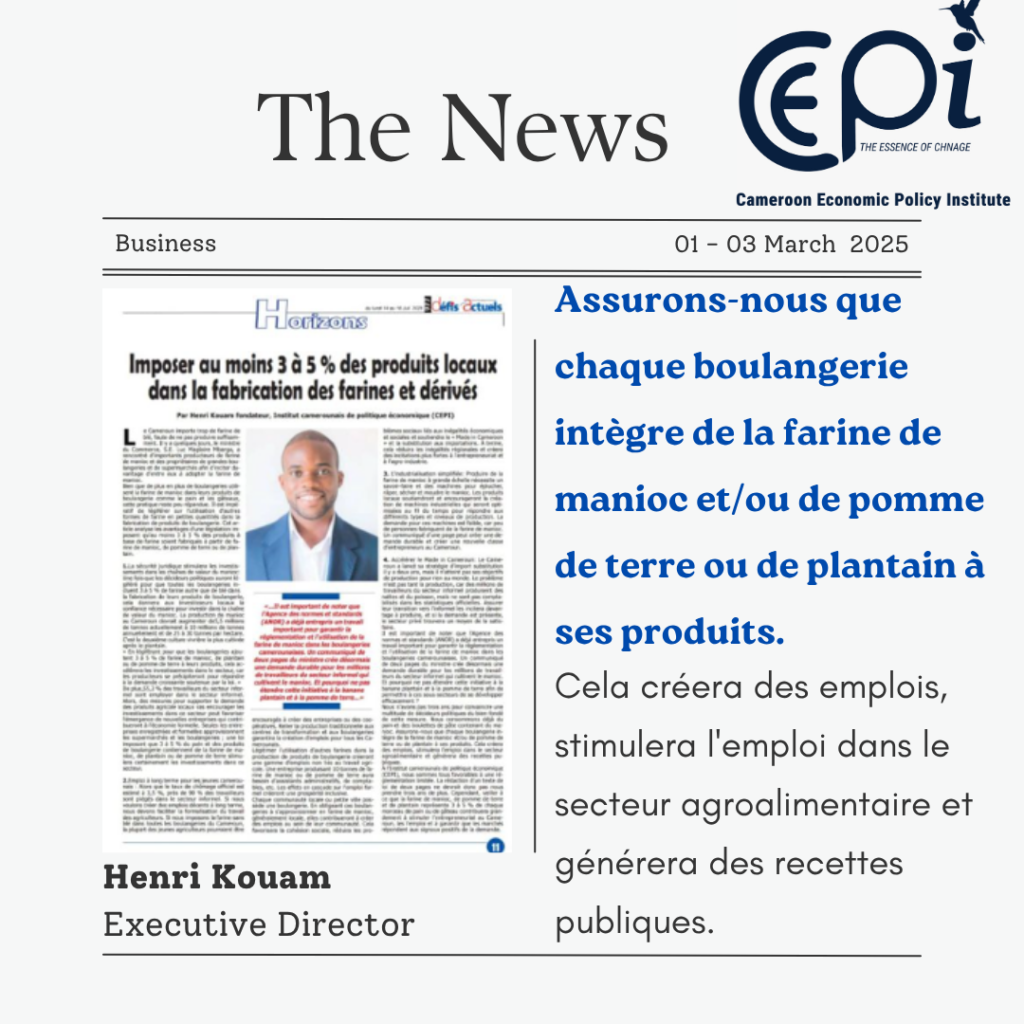
Cameroon imports too much wheat flour due to insufficient domestic production. Last week, the Minister of Trade, H.E. Luc Magloire Mbarga, met with major cassava flour producers and owners of large bakeries and supermarkets to encourage more of them to adopt cassava flour. Although more and more bakeries are using cassava flour in their baked goods such as bread and cakes, this practice remains uncommon. It is imperative to legislate on the use of other types of flour in small quantities in the production of baked goods. This article analyzes the benefits of legislation requiring that at least 3 to 5% of flour-based products be made from cassava, potato, or plantain flour.
1. Legal certainty will stimulate investment in cassava value chains : Once policymakers legislate requiring all bakeries to include 3 to 5% non-wheat flour in their baked goods, it will give local investors the confidence to invest in the cassava value chain. Cassava production in Cameroon is expected to increase by 5.5 million tonnes currently to 10 million tonnes annually and 25 to 30 tonnes per hectare. It is the second most cultivated food crop after plantain.
“By legislating that bakeries add 3 to 5% cassava, plantain, or potato flour to their products, this will accelerate investment in the sector, as producers will rush to meet the growing demand supported by the law.”
Moreover,55.2% of informal sector workers are employed in the informal sector. Therefore, measures to support the demand for local agricultural products will encourage investment in this sector and can foster the emergence of new businesses that will contribute to the formal economy. Only registered and formal businesses supply supermarkets and bakeries; a law requiring that 3 to 5% of bread and bakery products contain cassava, plantain, or potato flour will certainly stimulate investment in this sector.
2. Long-term employment for young Cameroonians: While the official unemployment rate is estimated at 3.5%, nearly 90% of workers are trapped in the informal sector. If we want to create decent, long-term jobs, we must facilitate the formalization of farmers’ work. If we mandate the use of wheat-free flour in all bakeries in Cameroon, most young farmers could be encouraged to start businesses or cooperatives. Linking traditional production to processing centers and bakeries will guarantee job creation for all Cameroonians.
Legitimizing the use of alternative flours in bakery production will create a range of jobs unrelated to agricultural work. A company producing 10 tons of cassava or potato flour will need administrative assistants, accountants, and so on. The ripple effects on formal employment will create inclusive prosperity.
Every local community or small town has a bakery. By requiring these bakeries to source their cassava flour, which is generally locally produced, they will help create jobs within their communities. This will foster social cohesion, reduce social problems linked to economic and social inequalities, and support “Made in Cameroon” products and import substitution. Ultimately, this will reduce regional inequalities and create stronger incentives for entrepreneurship and agribusiness.
3. Simplified industrialization: Producing cassava flour on a large scale requires expertise and machinery for peeling, grating, drying, and grinding the cassava. Locally sourced products will support and encourage the development of industrial machinery that will be optimized over time to meet different types and levels of production. Demand for this machinery is currently low, as few people are currently producing cassava flour. A one-page press release can create sustainable demand and foster a new class of entrepreneurs in Cameroon.
4. Accelerating Made in Cameroon: Cameroon launched its import substitution strategy two years ago, but it is nowhere near meeting its production targets. The problem isn’t so much production itself, as millions of informal sector workers produce mats and fish but aren’t counted in official statistics. Facilitating their transition to the informal sector will incentivize them to produce more, and if the demand is there, the private sector will find a way to meet it.
It is important to note that the Standards and Norms Agency (ANOR) has already undertaken significant work to ensure the regulation and use of cassava flour in Cameroonian bakeries. A two-page press release from the Minister will now create sustainable demand for the millions of informal sector workers who cultivate cassava. And why not extend this initiative to plantains and potatoes to allow these sub-sectors to develop effectively?
We don’t have three years to convince a multitude of political decision-makers of the merits of this measure. We already consume bread and dough balls containing cassava. Let’s ensure that every bakery incorporates cassava and/or potato or plantain flour into its products. This will create jobs, stimulate employment in the agri-food sector, and generate public revenue.
At the Cameroon Institute for Economic Policy (CEPI), we all favor limited regulation. Drafting a two-page law should therefore not take us another three years. However, ensuring that cassava, potato, and plantain flour constitutes 3 to 5% of every loaf of bread or cake will greatly contribute to stimulating entrepreneurship in Cameroon, creating jobs, and ensuring that markets respond to positive demand signals.
Author
Henri Kouam, Executive Director