COP31: How Can Africa Secure Sustainable Climate Finance Without Taking on More Debt?
November 18, 2026
CEPI Engages 450 Students of Sure Vision College on Responsible AI and Social Media Use
November 20, 2026
Introduction
At the heart of Cameroon’s food system lies an abundant absence: an abundant potential for agricultural production, yet an absence of food produced at the scale the country needs.
While over 70% of arable land goes uncultivated, 10% of the population (over 3 million people) experiences acute food insecurity. Furthermore, low agricultural output weighs heavily on the trade balance. In 2023, the trade deficit was 2,004 billion CFA. This was very much driven by food imports, which represented 22% of all merchandise imports. Rice alone cost 200 billion CFA. With each bag of rice imported, foreign exchange leaves alongside economic activity and potential jobs for Cameroonians. Sections 2 and 3 examine PIISAH’s operational axes and some major challenges faced by actors of the rice value chain. Then, we will evaluate how well the plan responds to the challenges before presenting our recommendations.
Section 1. Policy Response
PIISAH is a three-year (2024-2026) integrated plan for import substitution in the agropastoral and fisheries sector. It is structured around three operational axes.
Axe 1 focuses on securing and developing land and water perimeters: the plan targets securing 1,278,555 hectares of land for the cultivation of rice, maize, soy, and wheat, among others, and the construction or rehabilitation of 359km and 487km of roads, respectively.
Axe 2 targets improvement at various stages of the value chain. Notably, improvement in production, transformation, and sales. Specifically, for rice, this includes support for certified seed multiplication, input access for private operators, and the construction of forty 300-square-metre storage, drying, and processing units.
Finally, axe 3 addresses access to research, training, and finance. For rice, this translates into support for organising a single rice-sector interprofessional body and capacity-building for ten MINADER-supported actors. The full plan carries a total cost of 1,371,546,519,000 FCFA.
Section 2. Major Challenges faced by Rice Farmers
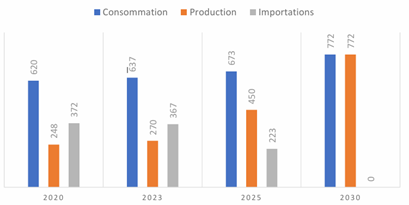
In Cameroon, rice farmers face many challenges. To evaluate the fit of the policy response, we need to dive into those challenges first.
The challenges faced by rice farmers can be divided into three categories, based on the stages of the value chain. There are challenges faced at the production stage, the harvest & post-harvest stages, and at the commercialisation stage.
At the production stage, quality seeds are severely limited, and productivity is low. The African Seed Access Index reported that Cameroon produces only 13% of the certified rice seeds it needs. Added to that, the country has no active breeders of rice. This, in addition to other factors, constricts the nation’s productivity. Rice yield in Cameroon (2.16 t/ha) is only half of the global average (4.4 tons per hectare). Yet, the average Cameroonian consumes 25kg of rice per year, thereby creating a persistent structural deficit of more than 350,000 tons. To make up for the deficit, the country imports 75% of the rice it consumes, further stretching the trade deficit.
At the harvest and post-harvest stages, there is post-harvest loss due to poor storage and persistent transformation gaps. A 2023 study found that locally milled rice loses up to 19.9% of its weight during storage. Additionally, there’s discolouration that reduces the market potential of the rice. Some of this value loss is connected to the lack of processing infrastructure. A joint report from the Japanese International Cooperation Agency and MINADER says that locally produced rice appeals less because of inadequate drying and milling. The lack of processing infrastructure is so severe that producers prefer transporting unprocessed paddy to Nigeria.
Local producers face uncompromising competition from imports. Most of the rice consumed in Cameroon is imported. In 2023, the country imported 620,000 tons of rice for 200 billion CFA. Strangely, the country imports more rice than it consumes. This is attributed to an informal reexport flow to Nigeria, where the import fees are higher than in Cameroon.
Section 3. Where PIISAH Holds – and Where It Doesn’t
PIISAH appears to be worth its weight in gold, despite costing well over a trillion francs. Its three axes address four out of the five major challenges faced by actors of the rice value chain.
There are investments in producing and vulgarising improved seeds. To address limited access to seeds, PIISAH allocates a budget of 200 million CFA to support the private sector in producing certified seeds. There’s also an additional two hundred million CFA to reinforce existing rice seed production companies and two hundred million CFA to vulgarise the high-yield seeds. To improve yield and production, the government makes a 250 million CFA bet to increase the number of private producers and support ten of the existing ones. Historically, production has increased at the same rate as cultivated area. This indicates that either increasing yield is an intractable challenge or increasing cultivated areas is more feasible. Given that 74% of arable land goes unused, it is sound to invest in exploiting those perimeters.
PIISAH spends over a billion on developing storage and processing infrastructure. To reduce post-harvest loss due to poor storage and transformation gaps, one billion CFA was allocated for the construction of forty warehouses to store, dry, and transform Paddy rice. Imported milled white rice has both the highest rate of discolouration (3.5%) and weight loss due to pest attacks (~20%). This indicates that domestic rice should be prioritised for longer storage periods. Moreover, there was a negligible weight loss for parboiled domestic samples. Therefore, it will be better to design the warehouses to parboil paddy rice first and store it for a longer period before sale. Eventually, the rice can be milled and sent shortly after to the market for consumption. In case of any excess processing capacity in the warehouses, prioritise the import of parboiled rice. First, because imported milled white rice had the highest fungi charge and weight loss, but also to create local jobs in rice processing.
There is assistance to acquire processing machinery, but Nigeria could be a band-aid. In addition to planning for warehousing, the state has made provision for assistance to facilitate the importation of processing machinery. While the processing infrastructure is enhanced, the government might want to consider creating a regional value chain with our friends in Nigeria. A lot of paddy rice is already informally exported to Nigeria for processing. As a stopgap measure, the state could formalise agreements where Cameroonian rice farmers can focus on exploiting more arable land, even at current yield, and producing paddy which they export to Nigeria before importing milled white rice. This could release some pressure on the trade deficit since we will offset the import bill from Thailand and India with transportation to and from a closer country, added to export revenue from selling the paddy rice. Also, this will create jobs in transportation and logistics.
Finally, there are no axes specifically aimed at curbing competition from abroad. However, in its design, PIISAH includes special fiscal and financial measures to discourage imports and incentivise local financing. MINADER will initiate dialogue with the Central Bank to establish a refinancing mechanism for loans granted by commercial banks to operators in the value chain. To limit imports, fixed import quotas will be set, and customs exemptions will be progressively reduced. Unfortunately, these lofty goals will need to pass the hard test of implementation. Imposing quotas and implementing the refinancing mechanism are beyond the purview of MINADER. These will be contingent on persuading a politically independent central bank and a Ministry of Trade incentivised to maximise tariff revenues. To face less resistance from the Ministry of Trade, quotas should be rolled out progressively and, in a manner, be compensated for by an increase in revenue from relaxing customs consumption. Also, MINADER should ensure that all new activities in the value chain can be fiscally tracked and taxed to ensure the sustainability of the program.
Recommendation
- Design the 40 warehouses to parboil paddy rice first and store it for a longer period before milling and sale.
- Create a regional value chain with Nigeria as a stopgap measure to compensate for the lack of processing facilities
- Roll out import quotas progressively and match them to be offset by the progressive relaxing of customs exemptions
- Create simple evaluation scorecards to encourage active citizenship
Conclusion
PIISAH is a serious attempt to confront Cameroon’s abundant absence. It recognises that the rice problem is not only about growing more rice, but about fixing the full value chain: land access, seeds, productivity, storage, processing, and market access. Its strength lies in this integrated approach. By investing in cultivated perimeters, seed systems, processing infrastructure, and farmer support, the plan directly responds to many of the constraints that keep Cameroon dependent on imported rice despite its agricultural potential. If implemented well, PIISAH could reduce food import dependence, retain more value locally, and create rural jobs.
References
Business in Cameroon. (2024). Officials reveal rice project on track to slash import bill and meet local demand. https://www.businessincameroon.com/agriculture/1012-15479-officials-reveal-rice-project-on-track-to-slash-import-bill-and-meet-local-demand
Food and Agriculture Organization of the United Nations. (2022). Cameroon: Rice value chain. https://www.fao.org/media/docs/handinhandlibraries/countries/cameroon/cameroon-final.pdf
Food and Agriculture Organization of the United Nations. (2025). Rice yields – UN FAO [Dataset]. Our World in Data. https://ourworldindata.org/grapher/rice-yields
Institut National de la Statistique. (2024). Commerce extérieur du Cameroun en 2023. https://ins-cameroun.cm/wp-content/uploads/2025/07/Note-sur-le-Commerce-Exterieur-2023-c-1.pdf
Mapiemfu-Lamare, D., Ambang, Z., Douksouna, Y., Tang, E. N., Ngome Ajebesone, F., Suh, C., & Tatah, B. N. (2023). Post-harvest constraints: Fungi and insects responsible for rice (Oryza spp.) losses during storage in Cameroon. Agricultural Sciences, 14, 785–803. https://doi.org/10.4236/as.2023.146053
Mabaya, E., Bila, S., Maffouasson, H., Waithaka, M., Mugoya, M., Anyoso, A., Sawe, J., & Tihanyi, K. (2025). Cameroon 2025 country study: The African Seed Access Index. The African Seed Access Index. https://www.minader.cm/wp-content/uploads/2025/12/CMR_2024_en_country-report_Nov2025_web.pdf
Mbondji, N. P. B., & Fon, D. E. (2023). Cameroon’s rice sector faced with import dependency. Agricultural Sciences, 14, 58–72. https://doi.org/10.4236/as.2023.141005
Ministère de l’Agriculture et du Développement Rural. (2024). Plan intégré d’import substitution agro-pastoral et halieutique (PIISAH) 2024–2026: Volet MINADER. https://www.minader.cm/wp-content/uploads/2024/07/PRESENTATION-PIISAH_DEPC.pdf
Sika Finance. (2024). Cameroun : La facture des importations de riz a diminué de 63,5 milliards FCFA en 2023. https://www.sikafinance.com/marches/cameroun-la-facture-des-importations-de-riz-a-diminue-de-63-5-milliards-fcfa-en-2023_46223
United Nations Food Systems Coordination Hub. (2025). UN strategic note on food systems transition in Cameroon. https://www.unfoodsystemshub.org/docs/unfoodsystemslibraries/country-case-profiles/cameroon/cp6-cameroon—un-strategic-note-on-food-systems-transition-docx.pdf
World Bank. Food imports (% of merchandise imports) – Cameroon. https://data.worldbank.org/indicator/TM.VAL.FOOD.ZS.UN?locations=CM
Author
Moukam Jules
Research Analyst