Strategies for Industrialising the Tomato Value Chain in Cameroon
November 12, 2026
Introduction
Economic growth in Cameroon is constrained by climate change. According to the World Bank, Cameroon could lose 4 to 10% of GDP by 2050 due to climate change. In 2014, climate-related disasters were already estimated to cost 5.7 million US dollars, and more recently, 2 million people were found to live in drought-affected areas, leaving roughly 8% of GDP vulnerable.
Still, climate change adaptation and mitigation are expensive. The IMF estimates that implementing Cameroon’s adaptation and mitigation actions will require about 57.64 billion US dollars by 2030. This is five times more than the expected 2026 state’s general budget revenue (5,687 billion CFA). Given the current tight fiscal space within which Yaounde operates, it is difficult to fund climate-related projects.
Nevertheless, a debt-for-climate swap could be a lifeline for Cameroon. Debt-for-climate swaps, by their design, can direct financing to climate-related projects without creating new financial obligations for governments. In this brief, we will define debt-for-climate swaps, then we shall explore two case studies (Ecuador and Gabon). Finally, we will explore how Cameroon could leverage this instrument and provide our recommendations.
Section 1. What debt-for-climate swaps are and their relevance for Cameroon.
Debt-for-climate swaps are financial operations in which a sovereign debtor and its creditors agree to cancel, exchange, or refinance part of the country’s public debt, conditional on the debtor committing the resulting debt-service savings to domestic climate mitigation and adaptation investments. The aim here is to reduce fiscal pressure while mobilizing additional climate finance.
The mechanism is simpler than it sounds. Cameroon, like most countries, spends a significant share of its budget servicing debt. In 2026, Repayment of interest on debt is about 532.5 billion FCFA. This is more than investments in infrastructure, three times the budget to defend the national territory, and four times the expenditure to strengthen the healthcare system. A debt-for-climate swap restructures a portion of existing debt in exchange for a government commitment to redirect part of what would have gone to debt service into agreed climate and development priorities. No new borrowing is required. No new money is created. What changes is the destination of what Cameroon was already obligated to pay.
The uniqueness of these swaps matters for a fiscally cautious government. These swaps do not require more debt to fund climate resilience. Instead, it is a call to renegotiate the terms of the debt the state already carries, so that some of the money destined for banks in New York can be invested at home to curb the adverse effects of climate change.
Section 2. Lessons from Elsewhere
There have been over 160 debt-for-climate transactions. Debt-for-climate transactions are not only theoretical financial instruments. Two cases are especially instructive for Cameroon: Ecuador, because it remains the largest swap executed so far; and Gabon, because as a fellow Central African, oil-dependent economy with a comparable debt profile, it offers the closest regional precedent.
Ecuador did the largest debt-for-nature swap to date. In May 2023, the country exchanged about 1.6 billion of dollar-denominated bonds for a new 656 million dollar ‘blue bond’. This deal, facilitated by Credit Suisse, involved Ecuador repurchasing its outstanding debt at a discount of nearly 60%. The operation will generate above 450 million dollars for marine conservation over the life of the deal, including an endowment fund expected to grow to over 277 million dollars by 2041. For Cameroon, the lesson is not the conservation angle specifically; it is the model of a swap engineered with credible outside guarantors. The deal was facilitated by Credit Suisse, but partial guarantees were also provided by the Inter-American Development Bank and political risk insurance from the DFC and IFC.
Gabon completed the first debt-for-nature swap on continental Africa. In 2023, it refinanced 500 million dollars’ worth of its bonds through a ‘blue loan’ arranged with Bank of America and the Nature Conservancy. Structurally, Gabon bought back its existing bonds for $436 million and replaced them with a new $500 million loan funded by blue bonds, with the interest payments on that new loan engineered to generate around $125 million for ocean conservation over 15 years, tied to a commitment to protect 30% of Gabon’s marine waters by 2030. But Gabon’s case also carries the most important cautionary note for Cameroon’s brief: later independent analysis found that the real fiscal savings from the deal were closer to only $60 million, far below the headline $500 million figure, because of how the new loan’s interest and fee structure was built. The gap between the announced size of a swap and the real relief it delivers is exactly the kind of scrutiny a Cameroonian version of this deal would need to withstand
Section 3. How Cameroon Could Leverage a Debt-For-Climate Swap
Precedent alone does not make the case. Gabon and Ecuador prove that debt-for-climate swaps are a legitimate financing tool. However, precedent alone does not make the case. That’s why in this brief we seek to answer a narrower and more practical question: given the country’s specific fiscal position and credit structure, is this tool actually an option and through whom?
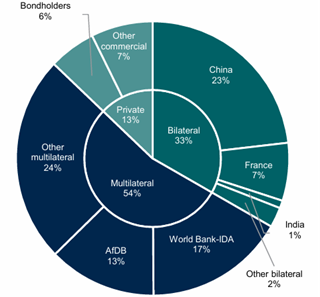
Cameroon Public and publicly guaranteed debt (World Bank, IDR 2025)
Cameroon’s 2024 external debt stock stood at US$15.77 billion. Most of this is owed to official creditors, especially multilateral lenders: US$6.07 billion to multilaterals versus US$4.65 billion to bilateral. This matters because multilaterals are more likely to supervise, co-finance, or provide technical support than to serve as classic debt-swap counterparties.
Cameroon Public and publicly guaranteed debt (World Bank, IDR 2025)
The most realistic bilateral candidates are China and France. China is Cameroon’s largest bilateral creditor, accounting for roughly 70% of bilateral debt in the IDR profile. However, China has generally favored new lending, rescheduling, and infrastructure finance over debt relief. France is smaller, but more institutionally plausible because AFD already operates the C2D debt-reduction/development mechanism in Cameroon. Since AFD’s Cameroon strategy already covers climate action, forests, flood prevention, hydropower, agroecology, and food security, a debt-for-climate swap with France could be framed as an extension of an existing cooperation tool.
Some potential areas of partnership are:
| French Interest | Potential Cameroon commitment |
| Sustainable forest and biodiversity management | Congo Basin forest conservation, community forestry, anti-deforestation monitoring |
| Flood-risk prevention | Drainage and flood-resilience projects in Douala and Yaounde |
| Low-carbon energy transition | Hydropower and rural clean-energy access |
| Agroecology and food security | Climate-resilient agriculture in the Far North |
Conclusion
Cameroon does not have to choose between financing development and climate resilience. Both challenges are the same if viewed through a different lens. A debt-for-climate swap has the potential to address both without adding to an already constrained fiscal position. Ecuador has shown what a swap looks like at scale when backed by strong multilateral guarantees, and Gabon has shown, closer to home, both the promise and the limits of what these deals can deliver.
Cameroon’s creditor profile points towards a specific, plausible path forward: France, through AFD’s existing C2D mechanism, is a far more institutionally realistic partner than China, with its currently lending-oriented posture. A swap with France, therefore, would not be a new financial experiment for either side, but a natural extension of a relationship already built around several of the exact priorities a debt-for-climate deal is designed to serve. The recommendation is for Cameroon, through MINEPAT and MINFI, to begin exploratory dialogue with France and AFD now, using the existing C2D framework as the entry point, with a first phase focused on the areas of clearest mutual interest: Congo Basin forest conservation and climate-resilient agriculture in the Far North.
References
Agence Française de Développement. (2024). AFD and Cameroon. https://www.afd.fr/en/ressources/afd-and-cameroon-0.
Agence Française de Développement. (2025). Cameroon. https://www.afd.fr/en/countries-regions/cameroon
Bloomberg. (2023). Gabon wraps up $680 million debt-for-nature swap. The Straits Times. https://www.straitstimes.com/world/gabon-wraps-up-680-million-debt-for-nature-swap.
C2D Cameroon. (n.d.). What is C2D all about? https://www.c2d-cameroun.cm/index.php/en/cd2-cameroon/what-is-c2d-all-about.
Debt for Climate Swaps Database. (n.d.). Debt for climate swaps. https://www.debtforclimate.com.
Directorate General of Budget. (2025). Citizen budget 2026: English version. https://www.dgb.cm/wp-content/uploads/2025/12/CITIZEN-BUDGET-2026_-ENGLISH-VERSION.pdf. .
International Monetary Fund. (2024). Cameroon: Request for an arrangement under the Resilience and Sustainability Facility—Press release; staff report; and statement by the Executive Director for Cameroon (IMF Country Report No. 24/53). https://rapports.investiraucameroun.com/api/file/download/zWK59kAon0sIISZMJbqaWEMoCPfjSy_1722780423730_PpoBR457Sb2aQVYPH1uc16wPhZVhnx.pdf.
International Monetary Fund. (2024). Climate change in Cameroon: Key challenges and reform priorities. In Cameroon: Selected issues (IMF Country Report No. 24/52). https://www.elibrary.imf.org/view/journals/002/2024/052/article-A003-en.xml.
Jones, M., & Campos, R. (2023). Ecuador seals record debt-for-nature swap with Galapagos bond. Reuters. https://www.reuters.com/world/americas/ecuador-seals-record-debt-for-nature-swap-with-galapagos-bond-2023-05-09.
Ministry of Economy and Finance. (2023). Government of Ecuador announces debt for nature swap operation to preserve Galapagos Islands’ biodiversity. https://ire.finanzas.gob.ec/content/2023/05/16.05.2023_Debt_for_Nature.pdf.
Miriri, D., & Chen, L. (2024). China stops short of Africa debt relief as it pledges more cash. Reuters. https://www.reuters.com/world/china-stops-short-africa-debt-relief-pledges-more-cash-2024-09-07.
Stephenson, P. K. (2025). Trapped in green debt: Debt for climate swaps are not enough. African Climate Wire. https://africanclimatewire.org/2025/05/trapped-in-green-debt-debt-for-climate-swaps-are-not-enough.
United Nations Environment Programme. (n.d.). Climate change: Cameroon. Interactive Country Fiches. https://dicf.unepgrid.ch/cameroon/climate-change.
World Bank. (2025). International debt report 2025. https://openknowledge.worldbank.org/server/api/core/bitstreams/b097dece-76e1-4f68-a74b-79f0a9f0e8e9/content.
World Bank Group. (2022). Cameroon Country Climate and Development Report. https://doi.org/10.1596/38242.
Author
Moukam Jules
Research Analyst