How Can We Build a Tax System That Supports Entrepreneurship in Cameroon?
October 24, 2026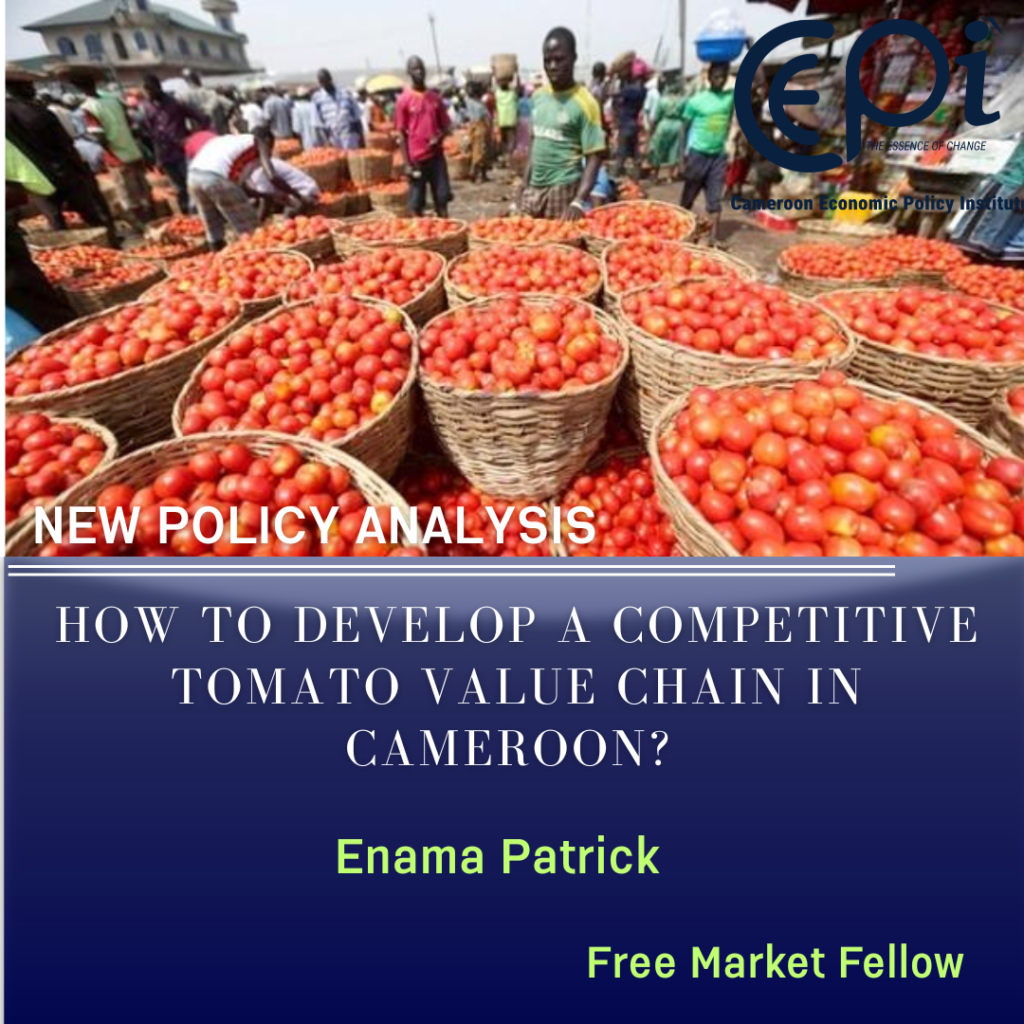
Introduction
Agriculture plays a vital role in Cameroon’s economy, but its transformation potential is underexploited. In this context, the development of agribusiness is a key driver for diversifying sources of income, creating jobs, and strengthening food self-sufficiency. Despite significant production, the tomato sector continues to face structural challenges related to financing, infrastructure, production techniques, and insufficient processing capacity (Kouam & Tassah, 2025). These constraints limit producers’ competitiveness, contribute to post-harvest losses, and undermine producers’ incomes. Therefore, how can Cameroon’s tomato sector be made more competitive and sustainable? This policy brief analyzes the main obstacles and their economic and social consequences, then proposes measures to develop a more agile and responsive tomato value chain.
Section 1. A Sector with High Potential Hindered by Structural Obstacles
Agriculture employs nearly 60 % of the country’s labor force, while accounting for approximately 11.5 % of gross domestic product (GDP) (Food and Agriculture Organization of the United Nations, FAO; World Bank (2026)). It faces limited access to markets, information, and farming tools; the tomato sector shares these same challenges and is no exception (Nkouadjio, 2018). As part of its National Development Strategy 2030, Cameroon aims for the structural transformation of the economy, particularly through agro-industry, the modernization of agriculture, and the marketing of agro-industrial production in foreign markets. Crops such as cotton, cocoa, bananas, and rubber, despite their high production volumes, do not contribute sufficiently to the national economy because they are often sold in their raw state, without processing, and remain subject to price volatility on the international market.
The tomato sector thus presents itself as a high-value-added alternative. However, the tomato sector struggles to be competitive, as it faces numerous structural challenges that have serious consequences. It can boost food security, support artisanal and small-scale farmers and encourage a more resilient food system in Cameroon. Family farms face limited production capacity due to poor access to credit and agricultural inputs (fertilizers, improved seeds, technologies, etc.), the use of rudimentary and artisanal techniques, and the isolation of production areas, which leads to significant post-harvest losses (FAO, 2016).
As for medium- and large-scale farms, they continue to face difficulties in accessing land and operate in an unfavorable business climate with poor digitization and complicated procedures as part of their daily realities. Compounding these challenges are the lack of transportation routes from production areas to the end consumer and natural disasters linked to climate change, which disrupt planting seasons. Furthermore, limited access to high-productivity technologies, the limited dissemination of research findings, a lack of training in modern cultivation techniques, the absence of industries that process tomatoes into value-added products, and increased price volatility in the market—driven either by production costs or by demand—are hindering the development of the tomato sector. The absence or ineffectiveness of public policies significantly contributes to slowing the momentum of the tomato sector, with real repercussions on the economy.
Section 2. Economic and Social Consequences Calling for a Sustainable Public Policy
These challenges have serious economic and social consequences. The poverty rate, for example, is projected to reach 23.3% in 2025, according to the World Bank/IBRD Report on the Economic Situation in Cameroon. The tomato sector, which is largely unindustrialized, is suffering heavy losses. In 2023, annual production stood at 1.2 million metric tons, accounting for nearly 27% of total vegetable production (Kouam & Tassah, 2025). Food insecurity is also a major problem, especially in rural areas, affecting 22% of the population according to the 2020–2030 National Development Strategy (SND30).
Fluctuations in tomato prices on the market create social risks: discontent, loss of profits, and indebtedness. They can also weaken the economic fabric, hinder growth, reduce efficiency, expose the population to health risks, and increase dependence on foreign sources, thereby disrupting the trade balance. In addition, there are indirect costs, such as the relocation of businesses, external economies, the crowding-out effect, and opportunity costs. These problems show that there is no clear public policy for the tomato sector, unlike other crops such as cocoa, bananas, and coffee, which receive tailored support measures to help them grow and gain a foothold in the international market. It is impossible to be competitive without a regulatory framework and a well-defined public policy.
Section 3. Measures Needed to Develop a Competitive Tomato Supply Chain
To develop a competitive tomato supply chain in Cameroon, close collaboration is needed among producers, transporters, traders, and public authorities. Over the next five years, the objectives are to build tomato paste processing plants, rehabilitate the roads connecting the production basins, and revitalize the Noun Food Canning Company (SCAN). It is also important to facilitate access to agricultural financing, encourage public-private partnerships, improve seed quality with support from IRAD, and strengthen training for producers in modern techniques.
Promoting AgriTech can help increase productivity, reduce post-harvest losses, and improve marketing. Furthermore, reducing trade barriers and strengthening certification through ANOR would provide better access to regional markets, particularly within the framework of the AfCFTA. With an average yield of twenty metric tons per hectare, tomatoes offer significant potential to support farmers’ incomes, create jobs, and strengthen food self-sufficiency. However, to remain competitive, production must scale up, appropriate investments must be made, and coherent public policies must be adopted.
The development of this sector must also balance economic efficiency with environmental protection by limiting deforestation and the harmful effects of pesticides. These actions would enable Cameroon to better leverage its local production, reduce its dependence on imports, and sustainably strengthen its agribusiness sector.
Conclusion
Ultimately, developing a competitive tomato sector offers Cameroon a real opportunity to strengthen its agribusiness, create jobs, and reduce its dependence on imports. But this potential cannot be realized without significant investments in infrastructure, product processing, agricultural research, and access to financing. The authorities must therefore adopt a clear and coherent policy, directly involving producers, investors, and all other stakeholders in the value chain. By encouraging innovation and promoting sustainable agricultural practices, it is possible to improve productivity while protecting the environment. By placing greater emphasis on its local production, Cameroon will be able to increase farmers’ incomes, strengthen its food security, and foster more equitable and sustainable economic growth.
References
Banque mondiale. (2026). Emploi dans l’agriculture (% de l’emploi total) — Cameroun. Indicateurs du développement dans le monde. https://donnees.banquemondiale.org/indicateur/SL.AGR.EMPL.ZS?locations=CM
Banque mondiale. (2026, 25 juin). Agriculteurs connectés, récoltes améliorées : les innovateurs de l’Agritech au Cameroun transforment l’agriculture. https://www.banquemondiale.org/fr/news/feature/2026/06/25/connected-farmers-better-harvests-how-cameroon-agritech-innovators-are-transforming-agriculture
Banque mondiale. (2026). État des lieux de l’économie africaine : faire aboutir les politiques industrielles en Afrique. Washington, DC : Banque mondiale. https://www.wathi.org/laboratoire/choix_de_wathi/etat-des-lieux-de-leconomie-africaine-faire-aboutir-les-politiques-industrielles-en-afrique-banque-mondiale-avril-2026/
Banque mondiale Cameroun. (2026). Agriculteurs connectés, récoltes améliorées : les innovateurs de l’AgriTech au Cameroun transforment l’agriculture. https://www.banquemondiale.org/fr/news/feature/2026/06/25/connected-farmers-better-harvests-how-cameroon-agritech-innovators-are-transforming-agriculture
Institut de formation de l’agriculture et technologies innovantes. (2024). https://www.minader.cm/wp-content/uploads/2022/03/TOMATE.pdf
Institut national de la statistique. (2025). Revenus et consommation, statistiques démographiques et sociales, publication Cameroun. https://ins-cameroun.cm/
Kouam, H., & Tassah, I. (2025). Réduction des pertes après récolte et du gaspillage alimentaire dans les filières agroalimentaires de manioc et de tomate au Cameroun. Institut de politique économique du Cameroun, Fondation Henri Kouam. https://camepi.org/wp-content/uploads/2025/12/Reduction-des-pertes-Alimentaires-apres-Recolte-dans-les-Filieres-Manioc-et-Tomate-au-Cameroun.pdf
Ministère de l’Économie, de la Planification et de l’Aménagement du territoire. (2020). Stratégie nationale de développement (SND30). Yaoundé : MINEPAT. https://minepat.gov.cm/wp-content/uploads/2022/04/Strategie-Nationale-de-Developpement-SND30_Fench.pdf
Nkouadjio Mbomda, F. (2018). Cameroun, culture des tomates : les objectifs des producteurs échouent en décembre. https://www.camer.be/cameroun-culture-des-tomates
World Bank. (2026). Agriculture, Fisheries and Forestry as a Percentage of GDP. https://data.worldbank.org/indicator/NV.AGR.TOTL.ZS?locations=CM
Author
Enama Patrick
Free Market Fellow