Rethinking Business Creation Policies in Cameroon to Stimulate Youth Entrepreneurship
November 9, 2026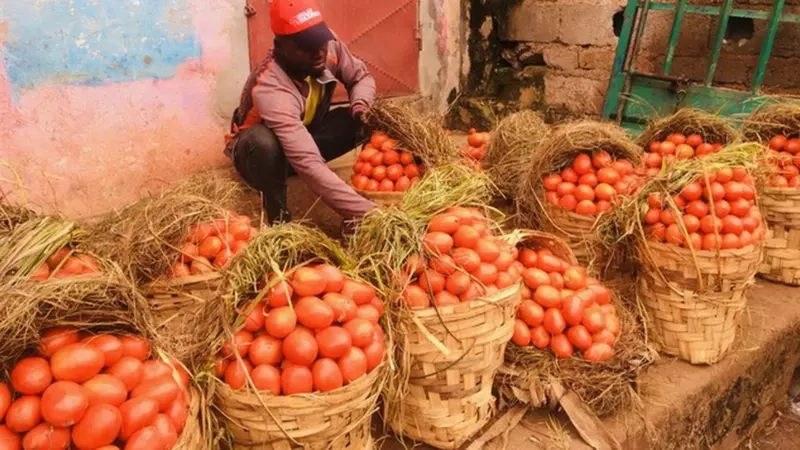
Introduction
The tomato is one of the great paradoxes of Cameroonian agriculture. The country has significant production potential, several production basins, and a vast domestic market (DataCameroon,2026). However, producers face recurring difficulties: highly volatile prices, post-harvest losses, weak bargaining power, a lack of storage and processing infrastructure, and limited access to stable industrial outlets. The available data indicate that the problem does not stem solely from low production levels. In 2020, national tomato production was estimated at around 1.1 million tonnes. In 2022, it stood at around 1.2 million tonnes. These figures show that there is indeed a significant production base ( MINADER, 2023 )
However, the real problem lies between the farm and the factory. Fresh tomatoes are very perishable. Conversely, a processing industry requires regular volumes, consistent quality, suitable varieties, and reliable logistics. Losses are generally linked to transport conditions, inadequate packaging, mishandling, and a lack of post-harvest infrastructure. The purpose of this paper is to understand the structural deficit, then to develop the missing industrial framework, to analyse how to move from import substitution to a competitive tomato industry, and finally to put forward recommendations.
1. Understanding the Structural Shortfall
Cameroon’s agricultural policy often approaches the tomato sector from a production perspective: improving seeds, increasing the use of inputs, strengthening technical advice, developing irrigation and boosting yields. These measures are important, but they are not enough. The fundamental problem is that agricultural production is not sufficiently organised around predictable industrial demand. The current supply chain remains largely fragmented. Producers decide for themselves what to plant. Middlemen buy according to market conditions. Wholesalers arrange transport and retailers mainly sell fresh tomatoes. When harvests arrive on the markets simultaneously, supply rises sharply whilst processing capacity remains limited.
Under these conditions, the more abundant the production, the more prices may fall; the more prices fall, the more producers are forced to sell quickly; the more quickly they sell, the more losses and waste increase ( Tekam F., 2026 ). Post-harvest losses must therefore be regarded as an industrial problem as much as an agricultural one. Every tomato lost represents not only a loss for the farmer, but also a loss of labour, water, fertiliser, transport and capital. Main production areas are located far from industrial facilities and major markets. MINADER itself has identified improvements in processing, stakeholder organisation and infrastructure as priorities for the sector.
2. Building the Missing Industrial Infrastructure
The priority is to move away from a model of proliferating small, isolated factories in favour of tomato industrial corridors. An industrial corridor links a production area to collection centres, quality control facilities, suitable transport links and one or more processing units. However, it must not be forgotten that building a factory is not enough. A factory without a regular supply of produce quickly becomes underutilised.
The second priority is therefore to develop industrial contract farming. Processors should enter into contracts with producer organisations before the start of the growing season. These contracts will specify expected volumes, varieties, quality standards, delivery periods and pricing rules. Producers will thus gain a more secure market outlet, whilst processors will secure their supply.
The third priority concerns industrial varieties. A tomato intended for the fresh market does not necessarily possess the characteristics sought by a processing plant. The industry must have access to varieties that offer, in particular, high industrial yield, good dry matter content, suitable colour, sufficient resistance to handling, and qualities that enable a greater quantity of processed product to be obtained per kilogramme of raw material.
The fourth priority is to establish modern collection centres that handle weighing, sorting, grading, packaging, temporary storage and the digital transmission of data to processors ( FAO, 2016 ). These centres would reduce handling and losses, whilst effectively linking producers and the industry.
3. Moving from Import Substitution to a Competitive Tomato Industry
Cameroon’s import-substitution strategy offers an opportunity to develop the agri-food processing sector. Market garden produce is one of the sectors that can help reduce dependence on imports. However, market protection must not be confused with industrial competitiveness, as an industry that survives solely on the back of trade barriers is not truly competitive. Cameroon must instead aim for a competitive import substitution. In other words, Cameroonian products must gradually replace imported products because they are competitive in terms of price, quality, availability, and suitability to consumer tastes. This strategy must then be extended to the regional market. A processor that produces exclusively for the Cameroonian market may struggle to achieve sufficient scale. By contrast, a factory designed from the outset to supply Cameroon, Chad, the Central African Republic, Congo, Gabon and other countries has much greater commercial potential.
4. Recommendations
Establishing a national tomato information system
MINADER, the INS, MINCOMMERCE and the customs authorities should set up a National Tomato Observatory.
This would monitor cultivated areas, production volumes, prices, imports, exports, processing capacity and periods of availability. This would enable an investor to decide where to build a factory, what capacity to install or how many producers to contract.
Create pilot processing corridors
The government should identify two or three regions offering the best conditions in terms of production, market access and infrastructure.
It would be preferable to concentrate public resources on a few sufficiently large hubs rather than funding a multitude of small units operating well below capacity.
Developing financing specifically tailored to the sector
Funding must cover not only industrial equipment but also working capital. A factory must purchase tomatoes before it can sell its finished products. Financial institutions could therefore offer lines of credit conditional on the existence of contracts between processors and producer organisations. This approach would simultaneously resolve the issue of financing for farmers and that of supply for processors.
Turning tomatoes into a regional export product
Cameroon should utilise the AfCFTA and CEMAC to facilitate the movement of processed products.
The aim would be to make Cameroon not only a tomato producer, but also a regional supplier of processed tomato-based food products.
Conclusion
The industrialisation of the tomato sector could become a key driver of agricultural transformation in Cameroon. The country already produces a significant quantity of tomatoes, but much of their value is lost due to difficulties with storage, transport, organisation and processing. It is therefore necessary to better link producers to markets and industries. Creating processing corridors, entering into contracts with producers, improving crop varieties and establishing collection centres can help to strengthen this sector. Under these conditions, Cameroon will be able to reduce certain imports, create jobs, increase producers’ incomes and gain greater access to the CEMAC and AfCFTA markets.
References List
Ambombo, M. (2025). Tomato production: The West in search of resilient methods. DataCameroon. https://datacameroon.com/production-de-la-tomate-louest-a-la-recherche-des-methodes-resilientes/
Cahiers Agricultures. (2020). Article 26. Cahiers Agricultures, 29, 26. https://www.cahiersagricultures.fr/articles/cagri/full_html/2020/01/cagri200047/cagri200047.html
Data Cameroon. (2026). Tomatoes: Foumbot facing overproduction, 25 years after the closure of SCAN. Data Cameroon. https://datacameroon.com/tomate-foumbot-en-surproduction-25-ans-apres-la-fermeture-de-la-scan/
Fall, A. A., David-Benz, H., Huat, J., & Wade, I. (2010). Local tomatoes and tomato paste production: The strength of contracts between farmers and industry. In G. Duteurtre, M. D. Faye, & P. N. Dieye (Eds.), Senegalese agriculture put to the market test (pp. 197–215). Karthala. https://www.academia.edu/16297538/Tomate_locale_et_production_de_concentr%C3%A9s_la_force_des_contrats_entre_paysans_et_industrie
Maison Agricole. (2026 can formalise a large proportion of the informal sector’s 50 billion dollars (Kofi Ocran et al.). Tomato cultivation in Cameroon: Cost, budget and profitability per hectare in 2026. https://maisonagricole.com/agriculture/culture-de-la-tomate-au-cameroun-cout-budget-et-rentabilite-d1-hectare-en-2026/
Mbahe, R. E. (2016). Development of a strategy to reduce food losses for smallholder farmers in Africa: Regional workshop on sharing experiences of post-harvest loss reduction initiatives: Final report. FAO. https://www.fao.org/fileadmin/user_upload/food-loss-reduction/Report_of_Douala_Post_Harvest_Meeting.pdf
Meli, G. (2022). Agribusiness: a fresh tomato processing plant coming soon to Maroua. Fabrik Aliments. https://www.fabrikaliments.com/usine-transformation-tomate-cameroun/
Ministry of Agriculture and Rural Development (MINADER). (2023). Statistical Yearbook of the https://fr.scribd.com/document/947614824/Annuaire-Statistique-Cameroun-2022-1
Njume, C. A., Ngosong, C., Krah, C. Y., & Mardjan, S. S. (2020). The tomato food value chain: Managing post-harvest losses in Cameroon. IOP Conference Series: Earth and Environmental Science, 542, 012021. https://doi.org/10.1088/1755-1315/542/1/012021
Tomato cultivation strategy in Cameroon. Lecture Bleu Collection No. 03: Micro-project idea – Tomato cultivation: technical and financial framework. Scribd. https://fr.scribd.com/document/910910686/Bleu-tomate-S-P
Tekam, F. (2026). Tomato prices plummet in Cameroon. Pressenza. https://www.pressenza.com/fr/2026/02/le-prix-de-la-tomate-seffondre-au-cameroun/
Cameroon: Agricultural value chain competitiveness study. Washington, DC: World Bank. World Bank Documents. https://documents.worldbank.org/en/publication/documents-reports/documentdetail/117901468222576023
World Bank. (2026). Connected farmers, better harvests: How Cameroon’s agritech innovators are transforming agriculture. https://www.worldbank.org/en/news/feature/2026/06/25/connected-farmers-better-harvests-how-cameroon-agritech-innovators-are-transforming-agriculture
World Integrated Trade Solution (WITS). (2026). Cameroon trade data. World Bank/UN Comtrade. WITS – World Bank. https://wits.worldbank.org/trade/comtrade/en/country/All/year/2024/tradeflow/Imports/partner/CMR/product/200290
Authors
Haiwang Djamo, National Coordinator/Research Analyst
Mbarga Guy Wangso, Research Analyst