The Role of the AfCFTA in Advancing Food Security in Central Africa
May 23, 2026
Prices will Rise for Consumers After Government Import ban on Corn/Maize
June 2, 2026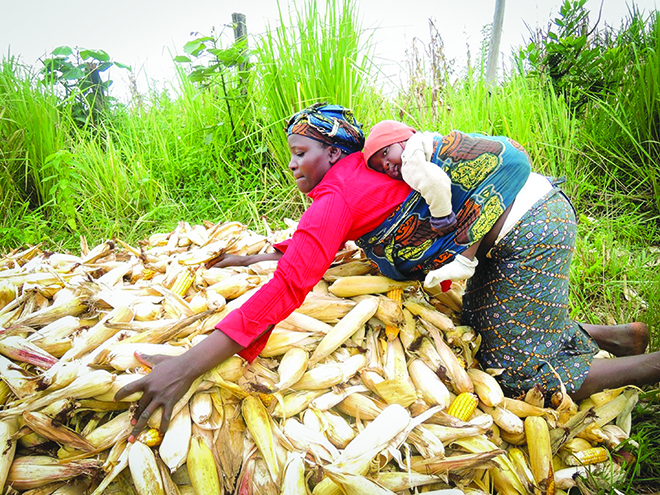
Introduction
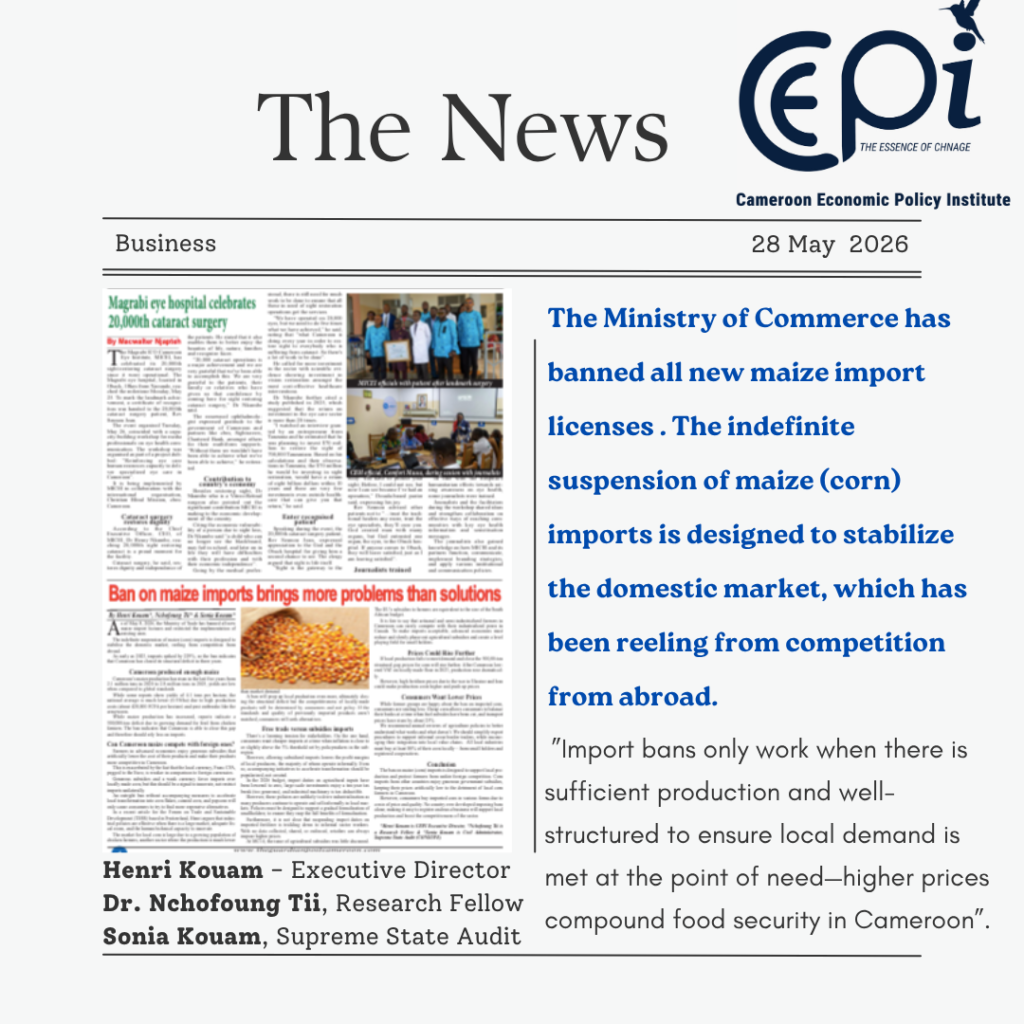
As of May 8th 2026, the Ministry of Commerce has banned all new maize import licenses and restricted the implementation of existing ones. The indefinite suspension of maize (corn) imports is designed to stabilize the domestic market, which has been reeling from competition from abroad. The Official Correspondence – No. 0424/MNCOMMERCE/GAB follows a high-level interministerial meeting chaired by the Prime Minister. While global maize imports have risen dramatically over the last year, Cameroon appears to be producing large quantities of corn used by households to make corn fufu, pap, and corn chaff, among other things.
While local harvests are overflowing and there are concerns that prices could fall and hurt farmers at a time when fertilizer prices are under strain due to the Iran war, it is premature and does not address a longstanding structural issue. Import bans are reminiscent of current U.S. policy, but while corn farmers celebrate, this policy masks a chronic lack of industrialization in the sector. As early as 2023, imports spiked by 229%, so the ban indicates that Cameroon has closed its structural deficit in three years.
Cameroon Produced Enough maize
Cameroon’s maize production has risen in the last five years from 2.1 million tons in 2020 to 2.8 million tons in 2025 (Fig.1). The main production basins are located in the Northern provinces (Bénoué, Mayo Rey, and Mayo Kani), but yields are low when compared to global standards. While some reports show yields of 4.1 tons per hectare, the national average is much lower (0.55t/ha) due to high production costs (about 428,000 FCFA per hectare) and pest outbreaks like the armyworm.
While maize production has increased, reports indicate a 500,000-ton deficit due to growing demand for feed from chicken farmers. The ban indicates that Cameroon is able to close this gap and therefore should rely less on imports. However, Cameroon has a complicated history with bans. Twice when it restricted imports of chicks from the EU, importers shifted to Brazil to make up for lost imports. Meanwhile, previous bans of maize proved unsuccessful due to ever-growing demand needs. Furthermore, maize-related imports are rarely in the raw form, as well-heeled Cameroonians rely on canned corn from France and the EU for salads as well as pre-made popcorn.
Can Cameron maize compete with foreign ones?
Admittedly, farmers in advanced economies enjoy generous subsidies that artificially lower the cost of their products and make their products more competitive in Cameroon. This is exacerbated by the fact that the local currency, the Franc CFA, pegged to the Euro, is weaker in comparison to foreign currencies. Generous subsidies and a weak currency favor imports over locally made corn, but this should be a signal to innovate, not restrict imports unilaterally.
Agricultural products are sensitive to external factors and price swings, making the ban a welcome gift for local corn farmers. Even so, an outright ban without accompanying measures to accelerate local transformation into corn flakes, canned corn, and popcorn will only cause consumers to try to find more expensive alternatives. In a recent article for Swiss-based TESS, Henri argues that industrial policies are effective when there is a large market, adequate fiscal room, and the human/technical capacity to innovate. The market for local corn is large due to a growing population of chicken farmers, another sector where the production is much lower than market demand.
Ultimately, Cameroon producers will need to transform corn into products that consumers already consume to ward off foreign competition. Growing demand from poultry farmers and a more sophisticated consumer require a more industrialized corn sector.
A ban will prop up local production even more, ultimately closing the structural deficit, but the competitiveness of locally-made products will be determined by consumers and not policy. If the standards and quality of previously imported products aren’t matched, consumers will seek alternatives.
Free Trade Versus Subsidies Imports
There’s a looming tension for stakeholders. On the one hand, consumers want cheaper imports at a time when inflation is close to or slightly above the 3% threshold set by policymakers in the sub-region. However, allowing subsidized imports lowers the profit margins of local producers, the majority of whom operate informally. Even so, accompanying initiatives to accelerate transformation should be popularized, not created.
In the 2026 budget, import duties on agricultural inputs have been lowered to zero, large-scale investments enjoy a ten-year tax break (too generous), and industrial machinery is tax-deductible. However, these policies are unlikely to drive industrialization as many producers continue to operate and sell informally in local markets. Policies must be designed to support a gradual formalization of smallholders, to ensure they reap the full benefits of formalization. Furthermore, it is not clear that suspending import duties on imported fertilizer is trickling down to informal sector workers. With no data collected, shared, or enforced, retailers can always impose higher prices.
At MC14, the issue of agricultural subsidies was little discussed. The EU’s subsidies to farmers are equivalent to the size of the South African budget. It is fair to say that artisanal and semi-industrialized farmers in Cameroon can rarely compete with their industrialized peers in Canada. To make imports acceptable, advanced economies must reduce and slowly phase out agricultural subsidies and create a level playing field for small holders.
Prices Could Rise Further
If local production fails to meet demand and close the 500,00-ton structural gap, corn prices will rise further. However, there is plenty of evidence that farmers tend to scale production when they are certain about market demand. After Cameroon lowered VAT on locally made flour in 2023, production rose dramatically
Farmers already face higher fertilizer prices due to the Iran war, and while they can switch to regional alternatives in Morocco, South Africa, and Nigeria, this imposes higher costs for small holders who are subject to a mix of external factors, ranging from higher shipping costs to divergent retail prices. The war in Iran has increased oil prices and shipping costs due to the closure of the Strait of Hormuz, reducing the gains of zero import duties on imported fertilizer.
Consumers Want Lower Prices
While farmer groups are happy about the ban on imported corn, consumers are smiling less. Cheap corn allows consumers to balance their books at a time when fuel subsides have been cut, and transport prices have risen by about 25%. Lower corn prices improve disposable incomes and improve food security in a country where 3 million people are at risk of acute food insecurity. Ultimately, the price of food crops like corn and cassava has a direct impact on household feeding preferences and standards of living. Propping up one industry at the expense of consumers is a short-term measure that ignores broader dynamics. If Cameroon’s corn sector is competitive enough to close a structural deficit in three years, it can ward off foreign competition – let consumers decide.
Conclusion
The ban on maize (corn) imports is designed to support local production and protect farmers from unfair foreign competition. Corn imports from other countries enjoy generous government subsidies, keeping their prices artificially low to the detriment of local corn farmers in Cameroon. However, consumers buy imported corn in various forms due to a mix of price and quality. No country ever developed imposing bans alone; making it easy to register and run a business will support local production and boost the competitiveness of the sector.
Henri Kouam, CEPI, Founder & Executive Director,
Dr. Nchofoung Tii , Economist & Research Fellow, CEPI
Sonia Kouam, Civil Administrator, Supreme State Audit
Appendix 1: Newspaper Article in Print