
A Simplified Trading Regime Will Unlock AfCFTA Trade in Central Africa – Faster
May 3, 2026
Free Market Reforms Will Unleash the True Gains of the AfCFTA
May 11, 2026
“AI-driven workplace transformations could exacerbate gender disparities.”
Introduction
There is no historical precedent for any technology that has exacerbated inequalities, but artificial intelligence (AI) could reshape the socio-economic landscape and further exclude women from economic and social life in Cameroon. The development of AI is a double-edged sword as it offers opportunities for empowerment but could also reinforce existing inequalities. The government has recognized this and aims for a workforce that is 40% female by 2040. This policy brief analyses how AI could potentially shape entrepreneurship and social life for women in Cameroon. In Part I, we analyze women’s role in socio-economic progress in Cameroon, followed by the factors promoting or limiting the use of AI and their implications in Section III. We conclude with policy recommendations and a brief conclusion.
i. How do Cameroonian Women Contribute to the Economy
In Cameroon, women are more entrepreneurial than men, especially in the informal sector where they are mostly employed. The Institute for National Statistics (INS) finds that 7 out of 10 women (68.3%) work independently, compared to 48.2% of men. Furthermore, women lead 23% of small and medium-sized manufacturing enterprises (SMEs) and 31% of micro-enterprises despite making up 51% of the population (CEPI, 2025). Furthermore, women’s labor force participation rate in Cameroon is estimated at 70.2% in 2021, well above the average for Sub-Saharan Africa. Furthermore, women in Cameroon dominate the industrial (57.8%) and commerce (53.4%) sectors while making up 51.4% of the informal sector workforce according to CEPI research.
From a tech standpoint, women make up 18-20% of workers in the tech sector despite facing a significant gender gap in internet use and access to ICT infrastructure, especially for rural women. Furthermore, only 3% of women in the IT sector hold executive positions, which is not surprising, as only 23.4% of women entrepreneurs in the Northwest and Southwest regions have access to ICT infrastructure. Rural women face glaring challenges in technology access due to social norms, connectivity issues, and affordability.
ii. How is AI Impacting Women?
To understand how AI could impact women, it is important to recognize key challenges they face, such as a significant gender gap in internet use and access to ICT infrastructure, particularly for rural women. Additionally, social norms, a lack of female role models, and stereotypes about abilities in technology further contribute to these low statistics. The Gender gap in internet access is wide, with women constituting only 31% of internet users compared to 69% for men. Furthermore, previous research finds that a mere 12% of Cameroonian women possessed basic digital skills, in contrast to 25% of men. Finally, more men use social media than women, as illustrated below.
Figure 1: Women Versus Male Social Media Users in Cameroon
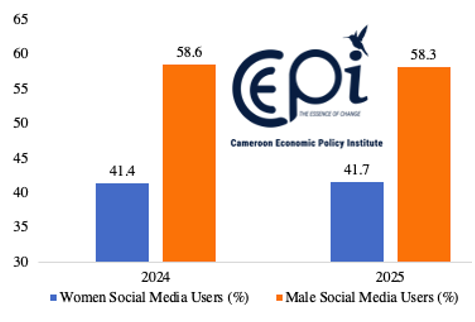
Source: Data Reportal & Cameroon Economic Policy Institute (CEPI)
As a result, we expect AI to boost productivity for women developers, students, and professionals. AI could boost women’s productivity by up to 40%, but mediating for localised factors means that productivity could increase by 25-40% for text-related tasks and by 5-10% for video-related tasks due to the high cost of subscriptions for AI-related video creation tools. Except for women who work in formal jobs, there’s no noticeable impact on women’s output from AI applications. However, the increase in social media users translates to greater access to AI tools such as Grok on X, Meta AI, etc. We caution against overoptimism as access to synthesized information through large language models does not translate into higher levels of productivity.
iii. Socio-economic implications of AI for women
AI could exacerbate the digital divide, as nearly 1 in 3 girls in Cameroon are married by 18 and drop out of school early. The socio -economic impact on girls could be profound, as the percentage of girls out of school in Cameroon is higher than that of boys, with girls facing lower enrollment and higher dropout rates. In 2019, about 84% of girls were enrolled in primary schools versus 93% of boys. Meanwhile, the dropout rate for girls was higher (11%), while only 8% of boys were dropouts in 2018. Furthermore, women in Cameroon spend 15.8% of their day on unpaid work versus 4.6% for men, which could further exacerbate the imbalance imposed on women by AI.
AI could impact women’s productivity less than their male counterparts: Most women in the workforce are employed in sectors that require low qualifications, driven by the gap in education they receive compared to men. Women are also likely to marry early or drop out, making them less suited to the jobs available in the labor market. While professional training exists, only 21.6% of women have received professional training compared to 28.6% of men.
Limited Opportunities for Women in the Digital Economy: The lack of equitable training limits women’s employment opportunities, keeping them in the informal sector and non-agriculture sector. As women make up 54.3% of the workforce, compared to 50.2% for men, the digital divide could have a more profound impact on them. However, we maintain that women in the tech sector stand to benefit.
AI will boost the wages of Formal Sector Employees: For female employees in the tech sector, AI will not directly raise their wages. This is because social partners negotiate the minimum age with employers, and this sets the foundations for negotiations across the industry. Based on current market trends, we can expect the wages of female tech employees to rise by 10 -25% over the next decade in Cameroon.
Promote Women’s Empowerment: AI will positively impact women over the long run by improving structural trends like higher school completion rates and falling school dropout rates. Meanwhile, programs from CEPI, Data Girl Technologies, All for Women, and the Henri Kouam Foundation are promoting inclusion by direct training and placement initiatives.
iv. Recommendations
- Mandate Gender-Inclusive AI Education: Policymakers must revise the national school curriculum to mandate early and gender-inclusive digital and AI literacy from primary school onward. This should focus on practical, problem-solving skills and ethical AI, ensuring content is culturally relevant and challenges existing gender stereotypes in STEM.
- Fund Mentorship & Guaranteed Internships: The private sector (especially technology, finance, and telecom companies) should commit to funding and implementing large-scale paid AI internship and apprenticeship programs specifically for young women with acquired AI skills. Policymakers can support this by offering substantial tax incentives for companies that verifiably hit internal gender-parity targets in their tech workforce.
- NGOs should prioritize establishing and managing safe, female-friendly “AI Learning Hubs” in rural and marginalized communities. These centers must offer free, reliable access to high-speed internet, modern computing equipment, and curated AI learning modules like machine learning and data science. Local policymakers (councils, regional authorities) should be required to ensure these hubs have stable electricity and security as a priority infrastructure investment.
- Create a Female AI Entrepreneurship Fund: This fund must offer dilutive grants, technical training, and business incubation services. The focus should be on ventures that use AI to address critical local development challenges (e.g., in agriculture, health, or education), creating visible role models and economic pathways for other girls.
Conclusion
The evidence clearly establishes a major challenge: while Cameroonian women drive a substantial portion of the economy, their minimal representation in the tech sector, at 18-20% of the workforce and only 3% of executive roles, risks perpetuating gender inequality in the future of work. This gap is critically linked to a lack of ICT access and digital infrastructure, particularly for rural women, alongside limiting social norms. As AI accelerates global transformation, this exclusion means AI systems developed without Cameroonian women’s input will likely embed existing biases. Therefore, targeted national efforts to close the digital divide and increase female leadership in AI are not just matters of equity, but essential for Cameroon’s inclusive, innovative, and sustainable economic future.
Authors;
Henri Kouam, Founder & Executive Director
Dr. Chefor Meungwe, Research Fellow
Dr. Annie Nkeng, Research Fellow