Cameroon suspends the Electronic Cargo Tracking Note (ECTN) on the Douala-N’Djamena and Douala-Bangui corridors
June 26, 2026
Harnessing the African Continental Free Trade Area to Accelerate Cameroon’s Agro-Industrial Transformation
July 20, 2026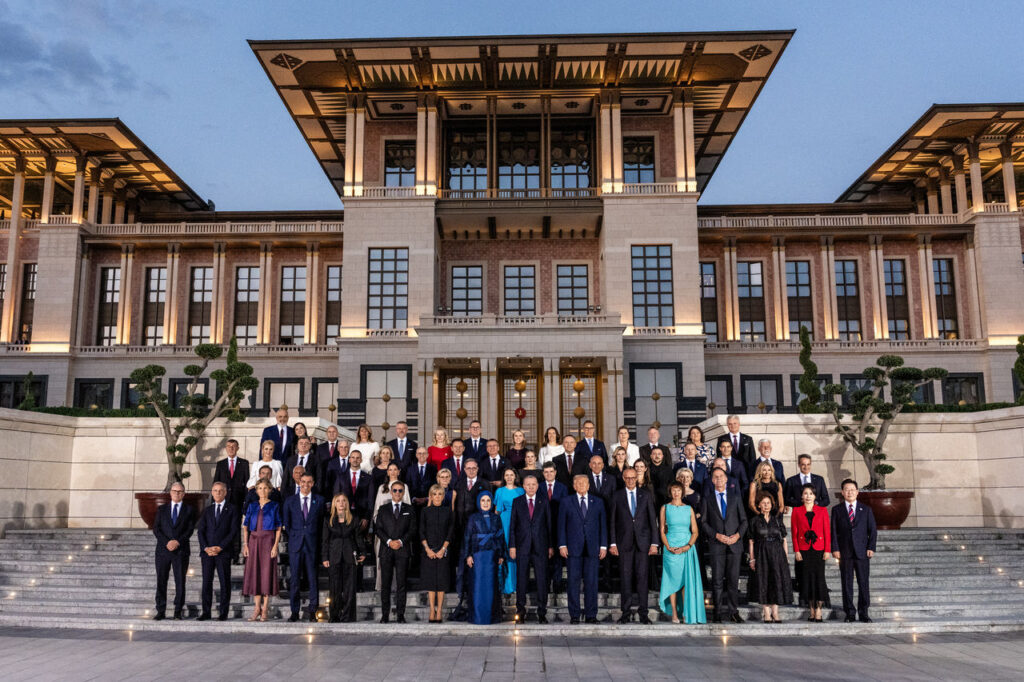
Key Highlights
- NATO allies re-commit to support Ukraine against Russia’s aggression.
- Europe has filled the Gap left by the U.S. Withdrawal of troops.
- NATO is in transition, but Article 5 was never at risk (In reality).
Introduction
NATO’s Ankara summit showed an alliance that has finally found its footing after transitioning since President Trump’s Second term. Europe and Canada are rebuilding military capabilities to fill the gap left by the withdrawal of U.S. troops. The true “transition” is in the development of new military and institutional arrangements that reflect the changing security paradigm.
No Public U.S. Disagreement, But Trump Mad About Lack of NATO Support
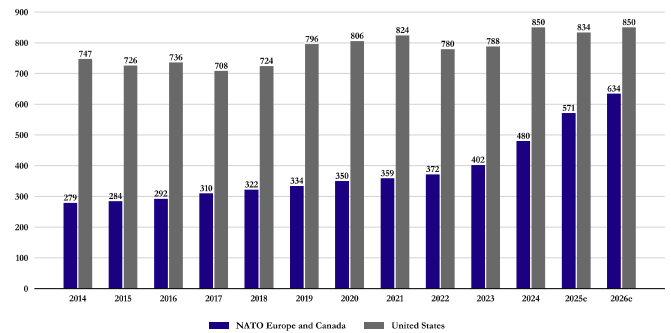
The U.S. President said he wanted Greenland, even as a working group is already in place to reassess U.S. involvement on the island. EU leaders avoided open confrontation and said little about it to ensure an ill-tempered Donald Trump doesn’t withdraw from the alliance altogether. In the end, he spoke of “love” and “unity”. Of course, NATO published a declaration that showed all allies are still committed to Article 5 simply because it is not clear that the U.S. can fend off Russia and China alone. So the U.S. needs Article 5 as much as any European ally. On the whole, the U.S. is still spending more than anyone else (figure 1), but that should not be the metric for any one NATO country.
Figure 1: The U.S. spends more – as it should given its multiple wars.
Source: NATO
The burden is shifting
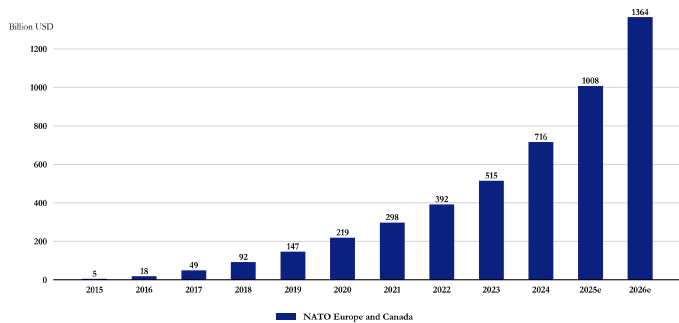
Europe and Canada are pulling their weight, spending over $570 billion, or 19% more than in 2024. If they maintain this trend, they will surpass the U.S. in the coming years, but spending alone is not enough. Where they spend this money matters as much. Europe must learn to buy European and prop up its defence sector as much as the U.S. has.
Figure 1: Extra-Core Spending ($, Billion)
Source: NATO
After European allies criticised President Trump’s war in Iran, he began withdrawing troops and equipment. Since then, Europe and Canada have filled 90% of the air defence gap left by the U.S. withdrawals. Europe must reclaim much of its defence, including spending, as it spends a significant part of its budget on U.S. equipment. This is not really
Europe Depends on the U.S. for Enablers
NATO has announced that it will acquire an A330 Multi-Role Tanker Transport aircraft, including Northrop Grumman Triton high-altitude long-endurance drones and Saab GlobalEye early warning control systems. All this falls under a fresh 50 billion USD requirement, which is a field day for the U.S. defence sector.
EU Allies pledged more support for Ukraine
European Allies pledged 70 billion euros for military equipment assitance, training for Ukraine for both 2026 and 2027. Much of the repackaging of the 40 billion pledge of long-term assitance agreed back in 2024. This included an EU support loan, but the EU and Canada have stepped in to replace the U.S. who withdrew its former contributions. Much of this is a repackaging of the 40-billion-euro pledge of long-term security assistance agreed at the Washington Summit in 2024 and allocations from the EU’s Ukraine support loan, but it underlines that by stepping up their own support, the European Allies and Canada have essentially replaced the contribution previously made by the US.
Ukraine will Manufacture Patriots — Create Licensing Fees for the US Defence Sector
President Zelenskyy was glad that Trump agreed to allow Ukrainians to manufacture Patriots. I hope for the Ukrainians he is referring ot th ecomplete system, because missiles alone are not very much help for Ukraine that can strike deeply into Russian territory. It will take some years for this to become a reality as legal requirments, infrastructure investment, and training must be completed before Ukraine can manufacture on its own. The Summit that took place in Paris a few days ago — the coalition of the willing — highlighted the need for Ukraine to find effective air and missile defence solutions. It anounced their intention to develop a separate integrated missile defence architecture for Europe.
Europeanisation: Mean Capabilities and Efficiency
The Europeanisation of NATO is well underway. But to avoid duplicative institutions and approaches, they should create avenues to act through the alliance without risk. However, the coalition of the willing and bilateral or EU-only initiatives should be used for defence and security initiatives that require withholding sensitive capabilities. Allies can work together without sharing all security and trade-related secrets. Higher defence spending and stronger capabilities are essential, but we must ensure that operational and defence planning processes are needed to improve response times, align command structures, and make sure that procurement is easier and more transparent.
A New Realism for NATO
Things will never be as they were — transatlantic divisions will take many decades to heal. European allies must now operate independently of the U.S. to create mutually reinforcing dependencies with the bloc. At our Monday meeting, when we spoke about global events, my resourceful colleagues noted that NATO must;
- Preserve arrangements that facilitate worldwide collaboration with partners.
- Prioritise domestic and regional security initiatives.
- Set timelines to develop certain technologies: anti-jamming drones, mobile sea launch capabilities, etc.
- Have separate European settings and operational strategies that do not depend on the Pentagon (URGENTLY).
We should celebrate the EU and Canada’s New Found Confidence
We should be cheerful, because an EU-centric NATO will be a glaring example of how to adapt from outdated alliances. Trump’s unproductive attacks in Iran show that not all is rosy for the U.S. Substantial investment and collective action on defence and security are allowing Europe to slowly reclaim its role as a global superpower.
Conclusion
The Ankara meeting declaration did not refer to a 2027 meeting, which is a sign that the EU and Canada are taking back control of their security and that NATO will become increasingly EU-facing over the long run. This is a boon for the EU and Canada that must accelerate joint work to improve capabilities at a time when middle powers must come together to face off against foreign powers.