Harnessing the African Continental Free Trade Area to Accelerate Cameroon’s Agro-Industrial Transformation
July 20, 2026
Cameroon’s Energy Transition Starts With Natural Gas
July 21, 2026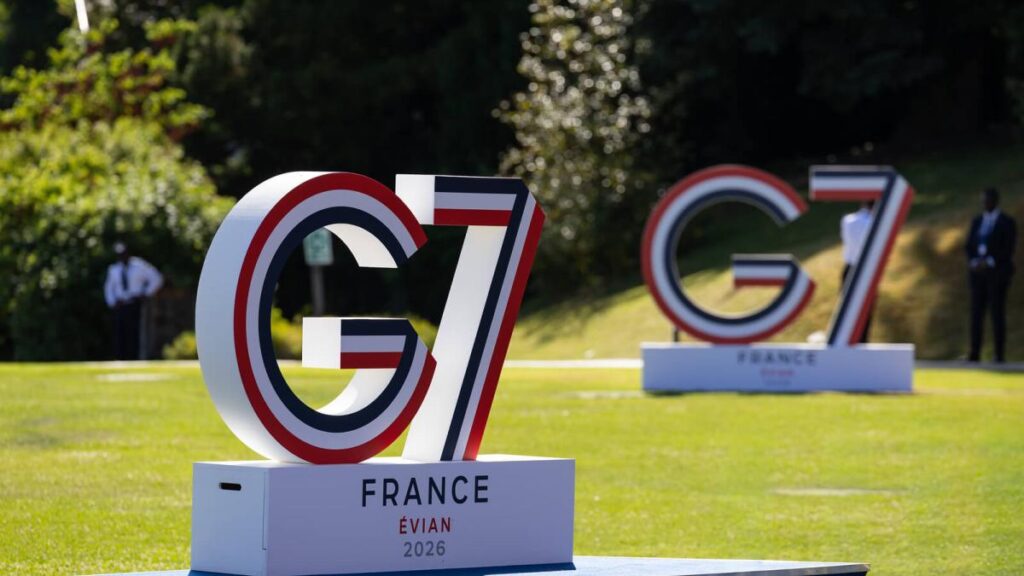
Introduction
In the past, the G7 was a significant event, and this year’s summit in Évian-les-Bains, France, from June 15 to June 17, 2026, was no different. The G7 was mostly security-facing this year. This is expected as the War in Ukraine rages on and NATO tries to adapt to a more defiant Donald Trump. There is newfound adaptability in the G7 that can be commended, and the club’s expansion to include some allies across Africa is a good photo-op, but coordination between the G7 and the global South is a long way off.
The G7 is a forum for advanced economies as they seek greater convergence in the face of a more abrasive U.S. Despite the noise around international diplomacy and several conflicting issues, there are some key takeaways from this year’s G7 meeting. This article provides the key outcomes of the G7 and outlines key takeaways for Africa as it grapples with an emergent and bipolar world order,
Ukraine may be the G7’s biggest winner.
Western countries provided a united front and reiterated support for Ukraine evena s , emerging with a strong statement of support from Western leaders despite President Volodymyr Zelenskyy failing to secure a meeting with the U.S. president, Donald Trump. G7 leaders pledged more deliveries of air defence systems and further support to its energy infrastructure and more sanctions against Russia. President Trump stated that the U.S. may soon reimpose sanctions on Russia’soila nd gas that were waived recently to ease the impact of the closure of the Strait of Hormuz. There was an important change for Ukraine, as President Trump notes that Putin, not Zelensky, should make a deal.
Iran in Focus
The Middle East remains a thorn in the side of Europe as high energy prices are causing inflation to rise and the Central Bank to raise policy rates. The framework for a peace deal was announced. For President Trump, his red line remains. Iran will not have any nuclear weapons in exchange for a lifting of sanctions on all its assets and a gradual re-introduction into the global economy.
While the Memorandum of Understanding (MoU) is welcome, the U.S. and Iran continue to bomb and disrupt trade in the Strait of Hormuz. A deal – a lasting one 0 will lead to the reopening of the Strait of Hormuz and allow energy prices to climb down from recent highs. Another sign of relief for watchers is President Trump’s claim that “Israel could do better” against Hezbollah in Lebanon. He also suggested that Syria may do a better job of quelling Iran’s proxy with limited civilian casualties.
China, the elephant in the room
China is the elephant in the room, but the lack of coordination between the U.S. and the EU allows China to operate much more strategically. The U.S. is more concerned about the competitiveness of its firms, not so much China’s Belt and Road Initiative (BRI) nor its global expansion. While African economies increasingly transition towards using the Yuan to clear their trade, the U.S. is more concerned about competitiveness. The FED could have been useful in providing Swap lines for central banks to slow the gradual retrenchment away from the dollar. However, diversifying central bank FX reserves sends a strong message that Western countries cannot ignore.
President Ruto of Kenya was Present
Not surprising to most – especially after Macron visited Kenya- President Ruto was present at the G7, likely calling for the usual reforms to the global financial architecture. As one of Africa’s bright spots and reeling with a more assertive and demanding youth, President Ruto is balancing Kenya’s investment needs with a broader need to converge towards the West – who share similar values of democracy and universal suffrage. However, the President was likely not picking sides, as it is one of the most indebted countries to China, with the latter remaining an important trading partner.
Time for Tough Talk on Aid
Indeed, foreign development assistance has not led to Africa’s development as previously thought. But there is a risk that Africa will miss out on low-interest loans as its citizens are more concerned about win-win partnerships with Europe. African leaders have done a poor job explaining how aid works. While 70% of Africa’s aid is dominated by grants, there is an important 30% that relfects low interest loans, which is badly needed by African countries that are currently highly indebted. There is no valid reason to prevent Africa from accessing low-interest loans. While the G7 is likely not the forum to discuss those issues, it is important to strike a realist tone rather than try to balance domestic politics with international priorities.
The G7 was a very Western affair this year. This is a signal that regionalism, friendshoring and near-shoring are increasingly shaping the agenda. The war in Ukraine is naturally more geopolitically and economically significant for Europe as Russia is fighting at its door. Meanwhile, the global repercussions from the war in Iran are causing energy prices and inflation to rise for all countries. One thing is clear: Western nations are turning more activist, and Africa could learn a thing or two from their playbook. For example, rather than seek to ostracise the U.S., countries are pursuing bilateral and plurilateral trade, securitya nd development initiatives to address global challenges.
What Lessons for Africa
Africa must urgently prioritise issues based on their implications and their economic effects. For example, the war in Ukraine and Iran have demonstrated Africa’s vulnerability to global supply chains. Governments and regional economic communities should perhaps pool funds to build refineries, chemical fertiliser plants and/or create specific incentives for investors looking to enter this sector. Chemical fertiliser plants are increasingly built by both private and public sector actors.
Africa should seriously think about the role it will play in the tech race. If chips are made in the Netherlands and Taiwan, software in Silicon Valley and inputs in Malaysia, China and Vietnam, Africa will have to produce something. They must identify what that will be and impose minimum processing requirements for the raw materials used to produce those inputs to ensure that they actively contribute to global supply chains.
We must set verifiable mechanisms to measure and ensure better flows of skills and technology transfers. Africa has a growing youth population that needs skills to compete in the emerging AI-centric economy. While their economies are mostly agrarian with some manufacturing ( a light characterisation), it is important to create the conditions for businesses and citizens to thrive in the new AI age.
Africa must mobilise local finance and create more intuitive systems allowing informal sector traders and operators to invest in the formal economy. At present, investing in stocks and bonds is only possible via traditional bank accounts or stock market companies and investment funds. A model that reflects the growing and persistent share of mobile money users and allows them to invest safely and efficiently from their phones will help policymakers mobilise more resources from locals and reduce their dependence on external debt.
Authors
Sonia Kouam, Civil Administrator,
Supreme State Audit, Republic of Cameroon