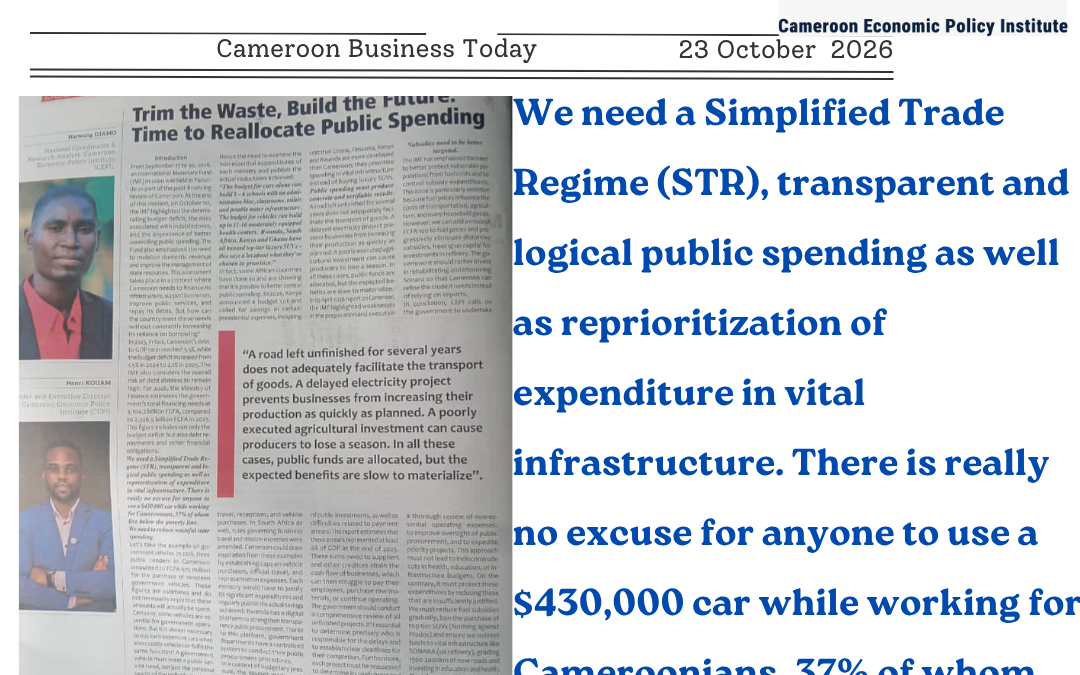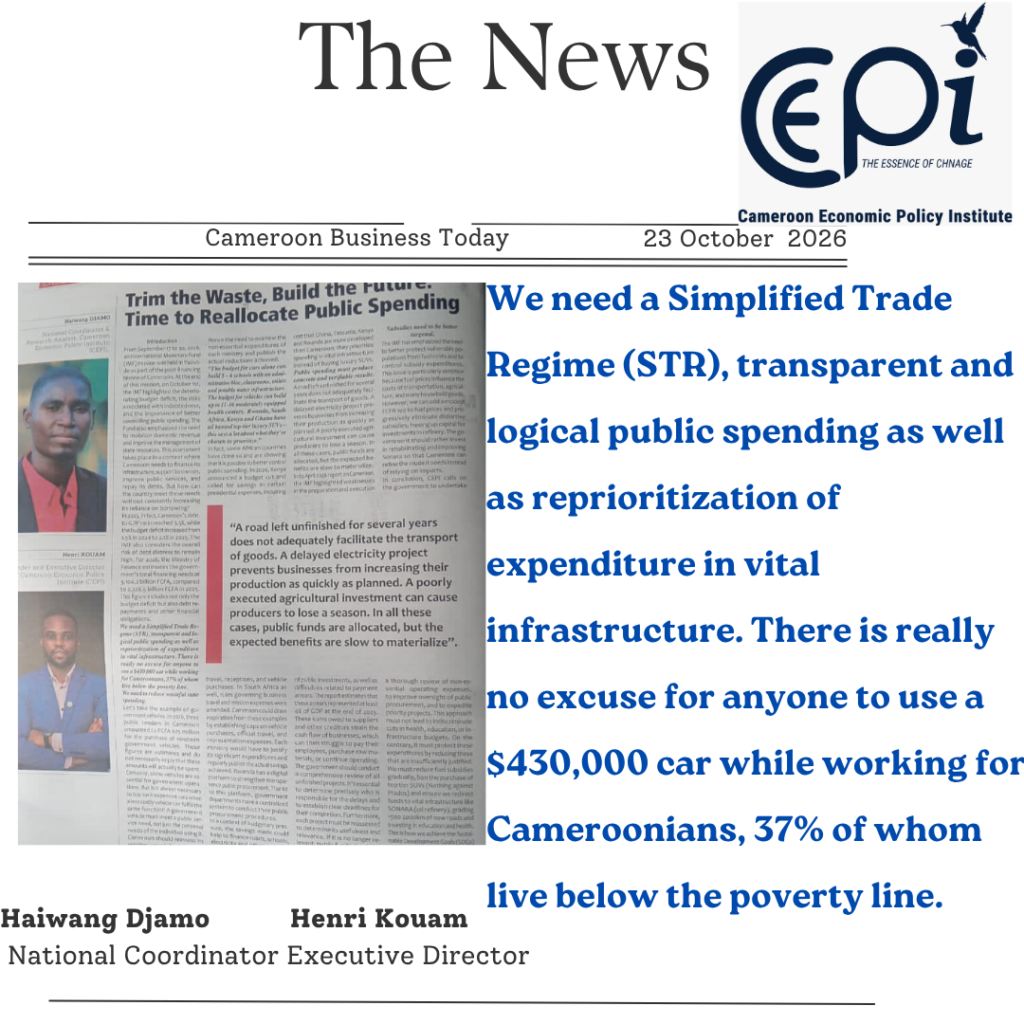
Trim the Waste, Build the Future: Time to Reallocate Public Spending
October 23, 2026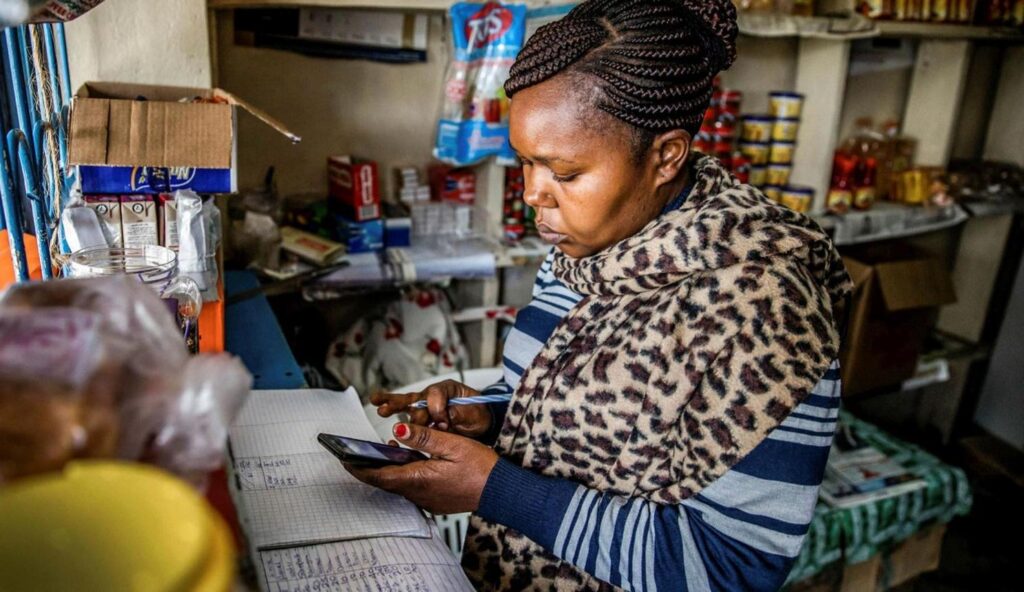
Introduction
In Cameroon, small and medium-sized enterprises (SMEs) play a crucial role in the economy. However, many entrepreneurs struggle to make their ventures sustainable. Between taxes, administrative red tape, financing challenges, and regulatory uncertainty, starting a business does not guarantee its growth. Taxation enables the government to fund public services, infrastructure, and development policies. When tax policies do not align with businesses’ cash flow, they can reduce their ability to invest, hire, and formalize
The Cameroonian government has launched several initiatives in this area. Nevertheless, the existence of a tax incentive does not guarantee that a young entrepreneur will be able to benefit from it. This policy brief first examines the main tax obstacles faced by entrepreneurs. It then presents the measures already undertaken by the government, before analyzing their limitations and proposing reforms tailored to the realities of Cameroonian small businesses.
This article analyses the tax-related obstacles faced by entrepreneurs in Section 1, current efforts to simplify and improve the tax system in Section 2 followed by what Reforms Are Needed to Build a Tax System That Supports Entrepreneurship in Section 4.
I. Tax Obstacles Faced by Entrepreneurs
According to the National Institute of Statistics, 53.5% of SMEs cite taxation as the main barrier to entrepreneurship (INS, 2018). The first problem is the burden of tax levies (Kouam, 2024). Taxes, local taxes, and tax prepayments can strain cash flow, especially when sales decline or when customers pay late. Taxes based on revenue are particularly burdensome because they do not always reflect actual profits. Furthermore, multiple filing deadlines, accounting requirements, and frequent changes to the law force entrepreneurs to devote time and resources to tax compliance. The 2026 Finance Act highlights the importance of keeping abreast of changes to the General Tax Code (DGI, 2026).
Small businesses rarely have the same resources as large companies to interpret tax laws, anticipate their obligations, and challenge administrative decisions. Furthermore, extending taxation to the formal sector may widen the competitive gap with informal operators.
The World Bank’s 2024–2025 Doing Business Survey confirms that tax rates and tax administration are among the obstacles cited by Cameroonian businesses.
II. Efforts Already Undertaken by the Cameroonian Government
Law No. 2013/004 of April 18, 2013, provides tax and customs benefits for eligible investors, particularly during the establishment and operational phases. These measures aim to encourage productive investment and job creation. However, the conditions for approval may restrict access to these benefits for small businesses with limited administrative resources.
Approved Management Centers (CGAs) assist small businesses with their accounting and tax obligations. The General Tax Code provides, under certain conditions, for 50% deductions on reported taxable income and on the tax base used to calculate withholding tax applicable to certain purchases. These benefits can reduce members’ financial burdens and improve their management.
Furthermore, Law No. 2024/020 of December 23, 2024, introduced the General Synthetic Tax (IGS), intended for eligible taxpayers with annual revenue of less than 50 million CFA francs, excluding taxes. The flat-rate amount depends on revenue, and the rates are reduced by half for CGA members (Kouam, 2025). However, a revenue-based tax can place a heavy burden on low-margin businesses. The General Directorate of Taxes is also developing electronic filing and payment systems to reduce the need for in-person visits and simplify procedures. The 2026 Finance Act provides targeted incentives for certain equipment intended for startups, for the integration of recent graduates, and for investments in economically depressed areas. Finally, business start-up centers are working to simplify administrative procedures, and funding mobilized by partners such as the IFC and Afriland First Bank supports SMEs.
III. Why Are These Measures Still Insufficient?
First, some tax incentives do not address the immediate needs of startups (OECD, 2026). A reduction in income tax is of little use when a company is not yet turning a profit. Similarly, tax exemptions on equipment do not cover operating expenses such as rent, utilities, transportation, and suppliers. Incentives must therefore better address cash flow needs and the various stages of a company’s development. Furthermore, administrative complexity can limit access to existing programs (OECD, 2015). Accredited Management Centers and digitalization are useful steps forward, but their effectiveness depends on the simplicity of procedures and the quality of support provided.
Finally, the lack of public data on outcomes limits the evaluation of current policies. It is necessary to know the number of beneficiary businesses, the jobs created as a result of tax incentives, and compliance costs. This information would make it possible to identify effective measures, correct those that are less effective, and better direct public resources toward job creation and business development.
IV. What Reforms Are Needed to Build a Tax System That Supports Entrepreneurship?
Create a Truly Integrated Digital Tax Portal
The digitization initiative implemented by the DGI must evolve into a more integrated process, where entrepreneurs can access their tax information, deadlines, returns, payments, and requests for assistance all in one place. The system could include automatic reminders, guides tailored to each business’s tax regime, and a way to report errors. It must also provide in-person assistance centers and solutions for entrepreneurs with limited internet access.
The success of this reform is measured by concrete indicators: the time it takes to file a return, the number of trips avoided, compliance costs, and the time taken to resolve complaints.
Making Formalization a Tangible Economic Advantage
Formalization is not merely a legal obligation. It must provide concrete benefits that persuade entrepreneurs to join the formal sector. The government can strengthen the link between business registration, support from CGAs, access to public procurement, support programs, and financing options. The criteria must be clear, the procedures accessible, and the benefits well explained. It is also useful to review the IGS system to ensure that the flat-rate amounts are appropriate for the profit margins of small businesses. A simplified tax system must not become an excessive burden for low-profit businesses.
Establish an ongoing evaluation of SME tax policy
A consultative body bringing together the DGI, the MINFI, the MINPMEESA, employer organizations, CGAs, and business representatives can regularly examine the challenges faced by taxpayers. It will publish an annual report card showing, among other things, the use of tax benefits, compliance costs, administrative processing times, tax appeals, and trends in business formalization. This evaluation should make it possible to modify measures that do not yield the expected results. It also helps make tax policy more predictable and strengthen trust between businesses and the government.
Conclusion
Cameroon has several measures in place to support investment and SMEs. However, the mere existence of these measures does not guarantee their effectiveness. Their success is measured by their ability to facilitate business creation, employment, and investment, and to help young businesses survive. The challenge, therefore, is to make the tax system accessible to small businesses, which often have limited resources to handle administrative procedures. This does not mean reducing all taxes, but rather adapting tax obligations to the means of businesses, simplifying procedures, and measuring results.
Reference List
Banque mondiale. (s. d.). Business Ready: Methodology. https://www.worldbank.org/en/businessready/methodology
Direction générale des impôts (DGI). (s. d.). Dématérialisation des obligations déclaratives et de paiement des impôts, droits et taxes. https://www.impots.cm/fr/document/dematerialisation-des-obligations-declarative-et-de-paiement-des-impots-droits-et-taxes
Direction générale des impôts (DGI). (2026). Code général des impôts : Mis à jour au 1er janvier 2026. https://www.impots.cm/index.php/fr/publication/code-general-des-impots-mis-jour-au-1er-janvier-2026
Direction générale des impôts (DGI). (s. d.). Impôt général synthétique : Champ d’application et tarifs. https://impots.cm/en/node/1244
Institut national de la statistique (INS). (2018). Deuxième Recensement général des entreprises en 2016 (RGE-2) : Rapport principal. https://ins-cameroun.cm/wp-content/uploads/2025/06/Rapport_principal_RGE-2_version_finale.pdf
Kouam, H. (2024). A Simple Overview of Fiscal Policy in Cameroon, Cameroon Economic Policy Institute (CEPI), https://camepi.org/wp-content/uploads/2024/05/FRE-Sommaire-de-la-politique-fiscale.pdf
Kouam, H. (2025). A Supportive Tax Rate Will Boost Female Entrepreneurship, Cameroon Economic Policy Institute (CEPI), https://camepi.org/a-supportive-tax-rate-will-boost-female-entrepreneurship-2/
Ministère des Finances (MINFI). (2013). Arrêté n° 366 précisant les modalités de mise en œuvre des avantages fiscaux et douaniers de la loi n° 2013/004. https://minfi.gov.cm/arrete-n-366-minfi-sg-dgi-dgd-du-19-nov-2013-precisant-les-modalites-de-mise-en-oeuvre-des-avantages-fiscaux-et-douaniers-de-la-loi-n-2013-004-du-18-avril-2013-fixant-les-incitations-a-l-investissemen/
Ministère des Finances (MINFI). (s. d.). Les Centres de gestion agréés, cadres de partenariat entre l’administration fiscale et les PME. https://minfi.gov.cm/les-centres-de-gestion-agrees-cadres-de-partenariat-par-excellence-de-ladministration-fiscale-et-des-pme9/
Ministère des Finances (MINFI). (2025). La nouvelle loi portant la fiscalité locale : Enjeux et perspectives. https://www.minfi.gov.cm/wp-content/uploads/2025/02/DGI_EXPOSE_CONFERENCE_ANNUELLE_2025.pdf
Ministère des Finances (MINFI). (2026). Loi de finances 2026 : Comprendre les nouvelles mesures. https://minfi.gov.cm/loi-de-finances-2026-comprendre-les-nouvelles-mesures/
Ministère des PME, de l’Économie sociale et de l’Artisanat (MINPMEESA). (s. d.). Cadre réglementaire des PME et formalités de création d’entreprises. https://www.minpmeesa.cm/site/pme/cadre-reglementaire/
Ministère des PME, de l’Économie sociale et de l’Artisanat (MINPMEESA). (2025, 4 avril). Financement des PME : 36 milliards de FCFA pour soutenir le développement des PME et spécifiquement l’entrepreneuriat féminin. https://www.minpmeesa.cm/site/financement-des-pme-36-milliards-de-fcfa-pour-soutenir-le-developpement-des-pme-et-specifiquement-lentrepreneuriat-feminin/
OCDE. (2015). Taxation of SMEs in OECD and G20 countries. OECD Publishing. https://doi.org/10.1787/9789264243507-en
OCDE. (2026). Corporate income taxation and business dynamism. https://www.oecd.org/en/publications/corporate-income-taxation-and-business-dynamism_59a40a50-en/full-report.html
République du Cameroun. (2013). Loi n° 2013/004 du 18 avril 2013 fixant les incitations à l’investissement privé en République du Cameroun. https://www.prc.cm/fr/actualites/actes/lois/170-loi-n-2013-004-du-18-avril-2013-fixant-les-incitations-a-l-investissement-prive-en-republique-du-cameroun
World Bank Group. (2025). Cameroon – World Bank Enterprise Survey 2024: Biggest obstacle affecting the operation of this establishment (m1a). https://microdata.worldbank.org/catalog/6675/variable/V293
Author
Boulga Kolyang Joel
Free Market Fellow