Fisheries Subsidies: How Does Cameroon Stack Up Against Global Standards?
September 8, 2026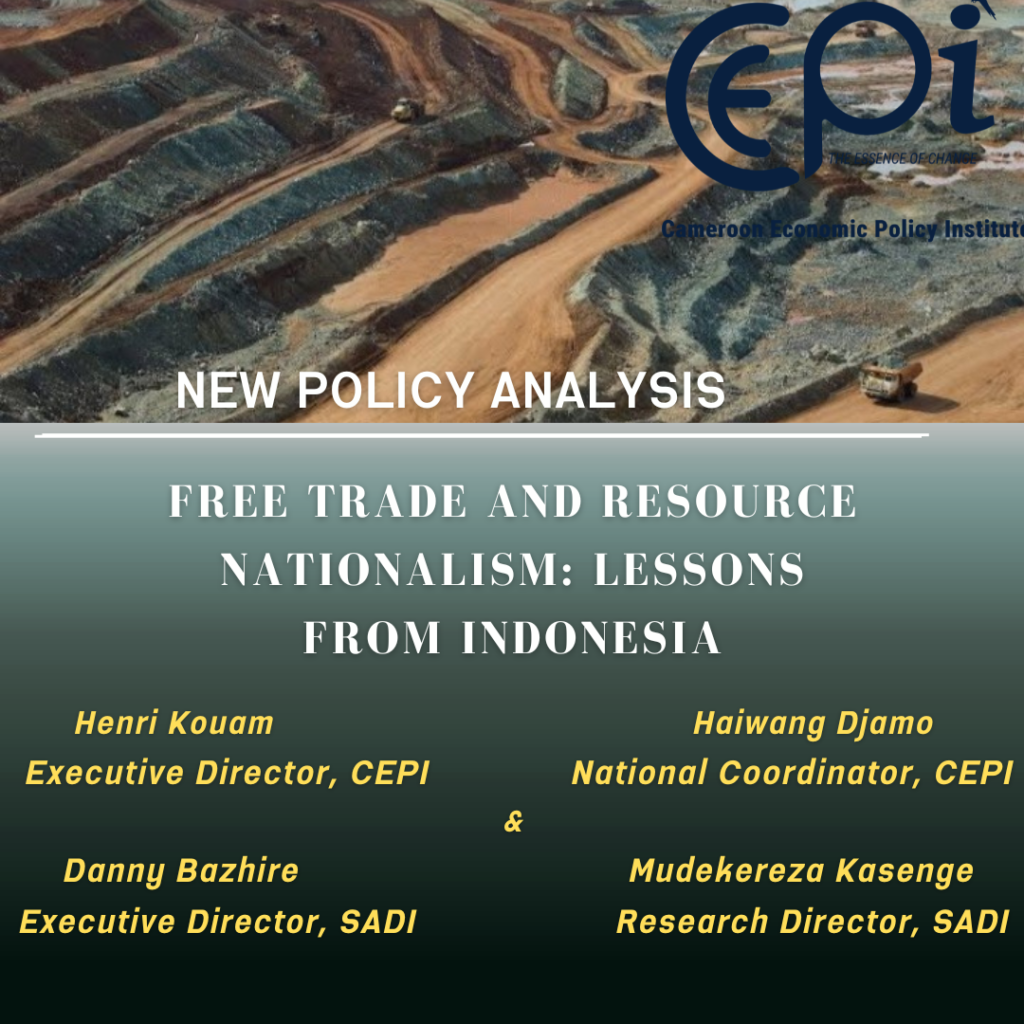
Introduction
Free trade and resource nationalism often clash when it comes to managing natural resources. Indonesia exemplifies this tension through its bans on mineral exports, which aim to boost local processing. In Africa, the “resource curse” demonstrates how mineral abundance can hinder development, particularly in Cameroon, where restrictions might limit revenue but stimulate industrialization. Globally, experiences range from open markets to strategic protectionism. Free markets promote competitiveness, but resource nationalism seeks to preserve economic sovereignty.
This paper examines how free trade affects critical minerals in Cameroon and the Democratic Republic of the Congo. It then compares open-market policies with those of national resource control. Finally, it examines the lessons and limitations of the Indonesian model and suggests ways to adapt this model to the African context.
i. The Role of Free Trade in the Critical Minerals Sector in Cameroon and the DRC
Why are free markets relevant in Cameroon and the DRC?
Free trade can play an important role in the development of the critical minerals sector in Cameroon and the DRC. Against the backdrop of a global energy transition, where demand for cobalt, lithium, nickel, and rare earth elements is rising rapidly, this seems obvious. The DRC accounts for approximately 70% of global cobalt production—a mineral essential for electric vehicle batteries—while Cameroon has significant deposits of cobalt, nickel, and iron, particularly in Nkamouna and Mbalam-Nabeba (International Energy Agency, 2024).
Indeed, more open markets can foster investment, technology transfer, and the integration of both countries into global value chains. It should be noted that excessive trade restrictions, regulatory instability, and corruption reduce the attractiveness of the African mining sector (Freund, C., & Rocha, N., 2011). Conversely, a more open and predictable economic environment can encourage local mineral processing and the creation of industrial jobs. Indonesia serves as a prime example, as through greater trade integration, it has developed a significant nickel processing industry (Asyono, A. H., et al., 2026).
However, Cameroon and the DRC need strong institutions to facilitate free trade and produce positive results. In the DRC, critical minerals are sometimes linked to armed conflicts and the financing of armed groups in certain mining areas in the eastern part of the country. According to Amnesty International (2021), artisanal mining exposes many workers to precarious conditions, particularly children and local communities. This clearly demonstrates that economic freedom must be accompanied by rules ensuring transparency, safety, and the protection of human dignity. But both countries would benefit from building a mining sector capable of supporting local development and improving people’s living conditions, rather than simply exporting more minerals.
ii. Free-Market Policies versus Nationalist Policies (Cameroon and the DRC)
Policies Promoting Free Markets in the Mining Sector
Policies promoting free markets encourage the liberalization of the mining sector in Cameroon and the DRC in order to attract foreign investment and improve the business environment for multinational corporations. These policies rely in particular on tax incentives and openness to foreign capital. In the DRC, the 2002 Mining Code stimulated the influx of investors thanks to the guarantees it offered, while the 2018 revision introduced stricter tax conditions that may reduce the sector’s attractiveness (Lirigo, 2018). A progressive tax system thus appears to be a means of balancing public revenue and economic attractiveness (Laporte et al., 2019).
Liberalization has also encouraged the establishment of multinational corporations, bringing capital, technology, and technical expertise (Bridge, 1999). In Cameroon, alignment with certain international standards has strengthened the competitiveness of the mining sector (Andrews, 1991). However, these policies raise concerns regarding the unequal distribution of income, resource exploitation, and the marginalization of local communities, hence the need to strike a balance between private interests and social responsibility.
Nationalist Policies in the Mining Sector
Nationalist policies influence mining and environmental governance by emphasizing state control, resource sovereignty, and local participation. In Indonesia, the IKN law illustrates a centralization of power that benefits elites more than indigenous peoples (Halmadiningrat & Firdharizki, 2024). In China, the state combines centralization with limited decentralization by integrating certain local initiatives into a tightly controlled policy framework (Xiang & Lo, 2024).
Community participation, however, remains limited. In Indonesia, indigenous populations are often marginalized (Halmadiningrat & Firdharizki, 2024), while in China, their involvement in green nationalism remains state-regulated (Arantes, 2023). On the environmental front, however, nationalism can support ecological protection, as demonstrated by the Vauban case, where patriotism and ecology converge (Posocco & Watson, 2022). Nevertheless, tensions between central authority and local autonomy sometimes undermine environmental governance and fuel social and ecological conflicts (Turnip & Hasibuan, 2024).
Adaptation for Human Dignity and Freedom
Nationalist and free-market policies can contribute to human dignity and freedom when they promote transparency, local autonomy, and economic openness. Nationalist policies strengthen self-sufficiency and local governance (Baughn & Yaprak, 1996), while free-market principles support economic opportunities and individual freedom (Friedman, 2002; Diana & Olga, 2024). The main challenge remains reconciling economic sovereignty with openness in order to ensure the free flow of ideas and resources, which is essential to human dignity (McCartney).
iii. Lessons Learned from Indonesia
Indonesia has successfully transitioned from simple mining to full integration into the electric vehicle battery supply chain (Hanan Nugroho, 2026). Its strategy was based on the creation of highly specialized Special Economic Zones (SEZs), such as the Morowali Industrial Park, which offer turnkey integrated infrastructure. Implemented within a stable and predictable macroeconomic environment, this targeted industrialization policy attracted massive foreign direct investment (FDI). It generated spectacular local growth, with GDP in nickel-producing regions surging by 98%, while boosting employment and raising national wages overall.
iv. What Did Not Work Well
This rapid growth revealed major flaws. Environmentally, aggressive industrialization caused massive deforestation and polluted fragile ecosystems such as Raja Ampat (Edarsasi, P. R., 2025). Economically, hyper-specialization created a critical dependency: in 2023, Indonesian overproduction (more than 50% of the world’s nickel) caused prices to collapse, weakening the economy. Furthermore, the absolute dominance of Chinese FDI restricted the country’s trade autonomy, while the lack of regulation fostered oligopsonies of smelters that dictated prices to miners. Finally, local inflation eroded wage gains, and the lack of skills transfer confined the local workforce to low-skilled jobs with little real added value.
v. Contextual Differences and Africa’s Adaptation
The African context is characterized by political fragmentation and a lack of integration infrastructure. To adapt, Africa must move away from purely national SEZs in favor of regional, interconnected value chains, such as the Lobito Corridor. Inspired by the Airbus model, each country must lead a specific, transformative segment of the chain before any exports take place. It is crucial to enforce strict ESG standards from the outset, diversify financial partners to avoid monopolies, and establish mandatory training programs funded by mining companies, ensuring that local executives have access to senior technology leadership positions.
Policy Recommendations
- Strengthen the stability of the legal and fiscal framework to attract responsible investment in the critical minerals sector.
- Encourage local mineral processing through tax incentives, appropriate infrastructure, and improved access to energy.
- Invest a larger share of mining revenues in infrastructure, technical training, and local skills development.
- Enhance transparency and combat corruption through better governance and increased oversight of mining revenues.
- Enforce compliance with environmental and social standards to protect local communities and preserve natural resources.
Conclusion
Indonesia’s experience shows that resource nationalism can accelerate industrialization when it is underpinned by strong institutions, productive investments, and a long-term strategic vision. However, its limitations serve as a reminder that protectionism alone does not guarantee economic diversification or sustainable development. This means that Cameroon and the DRC must balance the benefits of free trade with an industrial policy capable of strengthening local processing, creating skilled jobs, and increasing the value added of critical minerals.
Reference
Asyono, A. H., Samputra, P. L., & Djatmiko, H. (2026). Transformation structurelle nationale dans une économie des minéraux critiques : une évaluation multisectorielle de la stratégie indonésienne de valorisation en aval du nickel. Economies, 14(4), 133. https://doi.org/10.3390/economies14040133
Baughn, C. C., & Yaprak, A. (1996). Economic nationalism: Conceptual and empirical development. Political Psychology, 17(4), 759–778. https://doi.org/10.2307/3792136
Bridge, G. (1999). Harnessing the bonanza: Economic liberalization and capacity building in the African mining sector. Natural Resources Forum, 23(3), 209–220. https://doi.org/10.1111/j.1477-8947.1999.tb00248.x (doi.org in Bing)
BRGM. (2025). Croissance du nickel indonésien face à ses limites. MineralInfo. https://www.mineralinfo.fr/fr/ecomine/croissance-du-nickel-indonesien-face-ses-limites
Dushkova, D., & Ivlieva, O. (2024). Empowering communities to act for a change : A review of the community empowerment programs towards sustainability and resilience. Sustainability, 16(19), 8700. https://doi.org/10.3390/su16198700
Friedman, M. (2002). Capitalism and freedom. University of Chicago Press. (Original work published 1962)
Edarsasi, P. R. (2025). Mise en œuvre du nationalisme des ressources par le biais d’une politique de valorisation en aval du nickel comme forme de souveraineté économique indonésienne. International Journal of Social Science and Human Research, 8(12), 9579–958X. https://doi.org/10.47191/ijsshr/v8-i12-49
Freund, C., & Rocha, N. (2011). Quels sont les freins aux exportations africaines ? (Document de travail sur la recherche en matière de politiques de la Banque mondiale n° 5730). Banque mondiale. https://documents1.worldbank.org/curated/en/309711468031496273/pdf/WPS5730.pdf
Hanan Nugroho. (2026). Resource Nationalism, Elite Power, and Developmental Statecraft in Indonesia. Vol. 10 No. 1 (2026). https://journal.bappenas.go.id/index.php/jpp/article/view/835
International Energy Agency. (2024). Global critical minerals outlook 2024. https://www.iea.org/reports/global-critical-minerals-outlook-2024
Laporte, B., Lirigo, J., & Andrews, T. (2019). Rent sharing and progressivity of tax regimes in the mining sector. Resources Policy, 63, 101412. https://doi.org/10.1016/j.resourpol.2019.101412 (doi.org in Bing)
Lirigo, R. M. (2018). Révision du code minier en RDC: Vers une fiscalité compétitive ou dissuasive? International Journal of Innovation and Scientific Research, 40(1), 253–263. http://www.ijisr.issr-journals.org/abstract.php?article=IJISR-18-305-03.
Mc Cartney, A. M., Anderson, J., Liggins, L., Hudson, M. L., Anderson, M. Z., TeAika, B., Geary, J., Cook-Deegan, R., Patel, H. R., & Phillippy, A. M. (2022). Balancing openness with Indigenous data sovereignty: An opportunity to leave no one behind in the journey to sequence all of life. Proceedings of the National Academy of Sciences of the United States of America, 119(4), e2115860119. https://doi.org/10.1073/pnas.2115860119
Authors
Henri Kouam
Executive Director, CEPI
&
Haiwang Djamo
National Coordinator, CEPI
&
Danny Bazhire
Executive Director, SADI
&
Augustin Mudekereza Kasenge
Research Director, SADI-DRC