Monetary Policy Report 24/25: Cameroon and Central Africa
June 13, 2026
A More Confident Europe Emerges at NATO Ankara Summit
July 14, 2026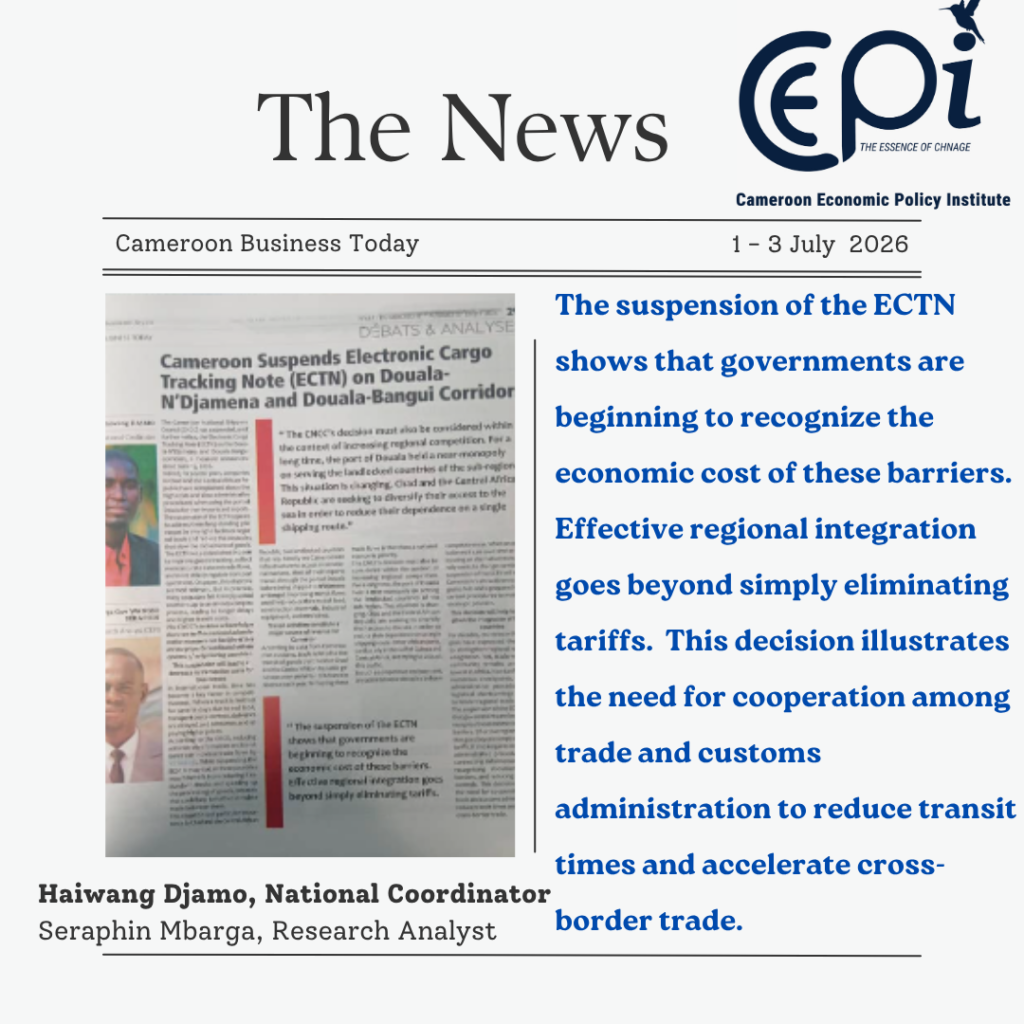
Introduction
The Cameroon National Shippers Council (CNCC) has suspended, until further notice, the Electronic Cargo Tracking Note (ECTN) on the Douala-N’Djamena and Douala-Bangui corridors, a measure announced since June 15, 2026. Indeed, for several years, companies in Chad and the Central African Republic have complained about the high costs and slow administrative procedures when using the port of Douala for their imports and exports. The suspension of the ECTN appears to address these long-standing grievances by aiming to facilitate regional trade and reduce the obstacles that slow the movement of goods.
The ECTN was established in 2006 to improve goods tracking, collect more accurate data on trade flows, and more strictly regulate transport operations. On paper, this objective seemed relevant. But in practice, many operators felt it simply added another step to an already complex process, leading to longer delays and higher transit costs. The CNCC’s decision acknowledges that even well-intentioned administrative measures can backfire if they are not properly coordinated with the systems of neighboring countries.
This suspension will lead to a decrease in transaction costs for businesses.
In international trade, time has become a key factor in competitiveness. When a truck is held up for several days due to red tape, transport costs increase, deliveries are delayed, and consumers end up paying higher prices. According to the OECD, reducing administrative formalities and transit times can increase trade flows by 5% and 15%. While suspending the BESC is essential, all three countries would benefit from reducing it redundant checks and speeding up the processing of goods, because that could help to further stimulate trade between them.
This situation is of particular importance to Chad and the Central African Republic, two landlocked countries that rely heavily on Cameroonian infrastructure to access international markets. Most of their imports transit through the port of Douala before being shipped to N’Djamena or Bangui. Improving transit flows could help reduce the costs of food, construction materials, industrial equipment, and medicines.
Transit activities constitute a major source of revenue for Cameroon
According to data from Cameroonian customs, trade related to the transit of goods destined for Chad and the Central African Republic generates over 410 billion CFA francs in revenue each year. Protecting these trade flows is therefore a national economic priority. The CNCC’s decision must also be considered within the context of increasing regional competition. For a long time, the port of Douala held a near-monopoly on serving the landlocked countries of the sub-region. This situation is changing. Chad and the Central African Republic are seeking to diversify their access to the sea in order to reduce their dependence on a single shipping route. Other African ports, particularly in the Gulf of Guinea and Central Africa, are trying to attract this traffic.
In such a competitive environment, any administrative obstacle can harm competitiveness. When an operator believes it can save time or money by using an alternative route, it naturally seeks to change corridors. The suspension of the ECTN will maintain Cameroon’s attractiveness as a logistics hub and is prepared to adapt certain procedures to maintain its strategic position.
This decision will help to strengthen the integration of CEMAC countries.
For decades, countries in the sub-region have expressed their desire to strengthen regional economic integration. Yet, trade within the community remains among the lowest in Africa. Non-tariff barriers, numerous checkpoints, complex administrative procedures, and logistical shortcomings continue to hinder regional trade.
The suspension of the ECTN shows that governments are beginning to recognize the economic cost of these barriers. Effective regional integration goes beyond simply eliminating tariffs. It also requires streamlining administrative procedures, interconnecting information systems, recognizing documents across borders, and reducing redundant controls. This decision illustrates the need for cooperation among trade and customs administration to reduce transit times and accelerate cross-border trade.
Authors
Haiwang Djamo
National Coordinator/Research Analyst
&
Mbarga Guy Wangso Séraphin
Research Analyst