Artificial Intelligence (AI) & Gender Equality in Cameroon
May 5, 2026
From the DSCE to the SND30: Is Cameroon Facing a Repeat of Its Structural Weaknesses?
May 12, 2026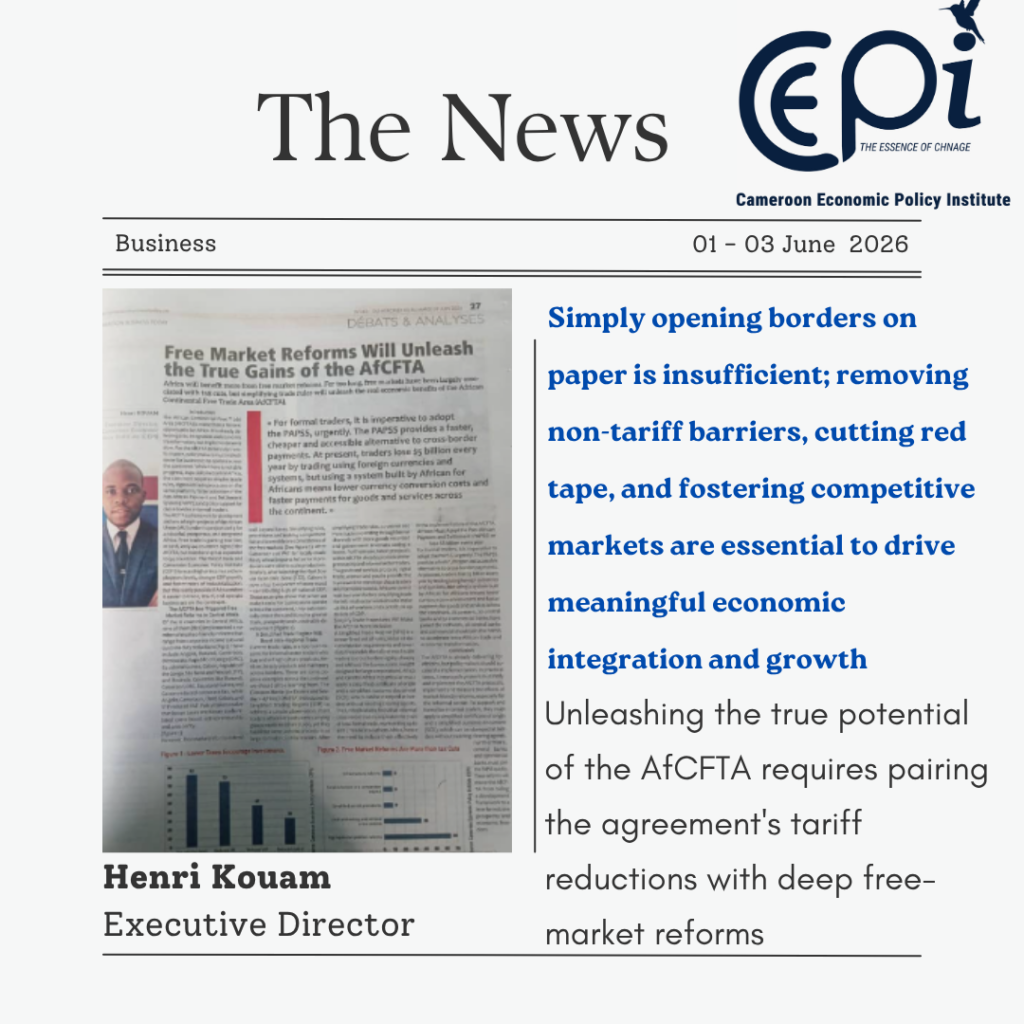
Africa will benefit more from free market reforms. For too long, free markets have been largely associated with tax cuts, but simplifying trade rules will unleash the real economic benefits of the African Continental Free Trade Area (AfCFTA).
Introduction
The African Continental Free Trade Area (AfCFTA) is more than a historic opportunity for Africa. It is already delivering jobs, integration and economic transformation, but implementation is slow. For the AfCFTA to be truly transformative, policymakers must make it easier for businesses to operate across the continent. While there is notable progress, especially in Central Africa, the continent requires simpler trade rules, digitized trade processes on the same platform, faster adoption of the Pan-African Payment and Settlement System (PAPPS) and policy support for cross-border informal traders.
The AfCFTA is a framework for development and one of eight projects of the African Union (AU) under its project 2063 for a peaceful, prosperous, and integrated Africa. Free trade is gaining traction; in 2018, only 44 countries signed the AfCFTA, but membership has expanded to 54 countries. The World Bank and Cameroon Economic Policy Institute (CEPI) forecast higher incomes and employment levels, stronger GDP growth, and faster rates of industrialization. But this is only possible if Africa makes it easier to trade, travel, and operate businesses on the continent.
The AfCFTA has Triggered Free Market Reforms in Central Africa.
Of the 11 countries in Central Africa, nine of them (82%) implemented a number of market-friendly reforms that range from corporate income cuts and customs duty reductions (Fig 1). These include Angola, Burundi, Cameroon, Democratic Republic of Congo (DRC), Equatorial Guinea, Gabon, Republic of the Congo, São Tomé and Principé (STP), and Rwanda. Countries like Burundi, Cameroon, DRC, Equatorial Guinea, and Gabon reduced corporate tax, while Angola, Cameroon, Chad, Gabon, and STP reduced VAT. Policymakers realize that lower taxes and fewer trade-related costs boost entrepreneurship and prosperity.
Figure 2: Lower Taxes Encourage Investments
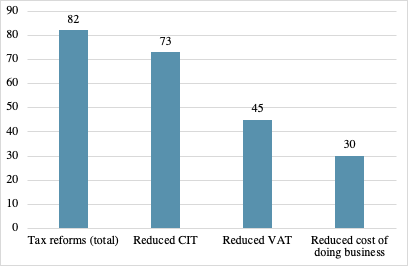
Source: Cameroon Economic Policy Institute (CEPI)
Free Market Reforms Are Boosting Prosperity Across Africa
However, free market reforms extend well beyond taxes. Simplifying rules, procedures and making competition fair and accessible are cornerstones of the free markets (See Figure 2). After Cameroon cut VAT for locally-made flour, wheat imports fell as local producers were able to scale production. Similarly, after launching the Nkok Special Economic Zone (SEZ), Gabon is now a top 5 exporter of sawn wood – contributing 6.5% of national GDP. These examples show that when we make it easier for businesses to operate across the continent, they automatically create the conditions for greater trade, prosperity and sustainable development.
Figure 2: Free Market Reforms Are More than tax Cuts
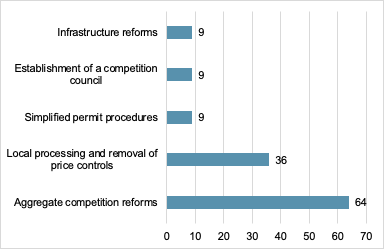
Source: Cameroon Economic Policy Institute (CEPI)
A Simplified Trade Regime Will Boost Intra-Regional Trade
Current trade rules are too burdensome for informal sector traders who buy and sell agriculture products, fertilizer, beauty products and machinery across borders. There are some positive examples across the continent we should all be learning from. The Common Market for Eastern and Southern Africa (COMESA) introduced its Simplified Trading Regime (STR) to address a simple observation: most traders at border posts were carrying goods worth less than $1,000, yet they faced the same customs procedures as large formal/industrial traders. After simplifying trade rules, countries see more traders operating through formal channels with more goods recorded and government revenues seeing a boost. Furthermore, labor protocols within AfCFTA already promote entrepreneurship and informal sector traders. The goods and services protocol, digital trade, women and youths provide the framework to transition these traders into formal networks. Africans cannot wait two years before simplifying trade for informal sector workers who make up 86% of workers and contribute up to 60% of GDP.
Simplify Trade Procedures will Make the AfCFTA More Inclusive
A Simplified Trade Regime (STR) is a streamlined set of rules, reduced documentation requirements and lower duty thresholds that allow small-scale traders to cross borders legally, cheaply and without the bureaucratic weight designed for large corporations. Africa and Central Africa in particular must apply a simplified certificate of origin and a simplified customs document (SCD), which can be stamped at borders without needing clearing agents.
The United Nations finds that informal crossborder trade is equivalent to 7-16% of total formal trade, representing up to 40% of trade in Southern Africa, hence the need to include them effectively in the implementation of the AfCFTA.
African Must Adopt the Pan-African Payment and Settlement (PAPSS) or lose $5 billion every year
For formal traders, it is imperative to adopt the PAPSS, urgently. The PAPSS provides a faster, cheaper and accessible alternative to cross-border payments. At present, traders lose $5 billion every year by trading using foreign currencies and systems, but using a system built by African for Africans means lower currency conversion costs and faster payments for goods and services across the continent. At present, 20 central banks and 52 commercial banks have joined the network, all central banks and commercial should join the PAPSS to accelerate intra-African trade and economic transformation.
Conclusion
The AfCFTA is already delivering for Africans, but policymakers should accelerate implementation. In practical terms, it means policymakers must ratify and implement the AfCFTA protocols, implement and measure the effects of market-friendly reforms, especially for the Informal sector. To support and formalize informal traders, they must apply a simplified certificate of origin and a simplified customs document (SCD), which can be stamped at borders without needing clearing agents. Furthermore, central banks and commercial banks must join the PAPSS quickly. These reforms will move the AfCFTA from being a development framework to a lever for inclusive prosperity and economic freedom.
Author
Henri Kouam
Executive Director