3-5% Locally Produced Flour Should Be Included in Baked Products.
March 10, 2025
REPORT – Property Rights Diagnostic: An Overview of Cameroon, Ghana and Nigeria.
June 10, 2025
Introduction
The EU Global Gateway, launched in December 2021, seeks to enhance Europe’s connectivity with the rest of the world by investing in sustainable infrastructure and systems in key sectors. It has a primary focus on developing countries and is a way for Europe to maintain its autonomy as relates to its economic and political relations ( Gili & d’Ambrosio Lettieri, 2023 ). Through its Global Gateway Investment Package, the EU will drive up to €150 billion in investments in Africa, half of its 300Bn target investment across the world. It will seek to strengthen key sectors like transport, health, and education, and find avenues to accelerate sustainable growth and decent job creation.
A primary focus of the global gateway investment package is a focus on sustainable development with developing partner states. These involves sustainable energy production, sustainable agri-food systems, and climate resistance and disaster risk reduction initiatives (EU 2022) According to a recent assessment of how the EU is carrying out the 2030 Agenda for Sustainable Development, each Global Gateway project, which is funded by the EU budget, will “identify and integrate the relevant SDGs at all stages – from design to implementation and reporting.” (European Commission, 2023)
Partnerships created in Cameroon: Given Cameroon’s critical economic standing as the largest economy in Central Africa, seeking to foster development within the confines of sustainability, the EU has sought to drive initiatives that will ensure this. Also, the country’s strategic location in the Congo basin provides a unique opportunity to foster sustainable development initiatives that would benefit the wider region. In line with its Global Gateway initiative, Team Europe brings together the EU, the European Investment Bank, Belgium, France, Germany, Italy, and Spain.
In its partnership with Cameroon, the EU adopted a Multiannual Indicative Plan for the period 2021-27 under the Neighborhood, Development and International Cooperation Instrument (NDICI-Global Europe). The EU, through this plan, will allocate €178 million in grant funding to the partnerships with Cameroon over 2021-24. (European Commission, 2023).
1). Potential for Sustainable Development
a). Enhancing trade and mobility (Road corridor between N’Djamena and Douala): Aligning with the EU’s strategic mission to foster connectivity and integration in the country, the Global Gateway has fostered major transportation projects in the country. As one of its major goals in its partnership with Cameroon, the EU seeks to promote political stability and economic development in the northern regions through sustainable and resilient territorial development in the face of climate change (European Commission, 2023). One project helping the partnership achieve this goal is the construction of the Lagone bridge connecting Cameroon and Chad, facilitating trade and movement across both countries. Also, key partners, the EU and European Investment Bank, have contributed FCFA 176.2 million to finance the road corridor between N’Djamena and Douala. According to the World Bank, this corridor “concentrates 35 percent of the GDP for both countries, 20 percent of Chad’s population, and 35 percent of Cameroon’s population.” (World Bank Group, 2022) The 229 km road will facilitate trade and mobility of people and goods, directly impacting about 7 million people. These projects will open up rural production areas and foster access to administrative, social, and economic services for indigenes of the region(European Investment Bank, 2023)
b). Addressing environmental degradation: In a bid to protect forests and improve forest governance, the EU instituted the Voluntary Partnership Agreement (VPA) with key timber-exporting countries. The VPA is a legally binding trade agreement between the EU and timber-exporting countries to ensure timber and timber products destined for EU markets are sustainably produced (VPA Africa – Latin America). This has, however, been suspended in Cameroon due to persistent illegal logging and failure to enforce forestry regulations. (The Guardian Post, 2024). Still keeping to its mission to foster sustainability, the new EU Deforestation regulation seeks to tackle climate change and protect biodiversity by preventing deforestation related to EU consumption of products from cattle, cocoa, coffee, palm oil, soya, wood, rubber, charcoal, and printed paper (European Commission, 2023). The implementation of these initiatives is a step in protecting the environment and fighting environmental degradation in partner states like Cameroon.
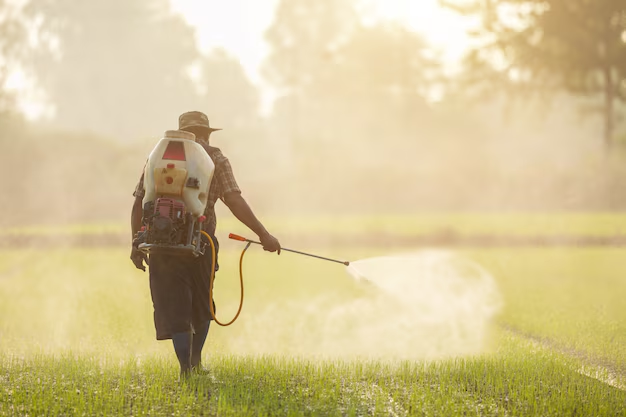
c). Sustainable agri-food systems (SODECOTTON): The EU’s initiative to enhance sustainable Agri-value chains seeks to boost investment in agriculture, enhancing its sustainable practice. These investments strengthen agricultural food systems to be resilient to unfavorable trends in the economy and climate shocks. (European Commission, 2022). In Cameroon, the EU is helping SODECOTON foster its energy transformation and modernization of its value chain. It will increase SODECOTON’s transformation capacity of cotton seeds and diversification of its products. The investment, worth 6.5 billion francs, will also help SODECOTON’s energy transition, financing the construction of 5 solar plants which will limit the company’s dependence on diesel (Africa News Agency, 2023).
-
Challenges in aligning EU Global Gateway initiatives with sustainability
Limited Information sharing: A major challenge in the alignment of EU Global Gateway objectives with sustainability is the fragmented and sometimes insufficient availability of critical project-related information. This is a result of a lack of accessible information on the objectives of different projects carried out and their targeted impact. There is also a lack of information on the implementation of these projects and the milestones achieved, limiting the drive for transparency. Also, local stakeholders are sometimes not involved in key conversations, creating a knowledge gap in implementation measures. A report by The Polish Institute of International Affairs stated that just 13% of people living in southern neighboring nations said they had noticed any real benefits from the Global Gateway operations. Also, only 20% of the citizens in the East Asia and Pacific (EAP) region declared knowledge of any projects (The Polish Institute of International Affairs, 2022). It is thus important for the communication and engagement on Global Gateway initiatives to reach the local populations.
Slow member state engagement: The degree of participation from different stakeholders varies and is crucial to the Global Gateway’s success. The implementation of the Global Gateway necessitates mobilizing participation from member states, public development banks, development finance organizations, and the business sector, employing the Team Europe Approach. The degree of participation differs throughout member states, with some being more reluctant to use more of their funds to carry out different investment projects in faraway developing markets (Teevan, 2022). The economic slowdown that member states have faced as a result of COVID-19 and other local challenges like the Russian invasion is to blame for this (Kaca, 2022). There are reports of EU member states already diverting aid budgets in response to the war (Gavas & Pleeck, 2022). Public institutions, being increasingly burdened with additional expenditure on healthcare and economic aid, may have less capacity to invest in infrastructure development (Kaca, 2022) in Africa.
3). Policy recommendations
a). Strengthen Local Capacity Building: Investing in local capacity building is essential for the sustainability of projects initiated under the Global Gateway program. This can be achieved by providing training and resources to local institutions and communities, ensuring they have the skills and knowledge to manage projects effectively. For instance, a focus on vocational training for youth and women in green sectors can help create jobs and empower these demographics, which are crucial for economic growth. According to the EU’s Multiannual Indicative Program for Cameroon (2021-2027), there is an emphasis on creating economic opportunities and decent jobs for youth, which aligns with this recommendation
b). Foster Multi-Stakeholder Partnerships: To maximize impact, the EU should foster partnerships that include not only governmental bodies but also civil society organizations, private sector actors, and local communities. Engaging diverse stakeholders can lead to more comprehensive project designs that address local needs effectively. For example, initiatives like Team Europe in Cameroon already bring together various EU member states to tackle issues such as climate change and sustainable development; expanding this model to include more local voices can enhance project relevance and effectiveness. By leveraging the strengths of various partners, the EU can create a more integrated approach to development that aligns with Cameroon’s National Development Strategy 2020-2030.
c). For Civil Society Actors and Think Tanks in Cameroon, the EU should involve them in monitoring and evaluation processes to enhance transparency and accountability of Global Gateway projects. They should leverage their expertise in working with SMEs and supporting local entrepreneurs.
Conclusion
The EU Global Gateway has the potential to foster sustainable development in Cameroon. If effectively executed, it will be able to enhance trade and mobility in the country, tackle environmental-related challenges, and develop more resilient and sustainable agri-food systems. However, for these impacts to be seen, there is a need for better communication and information sharing on projects being carried out and their intended impacts. There is also a need for more stakeholder engagement.
Reference List
- Africa News Agency. (2023). Cameroon: EU invests $11 million in Sodecoton’s energy transition, Africa News Agency. Available at: https://africa-news-agency.com/cameroon-eu-invests-11-million-in-sodecotons-energy-transition/ (Accessed: 07 January 2025).
- European Commission. (2023). Regulation on deforestation-free products. Available at: https://environment.ec.europa.eu/topics/forests/deforestation/regulation-deforestation-free-products_en (Accessed: 07 January 2025).
- European Commission. (2022). Global Europe: Neighbourhood, development and international cooperation instrument, International Partnerships. Available at: https://international-partnerships.ec.europa.eu/funding-and-technical-assistance/funding-instruments/global-europe-neighbourhood-development-and-international-cooperation-instrument_en (Accessed: 07 January 2025).
- European Commission. (2022). EU-Africa: Global Gateway Investment Package – Sustainable food systems, EU. Available at: https://knowledge4policy.ec.europa.eu/publication/eu-africa-global-gateway-investment-package-sustainable-food-systems_en (Accessed: 07 January 2025).
- European Commission. (2024). EU-Cameroon: country projects, International Partnerships. Available at: https://international-partnerships.ec.europa.eu/countries/cameroon_en (Accessed: 07 January 2025).
- European Commission. (2023). REPORT FROM THE COMMISSION TO THE EUROPEAN PARLIAMENT, THE COUNCIL, THE EUROPEAN ECONOMIC AND SOCIAL COMMITTEE AND THE COMMITTEE OF THE REGIONS. Available at: https://eur-lex.europa.eu/legal-content/EN/TXT/HTML/?uri=CELEX%3A52023DC0700 (Accessed: 07 January 2025).
- European Investment Bank. (2023). Global gateway: Team Europe finances road corridor project between Chad and Cameroon to the tune of €176.2 million, European Investment Bank. Available at: https://www.eib.org/en/press/all/2023-154-global-gateway-l-equipe-europe-finance-a-hauteur-de-176-2meur-le-projet-de-corridor-routier-entre-le-tchad-et-le-cameroun (Accessed: 07 January 2025).
- European Union. (2022). EU-Africa: Global Gateway Investment Package, European Commission. Available at: https://ec.europa.eu/commission/presscorner/api/files/attachment/874064/GG_Africa_InvestmentPackage.pdf.pdf (Accessed: 07 January 2025).
- Gili, A. and Ambrosio Lettieri, F. (2023). EU’s Global Gateway: Africa under a new spotlight, de – Für eine Welt ohne Hunger und Armut. Available at: https://www.welthungerhilfe.org/global-food-journal/rubrics/development-policy-agenda-2030/eus-global-gateway-africa-under-a-new-spotlight (Accessed: 07 January 2025).
- Kaca, E. (2022). The EU’s Global Gateway Strategy: Opportunities and Challenges, pl. Available at: https://www.pism.pl/publications/the-eus-global-gateway-strategy-opportunities-and-challenges (Accessed: 07 January 2025).
- Rachael, C et al. (2022). A Global Development Paradigm for a World in Crisis, Policy Papers, 275, Center for Global Development. Available at: https://ideas.repec.org/p/cgd/ppaper/275.html (Accessed: 07 January 2025).
- Tanyi, M. (2024). EU terminates timber agreement with Cameroon over illegal logging concerns., The Guardian Post. Available at: https://theguardianpostcameroon.com/post/4427/en/eu-terminates-timber-agreement-with-cameroon-over-illegal-logging-concerns (Accessed: 07 January 2025).
- Teevan, C. et al. (2022). The global gateway: A Recipe for EU geopolitical relevance?, The Global Gateway: A Recipe for EU Geopolitical Relevance? Available at: https://ecdpm.org/application/files/4616/5779/4869/Global-Gateway-recipe-EU-geopolitical-relevance-ECDPM-Discussion-Paper-323-2022.pdf (Accessed: 07 January 2025).
- World Bank Group. (2022). World Bank supports Cameroon and Chad to improve regional connectivity and resilience, World Bank. Available at: https://www.worldbank.org/en/news/press-release/2022/02/15/world-bank-supports-cameroon-and-chad-to-improve-regional-connectivity-and-resilience#:~:text=It%20combines%20investments%20in%20rail,and%2035%20percent%20of%20Cameroon’s (Accessed: 07 January 2025).
Authors
Elishammah Nyaba &. Henri Kouam
Junior Research Analyst Founder & Executive Director
Download the full Policy Brief in English here
Télécharger la Version Française ici