Policymakers Should Popularize Export/Import Procedures on Relevant Websites
September 8, 2025
ZLECAF : The urgency of simplifying Export/Import procedures
October 10, 2025
Introduction
Over the past decade, the size of government and the number of civil administrators have increased. But the experience of the past decade shows that capitalism and entrepreneurship have done more to slow poverty than state-oriented policies. Although the majority of workers are employed in the informal sector, they are employed, which reduces dependence on the welfare state. Some have argued that every country should have a social safety net for the most vulnerable, but the majority of Cameroonians are entrepreneurial, and creating a foundation for individual entrepreneurs and micro-SMEs to thrive will promote the creation of jobs that will allow citizens to thrive.
- Capitalism promotes job creation
In Cameroon, capitalism has already created countless jobs, especially since the majority of workers are trapped in the informal sector. There are currently about 8 to 9 million people of working age and 78.3% of them are self-employed. This proportion is higher in the female labour force (85.1 per cent) than in the male labour force (70.6 per cent), and the service sector (35 per cent) has the largest number of workers in the informal sector. The average salary of workers in the informal sector is 83,409 CFA francs per month. In urban areas such as Douala and Yaoundé, these entrepreneurs earn 96,367 CFA francs for workers in urban areas and 59,520 CFA francs for those in rural areas, i.e. a minimum hourly wage of about 669 CFA francs. The average monthly income of employers (181,200 CFA francs) is almost double that of the self-employed (93,500 CFA francs).
Capitalism will reduce poverty: As in most developing countries, some people in our society face difficult socio-economic realities. Not being able to pay for your children’s education and/or your next meal is not something we can take for granted. It is estimated that 37.5 per cent of the country’s population lives below the poverty line, with this figure exceeding 70 per cent in some areas. However, this is lower than the 46% of people who were living below the poverty line in 2022.This is worrying by any measure, but at the end of the day, we need entrepreneurship and not a wider social safety net. By making it easier to start and register a business, more people will be lifted out of poverty and avoid dependence on the state.
“It is true that capitalism can exacerbate poverty, but only if people are not empowered. If we train people and make it easier for them to start businesses with acceptable levels of taxation, entrepreneurship will create jobs and prosperity while reducing poverty in the long run.”
- Capitalism encourages innovation
The adoption of capitalism and the reduction of the role of the state have spurred innovation in Cameroon. From internet access to electricity supply, a large number of services have been developed thanks to foreign equipment, machinery and expertise. The percentage of the population with access to electricity has increased from 29% in 1991 to 71% in 2022.At the same time, the number of solar system providers has increased, with companies such as NNPIC Solar Energy, ProElec, Renewable Energy Innovators, and Solar Energy Cameroon, making energy more affordable for a range of companies. Businesses can now install their own electrical system and avoid power outages that reduce productivity and lead to lost revenue. At the same time, drones are becoming accessible to farmers and industrial manufacturers in a range of sectors, thanks to the creation of new companies, from Tagus Drones to Cameroon Flying Labs.
Figure 1: The upward trend of SMEs must continue
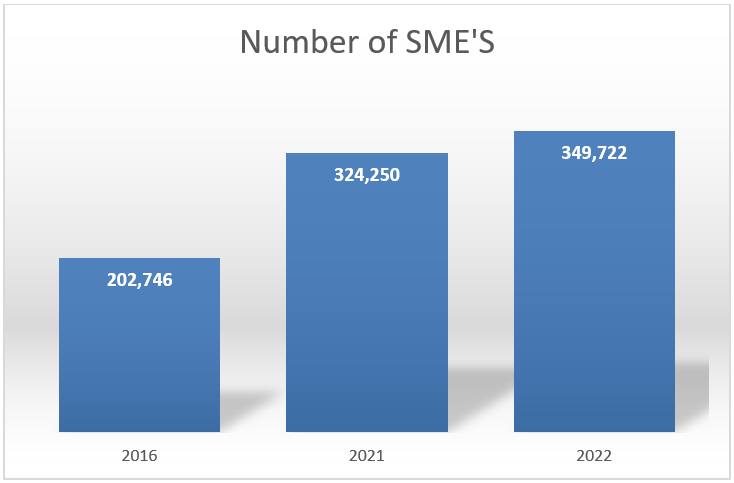
Source: MINPMESA (page 4) MINPMESA (Page 4)
- 3. Current attempts to create social safety nets are costly
Cameroon has currently borrowed $110 million from the World Bank to create/establish an effective social safety net for the most vulnerable. Every civilized society must take care of its “vulnerable.” But we must nevertheless be responsible enough to recognize the cost – collectively.
This program has three objectives;
- The first is to lay the groundwork for a safety net system and support project management ($7.8 million).
- The second component is the Pilot Cash Transfer Program with accompanying measures to boost household productivity ($36.3 million).
- The third component is the Public Works Pilot Program ($5.9 million).
Someone will have to pay for a social safety net and the number of beneficiaries will increase. The creation of a welfare state must not become the answer to unemployment and precariousness. Business-friendly reforms will create jobs in the long term without imposing huge costs on taxpayers or the state!
- What is the cost of free company registration for 1000 companies in Cameroon?
On paper, registering a company in Cameroon costs between 40,000 and 60,000 FCFA, but in reality, this cost could be higher. The suspension of registration fees for 1000 companies will cost 60 million FCFA or 99,000 dollars. Helping businesses and funding a social safety net are not mutually exclusive, but the long-term benefits of supporting businesses are enormous, both for governments and civil society.
To oppose a social safety net is to incur the wrath of most of us. But we have to challenge ourselves to think about the society we want. We cannot promote and encourage “dependency” when it is clear that more than 80% of people of working age are entrepreneurial. If we allow social safety nets to become easily accessible to all, it will become problematic to finance them.
Conclusion
In a capitalist economy, capital goods – such as factories, mines and railways – can be owned and controlled by the private sector, while labour is bought for a cash wage”.
If an enabling environment is created and people are equipped with the right tools, entrepreneurship will continue to grow in Cameroon, creating jobs, boosting prosperity for all, and reducing poverty. For our development experts, we cannot focus on the Sustainable Development Goal (SDG 1) without focusing on decent work (SDG 8).