Key Lessons for Africa After G7 Summit in Évian-les-Bains
July 21, 2026
From ENEO to SOCADEL: Implications of Re-nationalising the Energy Sector and How to Make it Deliver for Users
August 5, 2026
Introduction
Cameroon has a nascent natural gas sector that has developed mostly with the help of foreign expertise. Natural gas is a strategic resource, with proven reserves estimated at 6.18 trillion cubic feet; natural gas production is used for power generation, industry, and liquefied natural gas (LNG). Cameroon’s natural gas production averaged 2.04 billion cubic meters in 2024 and 2.18 bcm in 2025, while LNG exports reached 2.4 million tons in 2024. Even so, LNG revenue has declined over the last five years, dropping 8.1% in 2024 alone.
This policy brief will provide a snapshot of Cameroon’s natural gas sector by outlining its strategic importance in Section 1, the various types and nature of operators in Section II, and how LNG could shape the energy transition in Section III. We conclude with specific reforms required to advance private-sector-led development.
Strategic Importance of Cameroon’s Natural Gas Sector
Economy: After peaking at FCFA 622 billion in 2022, LNG revenue has declined steadily over the last five years to FCFA 421 billion in 2023, FCFA 381 billion in 2024, and FCFA 350 billion in 2025. Even so, it accounts for 11 – 17% of Cameroon’s export revenues (2025) and creates employment and livelihoods for thousands of Cameroonians.
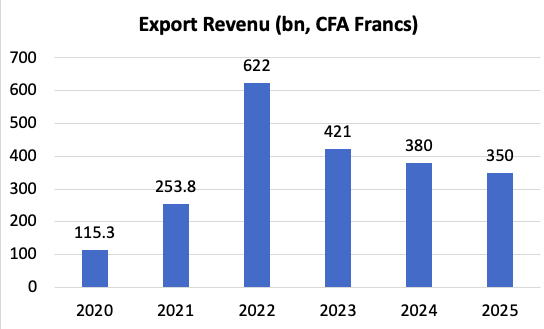
Source: INS, Business in Cameroon, Financial Afrik, Fin Afrik/INS Report, BIC
Government Revenues Depend on Natural Gas Exports and Trade
Natural gas is an important part of Government revenues (5%), according to some estimates, so lower sales or exports translate into lower net revenues. Lower export revenues are made worse by the exit of FLNG Hilli Episeyo, whose floating LNG terminal is leaving Cameroon for Latin America after eight years.
Natural Gas Will Contribute to Cameroon’s Energy Security
Natural gas contributes 20-25% of Cameroon’s thermal electricity and supplies major industrial hubs. While Edea is famous as a hub for hydroelectricity, natural gas is a backstop for the wider grid and nearby thermal infrastructure like the Yassa-Dibamba and Kribi gas plants. This prevents seasonal drops in hydroelectricity – however limited. Gas flows from the offshore gas field are supported by the Hilli Episeyo Floating Liquefied Natural Gas (FLNG) vessel near Kribi, which processes up to 2.4 million tons for exports.
In the past, LNG was transported in pre-filled cylinders from Bafoussam to Bamenda, causing regional shortages and prices to surge to FCFA 8500 – FCFA 15,000 due to logistical bottlenecks and the compounding impact of the Anglophone. The Hydrocarbons Prices Stabilization Fund (HPSF/CSPH) commissioned a modern LPG Filling Centre in Bamenda (Bangshie). The 6.25-hectare plant holds 200 metric tonnes of storage capacity and 12 stations that fill 600 – 650 cylinders per hour. This has brought prices down to FCFA 6500, and will support consumer disposable incomes. Furthermore, by localizing the production of LNG in the conflict-hit North West region, this safeguards local energy access, curbs deforestation and provides a cheap and reliable alternative to firewood and charcoal that are harmful to human health and the environment.
The Role of Foreign Companies and the Exit of Golan
Cameroon’s natural gas sector operates with a mix of private and public actors to balance commercial interest with local energy and financial security needs. The state-owned company, National Hydrocarbons Corporation (SNH), manages both licensing rounds and government interest.
Perenco – an independent operator that partners with SNH – is the primary upstream player, extracting gas from the Sanaga Sud fields. Meanwhile, midstream infrastructure has heavily relied on foreign firms since 2018. Specifically, Norwegian firm Golar LNG operates the Hilli Episeyo Floating LNG (FLNG) on the coast of Kribi, which has an offshore processing hub that has exported about 152 LNG cargoes or 2.4 million tonnes annually. The main player downstream is the Hydrocarbons Prices Stabilization Fund (CSPH), which insulates local consumers from market shocks by fixing prices i.e., 12.5kg cylinders are regulated at 6500.
The Exit of GOLAR is Causing Cameroon to Open its Market
In Mid-2026, Golar LNG officially finalized its exit as its eight-year contract came to an end and the depletion of the immediate offshore reservoir. As a result, the Hilli Episeyo is being disconnected to be redeployed to Argentina. The SNH, meanwhile, opened international bidding for nine new blocks, welcoming Chevron’s Noble Energy. Relying entirely on leased foreign assets leaves the local grid vulnerable to structural changes and contract expirations. Investing heavily in domestic pipelines, permanent processing plants (such as the CSTAR refinery project), and national distribution networks ensures Cameroon can directly process its own raw reserves—safeguarding long-term, self-reliant energy security.
Cameroon is opening up to more foreign firms
The current strategy creates a dependency vis-à-vis exploration and processing as SNH does not impose a rigorous technology and skills transfer in any of its agreements. While this reliance on foreign/skilled companies isn’t bad, it creates the wrong type of dependence that incentivizes exploring LNG sustainably over the long run. SNH has launched a call for tenders for Cameroon’s Yoyo – Yolanda’s gas deposits, with 2500 bcm in reserves that will be executed by Noble Energy. While 9 offshore gas sites in Douala-Kribi have been scoped up by Murphy West Africa.
LNG Should Lead Cameroon’s Energy Transition
Cameroon should prioritize natural gas in its energy transition as decentralized solar and wind solutions are only possible in new settlements. Cameroon’s natural gas reserves are estimated at 4.7 billion cubic feet, ranking at 44 out of 99 countries. Given that natural gas is clean and plentiful, Cameroon should/must exploit it; natural gas produces fewer emissions compared to coal and steel and can provide the power to support wind, solar, and hydroelectricity.
Cameroon’s CO2 per capita has been falling steadily from 0.45t in 1996 to 0.33t in 2024, while access to clean cooking has risen to 31% in 2023 from 10% in 2000 as a result of greater access to natural gas and the stabilization of a gas bottle from FCFA 8500 to FCFA 6500. LNG will form an important strategy for Cameroon going forward, especially as geopolitical rifts such as U.S.-China trade tensions, U.S.-Iran war, and near-shoring are creating new and natural trade patterns.
Skills and Technology Transfer Should be Verifiable and Measurable
However, there should be verifiable skills and technology transfer, and no new gas fields should be contracted out without an adequate strategy to train Cameroonian engineers on new approaches, technology, and strategies to manage gas plants effectively. Learning-by-doing should form an integral part of Cameroon’s strategy to ensure that local companies can harvest, store, and bottle natural gas effectively. There is no room for such an important process to be done with 100% imported equipment because it creates a dependence similar to China’s chokehold on the world with rare earths. While we stand firmly in favor of free trade, we must learn the skills to build and manage our own resources.
What Private Sector Friendly Reforms does the Sector Need?
Contracts Should Create Space for Cameroon’s Development: It is archaic to give out contracts with no requirements for companies to train, upskill, or transfer technology to a local body or firms. Our friends are Nobel Energy (Chevron) and Murphy West Africa should train at least 200 engineers, teach them offshore installation techniques, how to use, appraise, and develop software to ensure that Cameroon is fully autonomous in 20 years.
Maintain the current tax rates and investment incentives and do not provide unilateral subsidies to firms or companies, as this distorts competition in the market. All firms that receive or benefit from tax cuts should
Conclusion
Cameroon’s Natural gas sector is driven by public/private sector involvement. The state manages licensing, while the private sector operates and sells LNG internationally. Perecenco extracts, Golar LNG operates the Hilli Episeyo Floating LNG (FLNG) processes (contract ends in 2026), and the Hydrocarbons Prices Stabilization Fund (CSPH) ensures stable local prices. Natural gas is abundant and should form an integral part of Cameroon’s energy security strategy, and any future licensing agreement should ensure locals are trained and technology is transferred to ensure future gas deposits are exploited by Cameroonian companies.
Reference List
Hannah Ritchie and Pablo Rosado (2025) – “CO₂ and Greenhouse Gas Emissions” Published online at OurWorldinData.org. Retrieved from: ‘https://ourworldindata.org/profile/co2/cameroon’ [Online Resource], Le méthanier
(2026). Hilli Episeyo de Golar prépare son retrait des eaux camerounaises, Accessed on 26 may 2026, Business Finance Intelligence, https://businessfinanceint.com/le-methanier-hilli-episeyo-de-golar-prepare-son-retrait-des-eaux-camerounaises/
Actu cameroun. (2026). Liquéfaction de gaz : le navire-usine Hilli Episeyo quitte les eaux camerounaises, https://actucameroun.com/2026/07/06/liquefaction-de-gaz-le-navire-usine-hilli-episeyo-quitte-les-eaux-camerounaises/
Ener Data. (2026). NFE exits the Hilli Episeyo FLNG in Cameroon, https://www.enerdata.net/publications/daily-energy-news/nfe-exits-hilli-episeyo-flng-cameroon.html
RealNews. (2026). FLNG emerging as key to Africa’s Gas monetisation, energy security, NOG panel says, https://realnewsmagazine.net/flng-emerging-as-key-to-africas-gas-monetisation-energy-security-nog-panel-says/
ICLG. (2026). Cameroon – Oil & Gas Laws and Regulations 2026, https://iclg.com/practice-areas/oil-and-gas-laws-and-regulations/cameroon/
Berge, B. (2026). Cameroon: in 2025, LNG export revenues drop by 8.1%, Financial Afrik, https://www.financialafrik.com/en/2026/04/09/cameroon-in-2025-lng-export-revenues-drop-by-8-1/
Business in Cameroon. (2026). Cameroon’s LNG earnings soar by 148.8% in 2022 (INS), https://www.businessincameroon.com/energy/2302-13642-cameroons-lng-earnings-soar-by-148-8-in-2022-ins
INS. (2023). Note on Foreign Trade from January to September 2022, Accessed on 19 May 2026, https://ins-cameroun.cm/en/statistique/note-on-foreign-trade-from-january-to-september-2022/
Business in Cameroon. (2026). Cameroon’s LNG Export Earnings Hit Three-Year Low at CFA350 Billion, https://www.businessincameroon.com/public-management/0704-15983-cameroon-s-lng-export-earnings-hit-three-year-low-at-cfa350-billion
Kouam, H., & Kouam, S. (2022). The Impact of Public Sector Lending on Financial Stability in Central Africa (No. 116481). University Library of Munich, Germany. https://ideas.repec.org/p/pra/mprapa/116481.html
Authors
Henri Kouam, Executive Director
Haiwang Djamo, National Coordinator & Research Analyst
Dr. Franck Nkeudjoua Wondeu, Research Fellow
To Cite
Kouam, H., Djamo, F., & Woundeu, S. (2026). Cameroon’s Energy Transition Starts With Natural Gas, Cameroon Economic Policy Institute (CEPI), Henri Kouam Foundation