Opinion Piece: 250 Years Later: A Celebration of Adam Smith
August 31, 2026
Cameroon’s Energy Transition Starts With natural Gas
September 8, 2026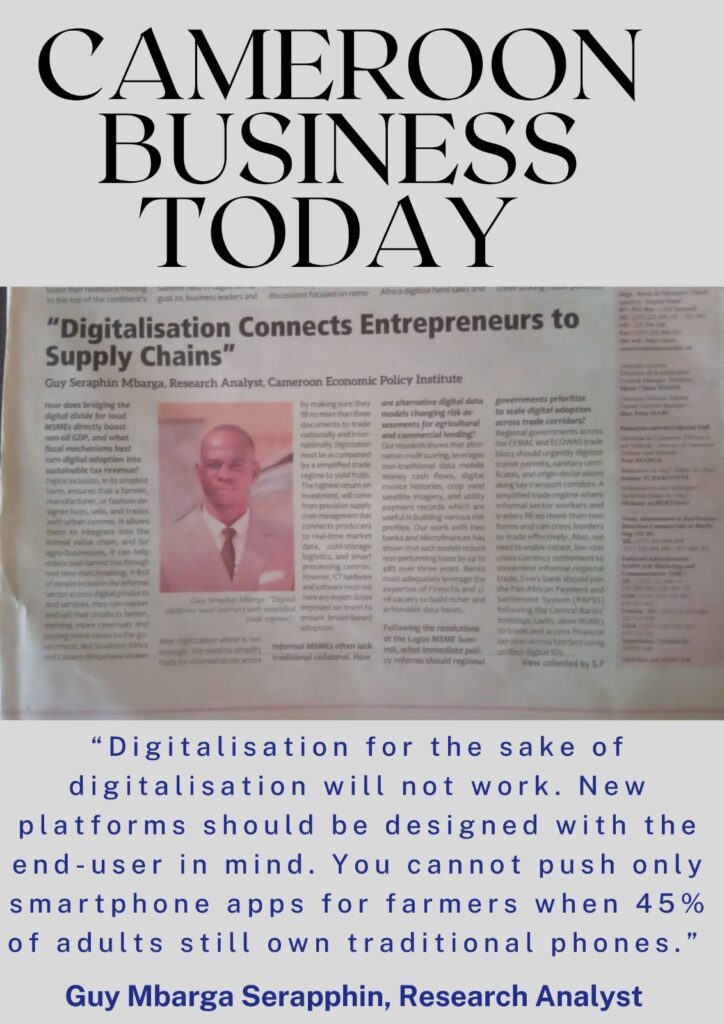
How does bridging the digital divide for local MSMEs directly boost non-oil GDP, and what fiscal mechanisms best turn digital adoption into sustainable tax revenue?
Digital inclusion, in its simplest form, ensures that a farmer, manufacturer, or fashion designer buys, sells, and trades with urban centres. It allows them to integrate into the formal value chain, and for agro-businesses, it can help reduce post-harvest loss through real-time matchmaking. If 85% of people locked in the informal sector access digital products and services, they can market and sell their products better, earning more revenues, and paying more taxes to the government. But Southern Africa [shows] that digitization alone is not enough. We need to simplify trade for informal sector actors by making sure they fill no more than three documents to trade nationally and internationally. Digitization must be accompanied by a simplified trade regime to yield fruits. The highest return on investment will come from precision supply chain management that connects producers to real-time market data, cold-storage logistics, and smart processing centres. However, ICT hardware and software must not have any import duties imposed on them to ensure broad-based adoption.
Informal MSMEs often lack traditional collateral. How are alternative digital data models changing risk assessments for agricultural and commercial lending?
Our research shows that alternative credit scoring leverages non-traditional data: mobile money cash flows, digital invoice histories, crop yield satellite imagery, and utility payment records, which are useful in building various risk profiles. Our work with two banks and Microfinances has shown that such models reduce non-performing loans by up to 48% over three years. Banks must adequately leverage the expertise of FinTechs and civil society to build richer and actionable.
Following the resolutions at the Lagos MSME Summit, what immediate policy reforms should regional governments prioritize to scale digital adoption across trade corridors?
Regional governments across the CEMAC and ECOWAS trade blocs should urgently digitize transit permits, sanitary certificates, and origin declarations along key transport corridors. A simplified trade regime where informal sector workers and traders fill no more than two forms and can cross borders to trade effectively. Also, we need to enable instant, low-cost cross-currency settlement to streamline informal regional trade. Every bank should join the Pan-African Payment and Settlement System (PAPSS), following the Central Banks’ footsteps. Lastly, allow MSMEs to trade and access financial services across borders through unified digital IDs.
Author
Guy Seraphin Mbarga
Research Analyst