A Supportive Tax Rate Will Boost Female Entrepreneurship
October 10, 2026
How Can We Build a Tax System That Supports Entrepreneurship in Cameroon?
October 24, 2026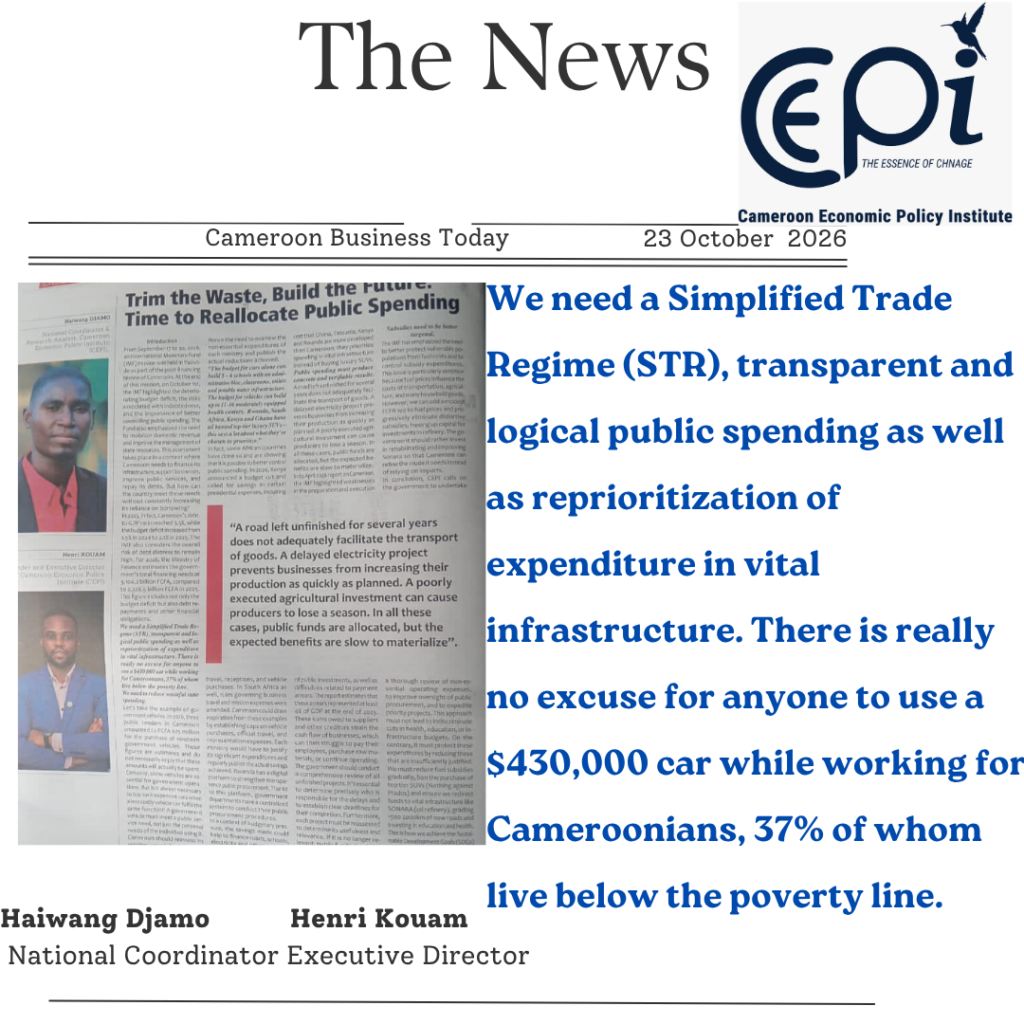
Introduction
From September 17 to 30, 2026, an International Monetary Fund (IMF) mission was held in Yaoundé as part of the post-financing review of Cameroon. At the end of this mission, on October 1, the IMF highlighted the deteriorating budget deficit, the risks associated with indebtedness, and the importance of better controlling public spending. The Fund also emphasized the need to mobilize domestic revenue and improve the management of state resources. This assessment takes place in a context where Cameroon needs to finance its infrastructure, support businesses, improve public services, and repay its debts. But how can the country meet these needs without constantly increasing its reliance on borrowing?
In 2025, in fact, Cameroon’s debt-to-GDP ratio reached 3.5%, while the budget deficit increased from 1.5% in 2024 to 2.1% in 2025. The IMF also considers the overall risk of debt distress to remain high. For 2026, the Ministry of Finance estimates the government’s total financing needs at 3,104.2 billion FCFA, compared to 2,326.5 billion FCFA in 2025. This figure includes not only the budget deficit but also debt repayments and other financial obligations.
We need a Simplified Trade Regime (STR), transparent and logical public spending as well as reprioritization of expenditure in vital infrastructure. There is really no excuse for anyone to use a $430,000 car while working for Cameroonians, 37% of whom live below the poverty line.
Henri Kouam, CEPI Founder
We need to reduce Wasteful the state’s spending.
Let’s take the example of government vehicles. In 2026, three public tenders in Cameroon amounted to 675 million FCFA for the purchase of nineteen government vehicles. These figures are estimates and do not necessarily imply that these amounts will actually be spent. Certainly, some vehicles are essential for government operations. But is it always necessary to buy such expensive cars when a less costly vehicle can fulfill the same function? A government vehicle must meet a public service need, not just the personal needs of the individual using it. Cameroon should reassess its priorities instead of systematically seeking new sources of funding. Hence the need to examine the non-essential expenditures of each ministry and publish the actual reductions achieved.
“The budget for cars alone can build 5 – 6 schools with an administrative bloc, classrooms, toilets and portable water infrastructure. The budget for vehicles can build up to 11-16 moderately equipped health centers. Rwanda, South Africa, Kenya and Ghana have all banned top-tier luxury SUVs – this says a lot about what they’ve chosen to priorities.”
Henri Kouam, CEPI Founder
In fact, some African countries have done so and are showing that it is possible to better control public spending. In 2024, the Kenya announced a budget cut and called for savings in certain presidential expenses, including travel, receptions, and vehicle purchases. In South Africa as well, rules governing business travel and mission expenses were amended. Cameroon could draw inspiration from these examples by establishing caps on vehicle purchases, official travel, and representation expenses. Each ministry would have to justify its significant expenditures and regularly publish the actual savings achieved. Rwanda has a digital platform to strengthen transparency public procurement. Thanks to this platform, government departments have a centralized system to conduct their public procurement procedures.
In a context of budgetary pressure, the savings made could help to finance roads, schools, electricity and other essential services, rather than continually increasing the debt. It’s no secret that Ghana, Tanzania, Kenya and Rwanda are more developed than Cameroon; they prioritized spending in vital infrastructure instead of buying luxury SUVs.
Public spending must produce concrete and verifiable results.
A road left unfinished for several years does not adequately facilitate the transport of goods. A delayed electricity project prevents businesses from increasing their production as quickly as planned. A poorly executed agricultural investment can cause producers to lose a season. In all these cases, public funds are allocated, but the expected benefits are slow to materialize.
In its April 2026 report on Cameroon, the IMF highlighted weaknesses in the preparation and execution of public investments, as well as difficulties related to payment arrears. The report estimates that these arrears represented at least 4% of GDP at the end of 2025. These sums owed to suppliers and other creditors strain the cash flow of businesses, which can then struggle to pay their employees, purchase raw materials, or continue operating.
The government should conduct a comprehensive review of all unfinished projects. It’s essential to determine precisely who is responsible for the delays and to establish clear deadlines for their completion. Furthermore, each project must be reassessed to assess its continued usefulness and relevance. If it is no longer relevant, public funds should be redirected to initiatives that truly address the country’s current needs.
Subsidies need to be better targeted.
The IMF has emphasized the need to better protect vulnerable populations from fuel costs and to control subsidy expenditures. This issue is particularly sensitive because fuel prices influence the costs of transportation, agriculture, and many household goods. However, we can add a modest FCFA 100 to fuel prices and progressively eliminate distortive subsidies, freeing up capital for investments in refinery. The government should rather invest in rehabilitating and improving Sonara so that Cameroon can refine the crude it needs – instead of relying on imports.
In conclusion, CEPI calls on the government to undertake a thorough review of non-essential operating expenses, to improve oversight of public procurement, and to expedite priority projects. This approach must not lead to indiscriminate cuts in health, education, or infrastructure budgets. On the contrary, it must protect these expenditures by reducing those that are insufficiently justified. We must reduce fuel subsidies gradually, ban the purchase of top tier SUVs (Nothing against Prados) and ensure we redirect funds to vital infrastructure like SONARA (oil refinery), grading 1500-2000km of new roads and investing in education and health. This is how we achieve the Sustainable Development Goals (SDGs) and our National Development Strategy (NDS 2030).
Authors
Haiwang Djamo
National Coordinator, Research Analyst, CEPI
&
Henri Kouam
Founder, Executive Director, CEPI