Simplifying Informal Cross-Border Traders Could Add FCFA 6.6 billion to the Public Purse
September 16, 2026
Palm Oil Sub-sector: A Review of Sector-Specific Policies to Support Balanced Development
September 22, 2026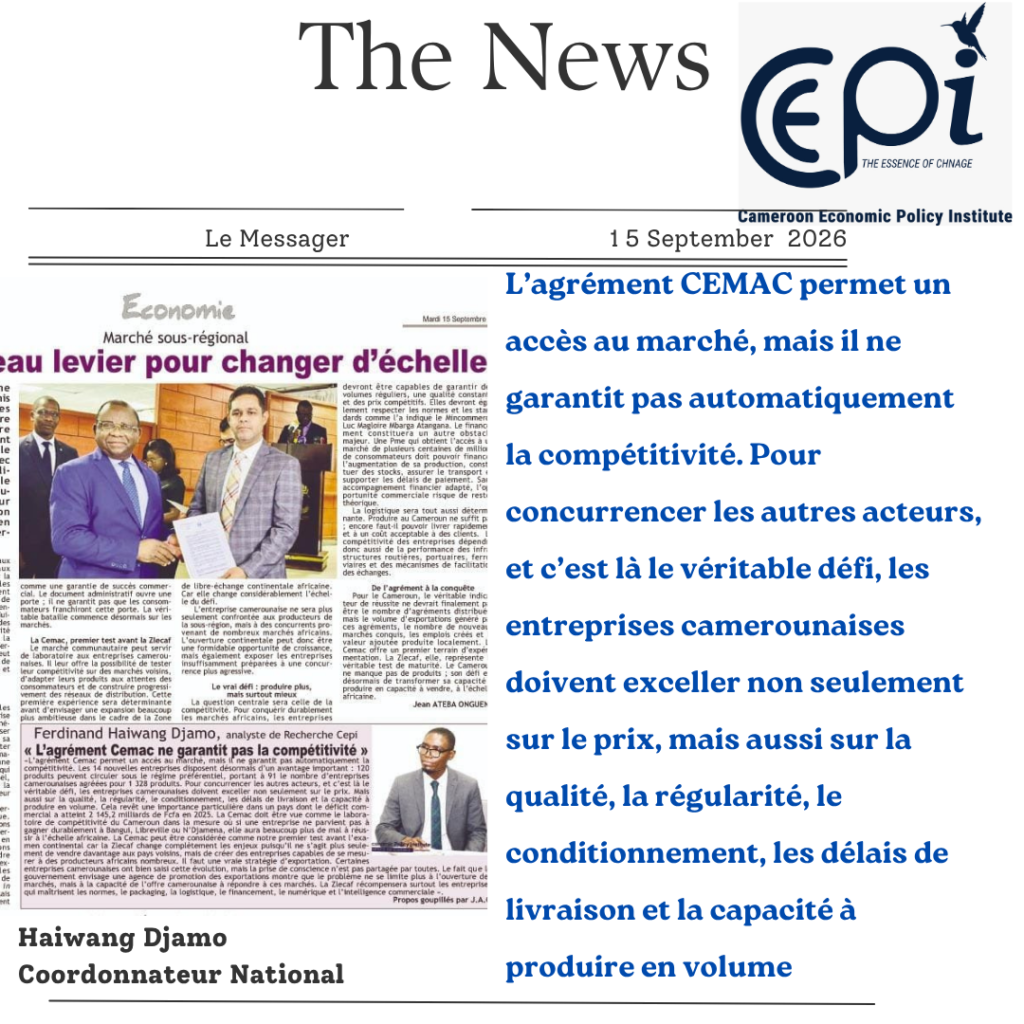
Can Cameroonian companies produce better products to compete with competitive products across the CEMAC region?
Yes, but we must avoid any confusion because CEMAC approval provides access to the market, but it does not automatically guarantee competitiveness. The 14 new companies now have an important advantage: 120 products can circulate under the preferential regime, bringing the total number of approved Cameroonian companies to 91, covering 1,328 products.
To compete with other players, and this is the real challenge, Cameroonian companies must excel not only in terms of price, but also in quality, consistency, packaging, delivery times, and their ability to produce at scale. This is particularly important in a country whose trade deficit reached CFAF 2,145.2 billion in 2025.
Therefore CEMAC should be seen as Cameroon’s competitiveness laboratory, because if a company cannot compete successfully and sustainably in Bangui, Libreville, or N’Djamena, it will have much greater difficulty succeeding at the African level.
The CEMAC market has been conquered, but the real test of maturity is the AfCFTA. Are Cameroonian companies aware of what is at stake?
CEMAC can be considered our first test before the continental examination, because the AfCFTA completely changes the stakes. It is no longer simply about selling more to neighbouring countries, but about building companies capable of competing with numerous African producers. This requires a genuine export strategy.
Some Cameroonian companies have clearly understood this shift, but awareness is not yet widespread. The fact that the government is considering establishing an export promotion agency shows that the problem is no longer limited to opening up markets, but also concerns the ability of Cameroonian businesses to meet demand in those markets.
The AfCFTA will primarily reward companies that master standards, packaging, logistics, financing, digital tools, and market intelligence.
Author
Haiwang Djamo, National Coordinator