
Banned Fertilizers in the EUShould BeBanned in Africa
August 25, 2026
Introduction
Regarded as Africa’s sixth region, the African diaspora now plays a significant role in the continent’s development. It is increasingly consolidating its economic power. In this regard, all African countries, following Cameroon’s example, have consistently called on and encouraged their nationals abroad to invest in their countries of origin, in order to contribute to their development. With an estimated total of over 6 million Cameroonians living abroad, according to the Ministry of Foreign Affairs, Europe is home to around 200,000, spread across the main countries shown in the first figure. The main destination for Cameroonians remains France, with an estimated population of over 100,000 (DSED, 2025), including a significant proportion of highly skilled individuals (AFD, 2020). According to a 2018 AU study, the Cameroonian diaspora in Europe is highly skilled (Eudif, 2023).
Figure 1: A selection of European countries with a significant Cameroonian presence
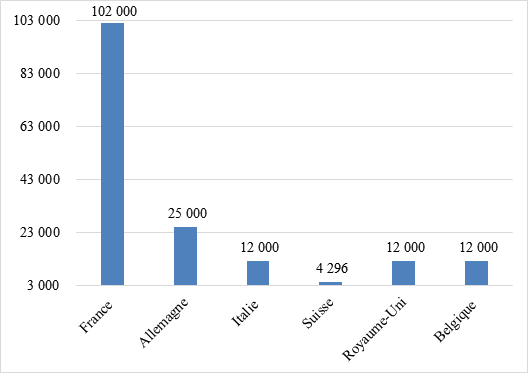
Source: The figures are drawn from both European development and cooperation agencies and statistical agencies.
Europe remains, overall, the preferred destination for Cameroonians. These statistics relate solely to those who have formalised their arrival by obtaining a residence permit. The figure could be an overestimate if Cameroonians residing illegally under European law were included.
Remittances as a financial flow
Indeed, remittances from Cameroonians in Europe – defined as money sent by the diaspora to relatives – are a significant source of funding for Cameroon’s development. They already constitute a source of external financing on a par with foreign direct investment, and provide much-needed foreign currency, whilst supplementing the incomes of poor families (North-South Centre 2006; Kouam, 2025).
In its Vision 2035, Cameroon highlighted the expected contributions from its diaspora in terms of funding (SNDS30, 2021). However, Cameroon does not have a formal institutional framework for the diaspora’s participation in development management (Eudif, 2023). Nevertheless, remittances generated by the Cameroonian diaspora generally account for 1.1 per cent of gross domestic product, which reflects a clear stabilisation compared with previous years (Fig. 2).
Figure 2: Trend in the value, in CFA francs, of remittances from the diaspora to Cameroon
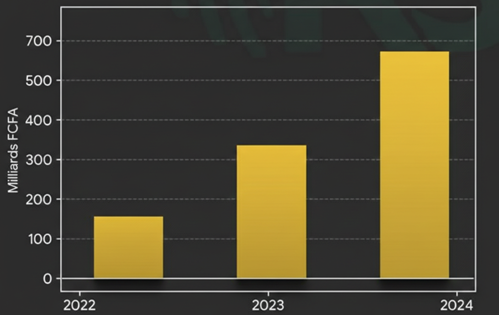
Source: the author, based on World Bank data
The Cameroonian diaspora can now be seen as an alternative to official development assistance. Of the 632 billion CFA francs remitted in 2024, nearly half came from the EU. France alone accounts for 35 per cent, whilst Belgium accounts for 12 per cent, the United Kingdom for 8 per cent, Germany for 7 per cent, Italy for 5 per cent and the rest of Europe for 5 per cent (Zogo, 2026). We must channel these resources into public and private investment to create jobs and wealth for investors.
Not only in terms of financial contributions, but also in terms of ideas, whilst enabling the financial independence of family members and instilling a spirit of entrepreneurship and business creation. This is because these ‘diaspora savings’ are often regarded as unproductive (Daum, 2007). Whilst productive investment by diaspora communities is gradually becoming a central theme in numerous international consultations on harnessing remittances for development, it also forms part of the current debate on financial accessibility and support for both supply and demand in relation to business creation or development and job creation (Lucas, 2014).
This analysis highlights the contribution of the Cameroonian diaspora to the country’s development; however, this contribution, whilst necessary and active, is primarily consumption-oriented (1) rather than focused on wealth creation or the establishment of SMEs. Despite the mechanisms put in place to promote the development and creation of SMEs (2), much work remains to be done to ensure the sustainable participation of the Cameroonian diaspora in Europe in the development of SMEs (3).
1. Significant Participation, but not Particularly Productivity-oriented
It is undeniable that the Cameroonian diaspora deserves credit for all the achievements it has made in recent years in terms of the economy, education, healthcare, the transfer of skills, and on a personal level. The funds sent by the Cameroonian diaspora are often one-off payments intended for immediate household consumption, mainly to cover essential needs such as food shopping, electricity and water bills, rent, children’s education, or property investment. Indeed, 90 per cent of these funds are spent on consumption or housing (Courtin, 2007). These various expenditures are by no means insignificant in themselves, as they contribute to the socio-economic well-being of their families back home and help to bridge the gap between rich and poor families in Cameroon.
The Cameroonian diaspora in Europe also helps to reduce social inequalities by carrying out social projects in Cameroon, particularly in rural areas, by building schools and health centres, and by drilling boreholes.
Investments by ‘Mbenguists’ in various sectors
The economic capital, in particular, is awash with second-hand markets where one can find second-hand goods sent by the diaspora for commercial purposes. Furthermore, there has been a proliferation of leisure venues such as snack bars, motels, hotels and gambling centres. These establishments are often named after the towns where the diaspora is based, as if to indicate that these places fall under their influence or are owned by ‘Mbenguists’. [A Cameroonian term used to describe those living in Europe.] The Cameroonian diaspora also invests in the construction of buildings intended for letting or for housing family members.
Consequently, these investments require a sound financial position not only on the part of the diaspora but also of their families who have remained in the country of origin. This investment trend stems from the lack of clarity surrounding the support mechanisms provided to the Cameroonian diaspora by the public authorities, which have only very recently begun to get involved, even though resistance persists.
When a member of the diaspora sets up a business, they must meet the same requirements and face the same obstacles in accessing bank finance, due to a lack of collateral in the country of origin and an often limited banking history in the country of residence. These challenges are exacerbated by the ‘dual space’, which manifests as a twofold absence: conditional support in the North and a lack of accessible aid in the South for diaspora investors, due to a lack of information or schemes that are difficult for non-residents to access.
2-Towards a more Productive Mobilisation of the Diaspora for SME development
We are increasingly seeing a range of initiatives aimed at making productive use of remittances to support business creation or mobilise savings, as well as the development of public policies addressing the migration-development nexus in the countries of origin of diaspora members. In the long term, this enables better management of migration, whilst ensuring its positive impact on development (Lucas, 2014). Building on the fact that remittances from the diaspora exceed official development assistance, most African countries, such as Cameroon, are implementing or attempting to implement a public policy on the diaspora (Lucas, 2014).
Recognising the potential of these remittances, the European Union has put in place strategic tools to help Africa, particularly Cameroon, capitalise on them and integrate them sustainably into their economies. It aims in particular to support the creation and growth of local industry. The Cameroonian economy relies mainly on small and medium-sized enterprises (SMEs), which are essential to the country’s structural transformation (SNDS30, 2021). The government initiatives currently in place to attract the diaspora to Cameroon resemble political programmes rather than a genuine movement aimed at encouraging the diaspora to set up SMEs. These include the removal of customs duties on agricultural inputs and on machinery, electric vehicles, wind turbines and solar panels.
This is also the case with the Strategy for Engaging the Diaspora in Cameroon’s Socio-Economic Development, an ongoing initiative (2025–2026) launched by MINREX, in collaboration with the IOM mission in Cameroon. It aims to support the Cameroonian government in drawing up a strategic document and a policy instrument designed to mobilise the diaspora in support of Cameroon’s sustainable and inclusive socio-economic development. The expected outcomes include a gender-sensitive engagement strategy, accompanied by an action plan, a mapping of the Cameroonian diaspora, and capacity-building on diaspora engagement within MINREX and amongst relevant stakeholders (Eudif, 2023). These strategies could help channel remittances towards productive investments, strengthen the participation of Cameroonians abroad in the financing of small and medium-sized enterprises, and promote the transfer of skills, technologies and commercial networks.
The National Development Strategy 2020–2035, for its part, aims to build the country’s economy through a series of regulatory reforms designed to attract more investment. It includes the objective ‘(iii) to attract capital holders (investors and the diaspora) and professionals from various sectors of the financial ecosystem’ (SNDS30, 2021).
The Cameroon Business Association (GECAM) has not stood idly by when it comes to harnessing the potential of the Cameroonian diaspora. Indeed, in October 2024, it launched the GECAM Diaspora Office. This initiative supports the Cameroonian government in its strategy to harness the potential of the diaspora to boost local businesses. So far, the initiative is at the mapping stage and has not yet yielded any concrete results.
Cameroon, like many African countries, benefits from external support and involvement (Mvogo et al, 2026) in establishing appropriate mechanisms to harness the savings of its diaspora, channelling them into sectors that generate long-term wealth. This is part of the co-development initiative between Africa and Europe, with the participation of the African Development Bank. The most high-profile initiative is the one supported by the French Development Agency under the name DIASDEV (Diaspora and Development), which involves European and African deposit banks. Its main aim is to secure financial flows from diasporas to their countries of origin, so that a portion of these savings can be channelled into investment across the African continent. This mechanism enables the savings of the diaspora to be channelled towards funding infrastructure and local SMEs. Launched in January 2023, this project runs until December 2026, with a total of 3 million euros mobilised, primarily intended for the deposit funds of the following countries: Benin, Cameroon, Côte d’Ivoire, Gabon, Mauritania and Tunisia. It is also in line with this initiative that Cameroon, more broadly, aims to raise 2,000 billion CFA francs from its entire diaspora to finance local projects.
The MEET Africa initiative (Cameroon, Côte d’Ivoire, Morocco, Senegal, Tunisia) is a project aimed at developing entrepreneurship amongst diaspora communities between Europe and Africa, implemented by the EU and the AFD, and co-financed to the tune of 8.5 million euros. Between 2020 and 2024, this project supported 142 entrepreneurial ventures. In Cameroon, in particular, the first phase of the initiative funded 15 projects led by an association representing the Cameroonian diaspora (SIAD), as shown in the figure below. The convincing results achieved in integrating young people into the labour market through salaried employment during the first phase are now being channelled towards helping young people find employment by setting up their own businesses and launching their start-ups.
All of this could increase the resources available to finance SMEs, infrastructure and productive projects, whilst reducing dependence on public and external funding. It may also strengthen the role of the diaspora as a source of patient capital and skills transfer.
Figure 3: MEET Africa Project intervention area
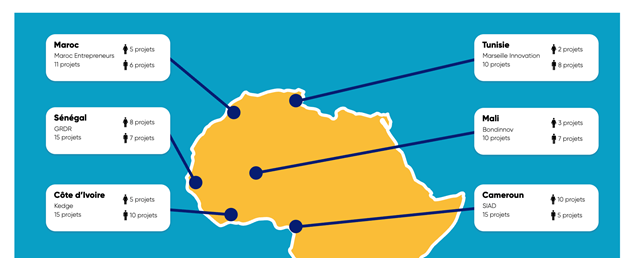
Source: https://www.meetafrica.fr/statistiques-meet-africa/
Furthermore, the WIDU project, which is also funded by the European Union, supports each entrepreneur in Cameroon in securing sponsorship from a relative living in one of the 27 EU Member States, in Switzerland, or in Norway, to receive a grant of up to 3,000 euros for their first application and up to 5,000 euros for their second and third applications. In addition to this financial support, entrepreneurs benefit from three personalised coaching sessions. Since its launch in 2019, it has consistently delivered encouraging results, as shown in this table.
Table 1: Summary of the WIDU project in Cameroon
| Indicator Value | Indicator Value |
| Businesses supported 2,230 | Businesses supported 2,230 |
| Amount of grants 4.0 million euros | Amount of grants: 4.0 million euros |
| Joint investment mobilised: 3.7 million euros. | Joint investment mobilised: 3.7 million euros |
| Jobs safeguarded and created: 4,880 | Jobs safeguarded and created: 4,880 |
| Proportion of jobs held by women: 48% | Proportion of jobs held by women: 48% |
Source: https://widu.africa/fr/cameroun
Recommendations
Today, Cameroon increasingly recognises the value of its diaspora to its development. However, to integrate it in a sustainable and permanent manner, several adjustments are necessary, particularly to support the growth of SMEs. It is therefore essential to:
- Rethink the issue of dual citizenship in Cameroon. This is the main obstacle: although mechanisms exist for foreign investment, the situation must be treated differently when it comes to a Cameroonian by origin, who should not be subject to the same conditions and tax regimes as a foreigner when setting up and establishing an SME.
- Establish a ministry responsible for the diaspora, given the significant contribution it makes to Cameroon in terms of remittances and the transfer of skills. In the same vein, seats in the Cameroonian Parliament should be allocated to the Cameroonian diaspora to best defend their interests, as is the case in Cape Verde.
- Encourage the Cameroonian diaspora, through government programmes or state agencies such as the Investment Promotion Agency (API), to invest in sectors facing labour shortages, with a view to training the local workforce and enabling it to achieve sustainable self-sufficiency.
- Channelling a small proportion of remittances intended for families into a solidarity fund, set up jointly by the State, banks and remittance agencies for a fixed period, and making this available to families on condition that they set up a small business, thereby facilitating their financial independence.
- Facilitating the integration of the diaspora into the high-performing sectors of the Cameroonian economy – which are very often in the hands of foreigners – will help to relieve pressure on the informal sector and create a more efficient and productive economic fabric.
- Preventing capital flight by enabling the Cameroonian diaspora to acquire SMEs, which could then – rather than repatriating capital, as foreign companies do – reinvest profits in the local economy, for example through investment in infrastructure and education, to name but a few. This also helps to reduce tax evasion.
- Jointly establish banks or set up partnerships between Cameroonian and European banks to enable the Cameroonian diaspora to access their bank accounts both in the European country where they are based and in their country of origin, for banks with branches in both Cameroon and Europe. This could facilitate access to credit and lend credibility to investments in Cameroon. This is already happening, for example between Senegal and France, as well as between Morocco and France.
- Encourage the Cameroonian government to commit more fully to the co-development policy and to recognise its benefits, particularly in terms of economic growth and the creation of SMEs. At the same time, encourage the diaspora to invest in the local economy to promote job creation, particularly for young people.
- Build on existing co-development initiatives from which Cameroon benefits to further facilitate the growth of SMEs.
- Draw inspiration from the co-development policies introduced by the EU in 2006, notably the co-development savings account scheme. This involves placing migrants’ savings into blocked accounts, so that they can be mobilised to finance projects in the Global South (Cameroon). It also aims to facilitate business start-ups in the country of origin (Cameroon). The advantage of this savings account is that 25 per cent of the savings is tax-deductible from taxable income, which is intended to attract the Cameroonian diaspora. Co-development aims to channel these remittances towards investment through various types of bank accounts.
- Encourage joint venture initiatives between the diaspora and local people to facilitate investment by the diaspora, enabling the country to benefit from foreign knowledge and skills, and vice versa.
- Enable the diaspora, through public and private sector programmes (GECAM), to support local industry through sustainable investment.
- Accelerate the implementation of government programmes on the diaspora’s participation in Cameroon’s development.
- Create a digital platform within the Ministry of External Relations, in conjunction with diplomatic missions in Europe, to provide regular and accurate figures on the number of Cameroonians living in Europe. This platform can also serve as a showcase for the various projects that the Cameroonian diaspora may undertake and provide information transparently to avoid any…
Conclusion
Although the Cameroonian diaspora appears to be included in the country’s development, the government remains wary. Relations with the diaspora have still not reached the point where a relationship of trust can be established, particularly during the post-election crises following the last two presidential elections, which saw the looting of certain diplomatic missions in Europe. However, this crisis of trust does not call into question the contribution made by this diaspora to Cameroon. Firstly, it enables them to provide comfortably for their families, thereby narrowing the gap between rich and poor. The realisation that these remittances are becoming very consistent and can be more profitable has led, as we have emphasised, the European Union to examine the issue, providing support for projects aimed at promoting growth and the creation of SMEs. It is also for this reason that the Cameroonian government is involved and is attempting to adopt a policy in this direction, despite several political obstacles. Other African countries, such as Morocco and Senegal, have policies relating to the diaspora; they take an interest in the savings of this diaspora, which facilitates their integration, and Cameroon could, for example, draw inspiration from this.
Although the Cameroonian diaspora’s contribution to national GDP is currently minimal compared with that of the countries mentioned above, it could increase in the coming years, particularly if the obstacles to c
References
AFD, AFD. (2020). Favoriser les investissements productifs de la diaspora camerounaise.” https://www.afd.fr/sites/default/files/pdfs/favoriser-les-investissements-productifs-de-la-diaspora-camerounaise-7640-fr.pdf
Bakewell, Oliver. (2012). Migration and Development. Cheltenham, UK ; Northampton, MA: Edward Elgar Publishing Ltd
Courtin, Christophe. (2007). Le codéveloppement : un alibi pour des politiques migratoires restrictives. Science Politique. Revue internationale et stratégique 68 (4): 43–47. https://doi.org/10.3917/ris.068.0043
Daum, Christophe. (2007). Le codéveloppement, grandeur et décadence d’une aspiration généreuse. Revue internationale et stratégique 68 (4): 49–59. https://doi.org/10.3917/ris.068.0049
Eudif. (2023). Diaspora Engagement Mapping CAMEROON.” https://diasporafordevelopment.eu/wp-content/uploads/2024/05/CF_Cameroon-v.3.pdf
Henri, Kouam. (2025). Economic Implications of the Pan-African Payment and Settlement Systems (PAPSS) on Inflation and Financial Stability.” J Glob Entrep Manage (2025): 129. DOI: 10.59462/3068-174X.3.3.129 https://scitechjournals.com/articles/economic-implications-of-the-pan-african-payment-and-settlement-systems-papss-on-inflation-and-financial-stability.pdf
Lucas, Virginie. (2014). Les activités de l’Agence française de développement en matière de soutien à l’investissement productif des diasporas. Économie. Techniques Financières et Développement 114 (1): 17–28. https://doi.org/10.3917/tfd.114.0017
Mvogo, Pierre Oyono, Jean Marie Etogo Assene Nkou, and Sanae Kasmi. (2026). European Implication in Migratory Governance in Africa Through Co-Development.” The International Journal of Interdisciplinary Global Studies, ahead of print, February 5, 2026. https://doi.org/10.18848/2324-755X/CGP/A159
North-South Centre. (2006). Migration and Co-Development: Social Remittances of the African Diasporas in Europe/ Case Studies: Netherlands and Portugal. https://rm.coe.int/168070ac75
SNDS30. (2021). SNDS30 Cameroun_ Version Rev DG Du 22 Nov 2021. https://ins-cameroun.cm/wp-content/uploads/2025/07/Strategie-Nationale-de-Developpement-de-la-Statistique-SNDS30.pdf
Zogo, Marius. (2026). Cameroun : la diaspora a transféré 652 milliards de FCFA en 2024, dont 35 % depuis la France. EcoMatin, January 28. https://ecomatin.net/cameroun-la-diaspora-a-transfere-652-milliards-fcfa-en-2024-dont-35-depuis-la-france
Author
Pierre OYONO MVOGO, Research Fellow