From ENEO to SOCADEL: Implications of Re-nationalising the Energy Sector and How to Make it Deliver for Users
August 5, 2026
Africa Minerals Export Control: Lessons From Indonesia
August 21, 2026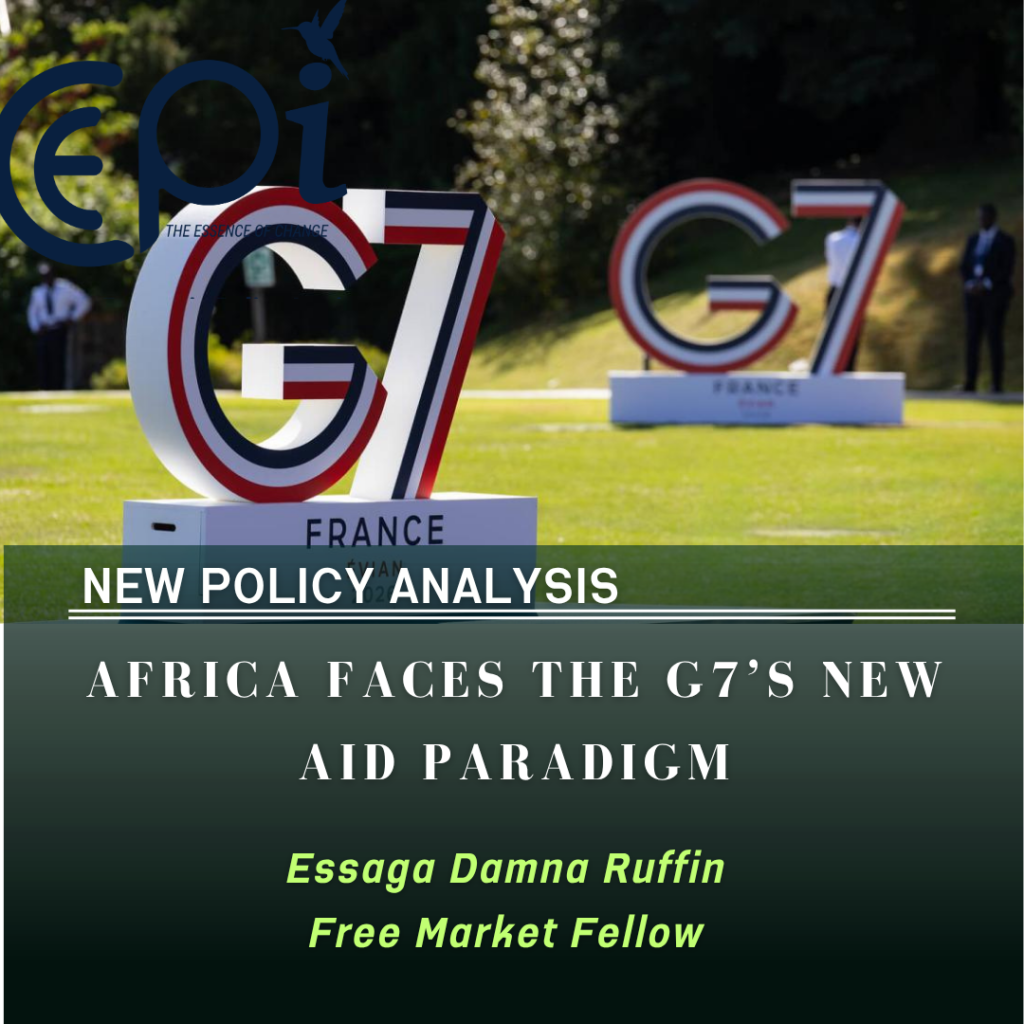
Introduction
Since the 1960s, North-South cooperation has undergone numerous events, challenges, and twists and turns that have shaped its evolution and the structure we see today. This cooperation is heavily focused on financial aspects, one of the main instruments of which is official development assistance (ODA) from countries in the North to those in the South, with funding largely dominated by the G7 countries, which alone account for more than 70% of total aid—aid that peaked in 2023 and is estimated at approximately $223.7 billion. However, at the previous G7 summit held June 15–17, 2026, in Évian-les-Bains, France, official development assistance underwent a major reform. Faced with the depletion of public budgets in Northern countries and the ongoing over-indebtedness of Southern countries, ODA is now outdated; contrary to all expectations, the G7 has opted for a transition to a new form of collaboration known as “mutual collaboration,” focused on co-investment. This shift could influence the future of the economies of countries in the Global South, particularly those in sub-Saharan Africa, which, according to World Bank data, are the primary recipients of global aid.
Our analysis focuses on four key areas: (1) the limitations of official development assistance and the factors that have led to the decline of this model; (2) the reforms undertaken by the G7 in response to these limitations; (3) the endogenous potential of sub-Saharan African countries; and (4) the implications of this paradigm shift for the region’s development.
1. Moving Beyond Official Development Assistance
ANGUS DEATON (2013) explained that effective development policy can only succeed in countries with strong institutions where good governance prevails and democracy is respected and implemented. Furthermore, he added that if a country is poor not because it lacks resources and opportunities, but rather because the conditions necessary for the proper functioning of a development policy are being violated, then directing ODA to the governments of such countries would literally amount to perpetuating and prolonging poverty in those states. Indeed, the vast majority of sub-Saharan African countries—if not all—fit Deaton’s description perfectly: rich in resources of all kinds, but with very weak institutions, corrupt governments, and fragile democracies. This aligns perfectly with the seminal work by Daron Acemoglu, Simon Johnson, and James A. Robinson (2001), in which they explain that a nation’s economic future depends on the quality of its institutions.
Since the institutions of sub-Saharan African countries are known to consist primarily of extractive economies, led by long-serving leaders and lacking any countervailing power, ODA is therefore largely intended to sustain rent-seeking networks rather than finance sustainable investments; in fact, in 2011, $4.4 trillion in assets belonging to wealthy residents of the Global South left the continent through tax evasion, finding their way into secret bank accounts in wealthy countries, thereby facilitating corruption among political elites, leaders, and senior officials in Southern nations, who are thus able to conceal stolen funds (Global Financial Integrity, Center for Applied Research (NHH), et al., 2015). The financial situation of these countries further illustrates this point: highly vulnerable to external shocks such as rising interest rates, they sometimes fail to strike a proper balance between their external debt and their domestic operating budgets: by 2025, more than half of African countries will be spending more on debt repayment than on their health and education systems, sometimes paying interest amounting to as much as 18% of these countries’ revenue—which demonstrates once again that, despite the aid allocated to them, Sub-Saharan African countries export more money than they receive, further weakening their economies.
In light of the evidence showing the ineffectiveness of ODA provided to these sub-Saharan African countries, the logical question to ask is: Who actually benefits from this system? Studies conducted by Global Financial Integrity, the Center for Applied Research (NHH), and others reveal that ODA is entirely characterized by resource-draining mechanisms facilitated by well-established financial structures in recipient countries; according to these studies, every $1 of aid sent to developing countries is equivalent to $10 illicitly extracted from those countries and funneled to rich nations.
Furthermore, Edmond Ghislain and Thomas Collombat (2024) analyze and explain that ODA is an economic strategy implemented by rich countries to “create” new customers for their products; they illustrate this with the following statement: “It is urgent to help developing countries advance so that they can become consumers of goods and services produced by rich countries as quickly as possible. The existence of tied aid is proof that aid is not a purely altruistic act, since forcing the purchase of technologies or machinery from the donor country or prioritizing the latter’s strategic interests redirects a large portion of the aid’s actual economic impact toward the economies of Northern countries. Aid therefore benefits companies in the North more than it does poverty reduction in the South.
However, geopolitical crises and external shocks—such as the blockade of the Strait of Hormuz—faced by developed countries would gradually lead them to focus more on immediate emergencies, including rising inflation, unemployment, or the transition to energy sources other than oil—a shift that requires them to mobilize colossal sums, which are far below the actual needs of sub-Saharan African countries, estimated at approximately $4 trillion. In other words, since the aid system is ineffective and primarily serves the interests of the North, the actual public resources that the G7 is willing or able to allocate today have become negligible. The budgets of the North are running dry, while the actual needs of the South—exacerbated by crises involving fertilizer shortages, malnutrition, and colossal debts—have become astronomical. As a result, the countries of the North can no longer—and no longer wish to—bridge this gap. The model is therefore mathematically and politically obsolete.
2. The New Reforms Adopted by the G7
The G7 countries have gradually recognized the need to rethink official development assistance. This is because financial aid alone is not sufficient to sustainably reduce poverty or inequalities between countries. Development also requires reforms, productive investments, and policies capable of strengthening the economic autonomy of recipient countries. This realization came well before the Évian-les-Bains conference, where several studies had already demonstrated the limitations of financial aid.
The shift from a traditional “donor–recipient” model to mutually beneficial partnerships can therefore be seen as a hopeful attempt to engage developing countries—particularly those in sub-Saharan Africa—in taking real ownership of their own development. It is in this context that Berg and Zanna (2010) explain that the effectiveness of ODA will depend heavily on the respective characteristics of each recipient country, particularly on the actions of public policymakers in response to the various economic challenges they face. Having understood this, the G7 therefore decided to transform aid into productive investments, which can be grouped into three categories.
On the financial front, plans are in place to modernize financial flows by revising the rules of the OECD’s Development Assistance Committee (DAC) by 2027 to better integrate private capital and non-traditional financing, on the one hand, and to establish a new global debt architecture to make it more predictable, transparent, and coordinated. These approaches will enable aid to be used as a lever to attract more private investment.
In terms of sovereignty, it was decided to strengthen the autonomy of aid-receiving countries by promoting and facilitating the mobilization of their own domestic resources, thereby enabling them to modernize their tax systems to increase their self-financing capacity over the long term and to respond more effectively to health crises without resorting to external aid.
From a structural perspective, plans call for the deployment of strategic economic corridors through the Partnership for Global Infrastructure and Investment (PGII), which—unlike past extractive models—will facilitate regional integration, the creation of local value chains, and the improvement of supply chains through the establishment of trade routes, particularly for critical minerals.
Since the G7 now considers that development can no longer rely primarily on official aid, the central question becomes what resources developing countries in general—and African countries in particular—are capable of mobilizing on their own to finance their own economic transformation.
3. The Endogenous Potential of Sub-Saharan African Countries
Developing countries are generally considered to be dependent on aid due to their difficult economic situation. However, it turns out that these countries are actually net creditors to the rest of the world.
To reach this conclusion, the study conducted by Global Financial Integrity and the Center for Applied Research took illicit financial flows into account when calculating Net Resource Transfers. The results speak for themselves: between 1980 and 2012, approximately $16,346.8 billion left developing countries, of which $13,371.9 billion was illicit. Africa thus lost nearly $789.2 billion, making it a net creditor as well.
This finding challenges the commonly held belief that capital flows primarily from rich countries to poor countries. It is also important to note that sub-Saharan Africa possesses a significant amount of domestic capital, estimated at over $4,000 billion (AgenceEcofin, 2026). Furthermore, remittances from the diaspora to developing countries reached $685 billion in 2024, surpassing the combined flows of foreign direct investment and official development assistance.
These figures clearly demonstrate that the real challenge lies not in receiving more aid, but rather in better mobilizing and retaining existing resources to finance development sustainably. It is essential to find ways to enable developing countries to retain and effectively use their own resources for their economic development.
4. The Implications of This Paradigm Shift for Sub-Saharan African Countries
Developing countries need development assistance; when faced with external shocks such as wars or pandemics, they become more dependent on ODA. However, as these countries’ economies improve and they begin to grow wealthier, they no longer express a need for ODA but instead seek to mobilize their own domestic resources for their development (UNCTAD). This shows that to end their dependence on official development assistance, African states must radically embark on transforming their economies with the goal of economic growth in order to become wealthier and fully realize their potential. This paradigm shift is therefore an opportunity for these states to choose this sole path that would benefit them without further delay. But to do so, we must first identify the factors and ills that, since their independence, have prevented them from achieving genuine economic growth. Studies conducted to date are nearly unanimous on this point: poor governance and mismanagement of resources are Africa’s ills. These ills lead to institutional and structural problems that undermine our economic stability.
Corruption is one of the major problems hindering development in sub-Saharan Africa. The continent’s corruption score is 32 out of 100, which is well below the global average of 42, as reported by Jeune Afrique. Corruption becomes a systemic problem when the benefits it provides outweigh the risks it entails.
In Cameroon, Viviane Ondoua Biwolé demonstrated in 2026 that when leaders remain in office longer than their legal term allows, this facilitates the misappropriation of public resources and key positions. This has serious consequences: governance is weakened, public enterprises are mismanaged, financial losses occur, and public debt rises. Consequently, the cost of corruption is not limited to the resources that are embezzled; ultimately, it is borne by citizens and future generations.
Recommendations
At the political level, leaders must respect the constitutions and the rules governing their offices. This means they must adhere to term limits and accept the rotation of power. This will allow for the renewal of public officials and limit the concentration of power. This will also reduce opportunities for the creation of networks of corruption, favoritism, and the misappropriation of public resources.
Regarding the informal sector, the government must recognize its economic significance and gradually integrate it into the tax system. Even though it is difficult to determine the exact revenue of a small retailer, a flat-rate tax tailored to the size of the business can be applied. The identified businesses could be given a period of 2 to 5 years to formalize their operations, with guidance on how to access existing support mechanisms. Ultimately, this approach will broaden the tax base, integrate informal activities, and strengthen the country’s national resources.
Conclusion
The shift in the model of official development assistance is a significant moment for sub-Saharan African countries. Foreign aid is gradually declining, but this should not be viewed solely as a problem. It can be an opportunity for African states to become more economically self-reliant. Africa has abundant resources, but it is difficult to use them effectively due to issues such as weak institutions, corruption, informal economic activities, and mismanagement of public resources. The real challenge is to transform these resources into investments that can truly support long-term growth. African nations must now rely less on external funding and learn to make better use of their own capabilities. This transition could ultimately help foster development that is more self-reliant, accountable, and sustainable for Africa.
References
Acemoglu, D., Johnson, S., & Robinson, J. A. (2001). The colonial origins of comparative development: An empirical investigation. The American Economic Review, 91(5), 1369–1401. https://www.aeaweb.org/articles?id=10.1257/aer.91.5.1369
Banque mondiale. (s. d.). Aide publique au développement nette reçue (dollars courants des États-Unis). https://donnees.banquemondiale.org/indicateur/DT.ODA.ALLD.CD
Berg, A., & Zanna, L.-F. (2010). Half empty or half full. Finance & Development, 47(3), 17–19. https://www.imf.org/external/pubs/ft/fandd/2010/09/pdf/fd0910.pdf
Conférence des Nations Unies sur le commerce et le développement. (s. d.). L’aide à la croisée des chemins : Tendances de l’aide publique au développement. ONU Commerce et Développement. https://unctad.org/fr/publication/laide-la-croisee-des-chemins-tendances-de-laide-publique-au-developpement
Deaton, A. (2013). The great escape: Health, wealth, and the origins of inequality. Princeton University Press.
Emond, G. E. (2024). L’aide publique au développement : Un instrument de développement ou un levier d’influence économique des pays donateurs ? [Essai de maîtrise, Université du Québec en Outaouais]. https://di.uqo.ca/id/eprint/1827/1/Emond_Ghislain_2024_Essai.pdf
France Diplomatie. (2026). G7 leaders’ declaration on mutually beneficial international partnerships. Ministère de l’Europe et des Affaires étrangères. https://www.diplomatie.gouv.fr/en/presse-et-ressources/decouvrir-et-informer/actualites/declaration-des-chefs-d-etat-et-de-gouvernement-du-g7-sur-des-partenariats-internationaux
Global Financial Integrity, & Centre for Applied Research, Norwegian School of Economics. (2015). Financial flows and tax havens: Combining to limit the lives of billions of people. https://www.gfintegrity.org/wp-content/uploads/2016/12/Financial_Flows-final.pdf
Instituto Affari Internazionali. (2026). A new era of aid: Acting together, from G7 2026 to G20 2027. IAI.
Jeune Afrique. (2025). Corruption en Afrique : État des lieux pays par pays. https://www.jeuneafrique.com/1764615/politique/corruption-en-afrique-etat-des-lieux-pays-par-pays/
OCDE. (2024). Coopération pour le développement 2024 : Financer le développement durable. https://one.oecd.org/document/DCD(2024)30/fr/pdf
Ondoua Biwolé, V. (2026). Quand l’illégalité a un prix : Le triple naufrage des entreprises publiques camerounaises. https://edocsflow.com/d/ebook-3-4-qui-est-encore-en-regle
Rose-Ackerman, S., & Palifka, B. J. (2016). Corruption and government: Causes, consequences, and reform (2nd ed.). Cambridge University Press.
Author
Essaga Damna Ruffin
Free Market Fellow