Cameroon’s Energy Transition Starts With Natural Gas
July 21, 2026
Africa Faces the G7’s New Aid Paradigm
August 11, 2026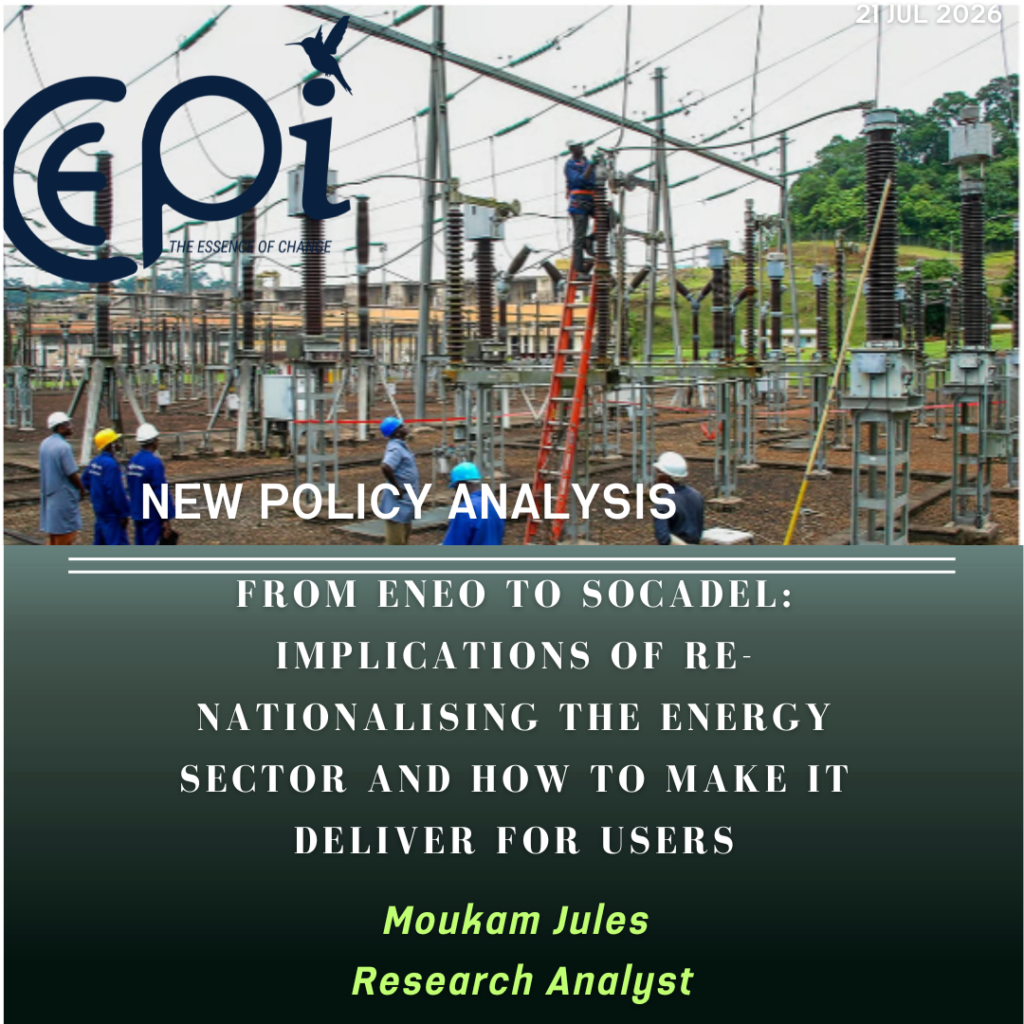
Introduction
By Presidential decree, on May 04 2026, ENEO was re-nationalised and renamed Cameroon Electricity Corporation (‘SOCADEL’ from the French name). In this operation, the government spent 78 billion Francs CFA to buy the 51% shares of Actis. Hence, the state is the sole owner of the sole electricity producer.
After letting the private sector operate it for 25 years, re-nationalising the electricity producer is a significant policy shift. Especially since only a minority of state-owned electricity companies in Africa make profits.
Nevertheless, SOCADEL has been mandated to carry out all activities relating, directly or indirectly, to the production, distribution, import/export, purchase, sale and use of electric power. Thereby making it the primary custodian of the bold energy objectives outlined in the National Development Strategy 2030 (NDS30): produce abundant energy to improve the living conditions of the people, meet industrialisation needs, and become an energy exporting country.
In this brief, we will do a historical exploration of electricity providers in Cameroon. From the privatisation of SONEL in the early 2000s to the more recent nationalisation of ENEO. Then, we will explore what this swing between private and public ownership implies for industrial policy and energy sovereignty in Cameroon. Finally, we will provide policy recommendations to ensure that SOCADEL delivers for its users.
Historical Exploration of Electricity providers in Cameroon: swing between Nationalisation and Privatisation
Since the year 2000, the electricity sector has been managed by four companies, two of which were privately owned.
From its creation in 1974, SONEL was operated as a publicly owned company up to its privatisation in 2001. Its generation capacity reached 819 MW for 452,000 connections. According to the former accounting and finance director, Garga Haman Adji, SONEL was a financially strong and mission-driven company. The profit increased from 286 million FCFA in 1974 to three billion in 1976. Also, the company reinvested all profits in the company and electrification projects.
In July 2001, SONEL was privatised. After making the unique bid of 71 million dollars, AES Corporation acquired 56% of SONEL’s equity and entered into a 20-year concession to generate, transmit, and distribute electricity in Cameroon. However, there were divergent views on the outcomes of this privatisation process.
Private sector investment yielded significant positive results. According to the International Finance Corporation, SONEL could not meet the growing demand for electricity in the country. The 452,000 connections were insufficient to serve a population of nearly 16 million people. The national steel melter, ALUCAM, single-handedly consumed about one-third of the supply and the overreliance on hydroelectric power exposed the country’s grid to droughts. Privatisation increased power capacity to 1,033 MW, enabled the construction of thermal power plants to hedge against the effects of droughts, expanded the number of connections by 75% to 792,000 and brought the electrification rate to nearly 50%.
The privatisation was not only unnecessary, but it was also ineffective, according to Pierre-Olivier Pineau. SONEL was not sold because of its poor governance or inefficiencies. It was sold to align with the World Bank’s structural adjustment credit (SAC) project. Because of the commodity price shocks that peaked in 1987, countries had to comply with SACs’ requirements in order to access credit. Assessing the state of the electricity sector three years after privatisation, he notes confused management and a dissatisfied population. In its first three years, AES SONEL had three managers. Also, there were power brownouts, and blackouts had become extremely frequent. The newspaper reported at least 57 court cases against AES SONEL seeking competition for losses due to power outages (Le Messager 2003)
ACTIS acquired AES SONEL in 2014. The UK-based private equity firm bought 56% of assets for 220 million US dollars. After a naming competition, the name Eneo Cameroun SA (Energy of Cameroon) was adopted. Subsequently, Eneo operated as a private company until a few weeks ago, when it was nationalised and called SOCADEL.
Implications for Industrial Policy, Energy Sovereignty, and State Capitalism in Cameroon
There are a few sectors more vital to an economy than the electrical energy sector. Whether to keep the massive industrial behemoths like ALUCAM running or the bulb in the local barber’s shop on, everyone needs electricity. In Cameroon, while stewardship of this sector swung between public and private hands, more households were connected, and the grid was protected from seasonality.
There are two major arguments for nationalising the energy sector: to control key resources within the country and to ensure an equitable distribution of energy. In an official release, the Minister of Finance and the Minister of Water and Energy state that the acquisition of ENEO was aligned with the broader economic policy to strengthen our economic sovereignty and ensure coherent governance of enterprises deemed to be of strategic interest. Also, the inequality in energy access is consistent with the mismatch between the current needs of this sector and the incentives of private companies. 77.1% of non-poor households are connected to electricity. This is more than two times the number for poor households (31.3%). Since poor people do not have money, they will not be the concern of a privately owned corporation looking out for its shareholders. However, a lack of access to electricity is a clear poverty trap. Kids in those homes cannot study, and adults cannot leverage online productive opportunities. Because the state is not primarily profit-seeking, it can invest in breaking poverty traps by investing in energy access.
Nevertheless, it is a significant fiscal burden to nationalise the energy sector. When fiscal space is tight and debt is prevalent, the state can redirect electricity expenses towards other budget items. In Cameroon, fiscal space is in fact tight. For 2026, state revenues amount to 5,731.1 billion CFA and expenditure to 6,278.0 billion CFA. That’s a raw 631 billion CFA budget deficit. However, the total financing needs for the state are above 3,104 billion CFA, when you add structured debt approaching maturity, outstanding amounts and other financing needs. Energy Supply alone is already the 6th highest budget-hungry program at 173,3 billion CFA. Acquiring ENEO meant acquiring a company that operates with a monthly structural cash flow gap worth billions of CFA. Since ENEO collected about 31 billion against its 44 billion obligations.
Additionally, governments tend to be inefficient in managing operations. Again, a minority of state-owned electricity companies in Africa make profits. In Cameroon, despite large subsidies received, the SOE portfolio has posted considerable losses throughout the last decade. Total SOE debt stood at 4,549 billion CFA (13.8% of GDP). Reportedly, SOEs have built up fiscal arrears with the state while the government accumulates arrears with SOEs through nonpayment of bills for their services. Privately owned companies are more incentivised to run efficiently because their survival literally depends on it. They will identify and eliminate wasteful spending while actively seeking to increase revenues.
Nationalising the energy sector was not the better decision. Nationalising ENEO guarantees state control of the key electricity sector. However, the sovereignty comes at a huge price. In any case, there is an indication that ACTIS wanted out. Besides the 150 billion it owed to financial institutions, ENEO owed up to 360 billion CFA to independent producers. Worse still, the government and SOEs already had an unconsolidated 266 billion in unpaid bills in 2024. Therefore, after being acquired by General Atlantic, ACTIS could have naturally sought to exit.
Policy Recommendations
- Implement more professional management of SOCADEL, with managers selected based on their qualifications, clear objectives, and published results to improve transparency and performance.
- Gradually open the electricity sector to other private actors, while maintaining government oversight, to improve efficiency and attract more investment.
- Facilitate access to electricity for rural and low-income populations through reduced rates and the development of solutions such as solar power and mini-grids.
- Create a single system to manage debts and payments in the electricity sector, to avoid financial bottlenecks and improve cash flow.
- Modernise the power grid by reducing losses and using modern technologies such as smart meters to better monitor consumption and increase revenue.
Conclusion
Re-nationalising the energy sector was a significant decision. Although it compounds an already precarious fiscal situation, nationalising ENEO gives the government operational leverage to expand electricity access to remote areas. For SOCADEL to deliver for its users, it should create a single system to manage debts and payments in the electricity sector, modernise the power grid by reducing losses, and invest in solar power for remote areas where the grid is not yet connected. Moreover, the state should gradually open the sector to the private sector to attract more investment.
References
African Energy. (2014). Actis buys out AES Cameroon. https://www.africa-energy.com/news-centre/article/actis-buys-out-aes-cameroon
Business in Cameroon. (2014). Cameroonian electrical company AES Sonel renamed Eneo after going to Actis. https://www.businessincameroon.com/energy/2409-5043-cameroonian-electrical-company-aes-sonel-renamed-eneo-after-going-to-actis
Cameroon Embassy in the Netherlands. (2020). National development strategy 2020–2030. https://cameroon-embassy.nl/wp-content/uploads/2022/11/NATIONAL_DEVELOPMENT_STRATEGY_2020_2030-resize-1.pdf
Directorate General of Budget. (2025). Citizen budget 2026 [English version]. https://www.dgb.cm/wp-content/uploads/2025/12/CITIZEN-BUDGET-2026_-ENGLISH-VERSION.pdf
General Atlantic. (2024). General Atlantic completes Actis acquisition. https://www.generalatlantic.com/media-article/general-atlantic-completes-actis-acquisition/
Henri Kouam. (2024). A name change will not improve the electricity sector. Substack. https://henrikouam.substack.com/p/a-name-change-will-not-improve-the
International Monetary Fund. (2026). Cameroon: Selected issues (IMF Country Report No. 26/081). https://www.elibrary.imf.org/view/journals/002/2026/081/article-A001-en.xml
Ministry of Water Resources and Energy. (2025). Renforcement de la souveraineté énergétique : Le MINEE annonce l’acquisition de parts majoritaires d’Eneo. https://minee.cm/en/renforcement-de-la-souverainete-energetique-le-minee-annonce-lacquisition-de-parts-majoritaires-deneo/
Marketscreener. (2024). Cameroon’s power firm grapples with debts as investor Actis prepares exit. https://www.marketscreener.com/news/latest/Cameroon-s-power-firm-grapples-with-debts-as-investor-Actis-prepares-exit-45965166/
Presidency of the Republic of Cameroon. (2026). Decree No. 2026/163 of 04/05/2026. https://www.prc.cm/en/multimedia/documents/10685-decree-n-2026-163-of-04-05-2026-socadel
River Resource Hub. (2011). Transparency in the dark: An assessment of electric utilities in sub-Saharan Africa. https://www.riverresourcehub.org/wp-content/uploads/files/attached-files/transparencyinthedark.pdf
Statistics Cameroon. (2025). Fifth Cameroon household survey (ECAM 5): Key findings brochure. https://ins-cameroun.cm/wp-content/uploads/2025/07/Depliant-Ecam-5-En.pdf
Shepherd, A., Mitchell, T., Lewis, K., Lenhardt, A., Jones, L., Scott, L., & Muir-Wood, R. (2013). Energy for all: Harnessing the power of energy access for chronic poverty reduction. GSDRC. https://gsdrc.org/document-library/energy-for-all-harnessing-the-power-of-energy-access-for-chronic-poverty-reduction/
World Bank. (2014). Public-private partnership stories: Cameroon—SONEL. https://documents1.worldbank.org/curated/en/632671468001776198/pdf/96881-BRI-PUBLIC-PPPStories-Cameroon-SONEL.pdf
Author
Moukam Jules